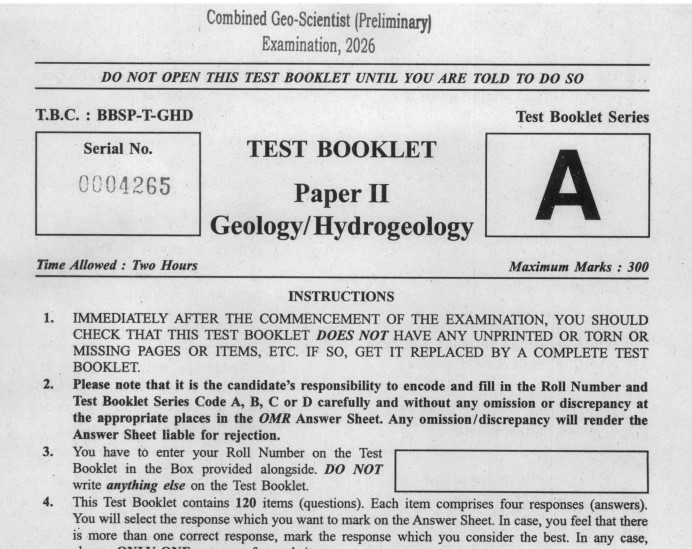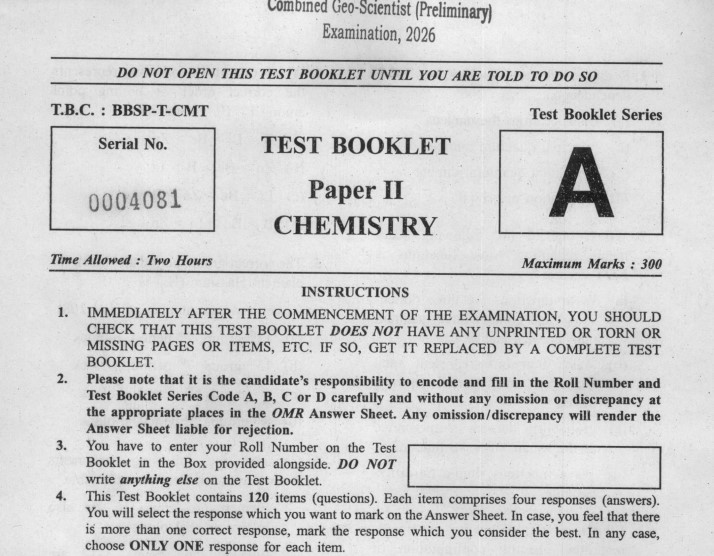
The Union Public Service Commission (UPSC) has officially released the Civil Services (Main) Examination 2025 Botany Paper II question paper, which is now available for all aspirants to download. Botany Paper II is one of the two optional subject papers for candidates who chose Botany as their optional in the Mains. The paper carries 250 marks and plays a key role in determining the overall merit of the candidate.
I am writing about this topic because every year, thousands of aspirants choose Botany as their optional subject, and having access to the actual question paper helps them plan better for future exams. By analysing the question pattern, candidates can understand the kind of analytical depth UPSC expects, the areas that get repeated, and how the weightage shifts between plant biotechnology, ecology, and applied botany. This makes it extremely valuable for those who are preparing for the next UPSC attempt or revising their preparation strategy. Having the question paper in hand gives clarity about how conceptual knowledge and scientific reasoning are tested in this subject.
About the Exam
The Civil Services (Main) Examination 2025 is the second stage of the UPSC recruitment process, following the Preliminary examination. It consists of nine descriptive papers, including two optional subject papers. For Botany, the syllabus is divided into Paper I (core concepts) and Paper II (applications and advanced topics). Paper II deals with topics such as plant breeding, genetics, ecology, biotechnology, and economic botany — making it one of the more applied sections of the subject.
Highlights of Botany Paper II 2025
Here’s a quick summary of the Botany Paper II conducted under UPSC Mains 2025:
- Exam Name: UPSC Civil Services (Main) Examination 2025
- Paper: Botany Paper II
- Type: Descriptive
- Maximum Marks: 250
- Duration: 3 hours
- Medium: English and Hindi
- Paper Format: Eight questions divided into two sections (A and B), of which five are to be attempted
Key Topics Covered in 2025 Paper
The 2025 Botany Paper II covered a balanced mix of traditional and applied topics. Some of the major areas were:
- Genetic Engineering and Plant Biotechnology: Questions on recombinant DNA technology, gene transfer methods, and applications in crop improvement.
- Plant Breeding and Tissue Culture: Emphasis on hybridisation techniques, somaclonal variations, and micropropagation.
- Plant Ecology and Environment: Ecosystem dynamics, biodiversity conservation, and global environmental changes.
- Economic and Ethnobotany: Questions related to medicinal and economically useful plants.
- Plant Pathology: Questions on host-pathogen interactions and disease control mechanisms.
This year’s paper was moderately difficult, with a few analytical questions that tested understanding rather than factual recall. Questions linking traditional botany with biotechnology trends made the paper more contemporary.
Importance of Downloading the Question Paper
For serious UPSC aspirants, downloading and going through the Botany Paper II 2025 is extremely beneficial. Here’s why:
- It helps understand how UPSC blends theoretical and applied concepts.
- Useful for identifying key topics that need deeper preparation.
- Gives insight into question phrasing and expected answer presentation.
- Assists in time management and understanding the paper’s overall flow.
Students preparing for the 2026 Civil Services Examination should use this paper as a reference model while practising descriptive answers.
How to Download Botany Paper II 2025 PDF
To download the official Botany Paper II 2025, follow these simple steps:
- Visit the official UPSC website – www.upsc.gov.in
- Go to the “Examinations” section.
- Click on “Previous Question Papers.”
- Select “Civil Services (Main) Examination 2025.”
- Find and click on “Botany Paper II” to download the PDF file.
N.B: If you want to download the question paper without any difficulty, you can easily download it by Click here.
The paper can also be accessed from authentic education portals that provide UPSC exam materials and archives.