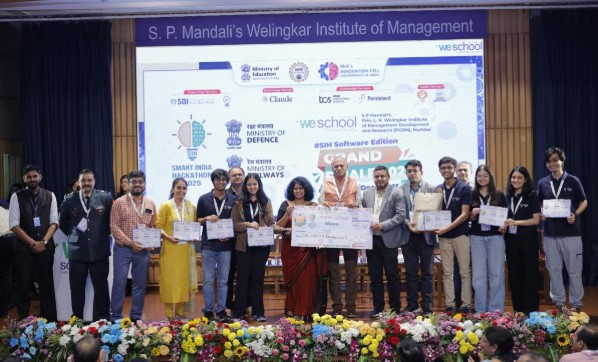
The Innovation Cell of the Ministry of Education, in collaboration with the All India Council for Technical Education (AICTE), honoured the top teams of the Smart India Hackathon (SIH) 2025 at the Prin. L. N. Welingkar Institute of Management Development & Research (WeSchool).
The event celebrated young innovators who created impactful, real-world solutions to pressing challenges, reflecting the strength of India’s expanding innovation landscape. The ceremony also highlighted the talent and creativity of the next generation of problem-solvers driving the country’s technological progress.
Every year, it pushes young minds to solve problems faced by ministries, industries and communities using creativity and technology. Celebrating the winners is not just about acknowledging individual achievements; it reflects India’s commitment to nurturing innovation at the grassroots level. At a time when technology is driving national development, recognising student innovators helps inspire thousands more to take up impactful projects. Sharing this story also brings attention to how India’s institutions are investing in innovation-driven education, encouraging students to move beyond textbooks and engage with real societal challenges.
About the Smart India Hackathon 2025
The Smart India Hackathon is an annual nationwide initiative that invites students to solve problem statements provided by various government departments, start-ups and industry partners. It includes:
- Software Edition for digital and AI-based solutions
- Hardware Edition for engineering and product design innovations
The 2025 edition saw participation from thousands of teams across the country, all competing to build functional and scalable solutions.
Highlights of the Celebration at WeSchool
The felicitation event at WeSchool showcased the energy, commitment and creativity of student innovators. Key highlights included:
Recognition of Winning Teams
Teams were honoured for developing impactful solutions in areas such as:
- Digital governance and public service delivery
- Health-tech and medical devices
- Environmental sustainability
- Agriculture and rural development
- Transport and safety systems
The solutions presented ranged from AI-based tools to low-cost hardware prototypes.
Leadership Addresses and Inspiration
Officials from MIC and AICTE spoke about the importance of building an innovation-driven culture in Indian campuses. Their messages highlighted:
- The value of experiential learning
- The need for industry-academia collaboration
- How initiatives like SIH prepare students for real-world challenges
WeSchool faculty and leadership also emphasised the importance of supporting young entrepreneurs.
Hands-on Demonstrations
Winning teams presented their prototypes and explained the journey from brainstorming to execution. These demonstrations allowed guests, mentors and industry partners to understand the thought process behind each solution.
Why SIH Matters for India’s Educational Landscape
The Smart India Hackathon plays a major role in reshaping technical education and encouraging innovation. Its impact includes:
- Bridging the gap between academic learning and field challenges
- Enabling students to work on high-impact, government-backed problems
- Fostering teamwork, leadership and analytical thinking
- Helping ministries receive workable solutions from young minds
- Encouraging future start-ups and patentable ideas
Many SIH winners have gone on to build start-ups, secure patents and collaborate with industry.
Role of WeSchool in Supporting Innovation
WeSchool, known for its focus on design thinking, leadership and multidisciplinary learning, played host to the celebration. The institute supports student innovators through:
- Innovation labs and incubation support
- Mentorship from faculty and industry experts
- Real-world case-based learning
- Partnerships that help students scale their ideas
The event strengthened the institute’s role as a hub for innovation-driven education.
Impact on Student Innovators
For the winners, this recognition is a major milestone. It provides:
- National visibility
- Mentorship opportunities
- Industry connections
- Encouragement to pursue entrepreneurial ventures
- Validation for their technical and creative skills
Events like this remind students that innovation is not restricted to advanced labs—ideas can grow anywhere with the right support.
Future Pathways for SIH Teams
Many teams from past SIH editions have continued their journey by:
- Launching start-ups
- Collaborating with ministries to refine their solutions
- Getting incubated at top innovation centres
- Winning global competitions
- Contributing to research and development
The 2025 winners are likely to follow similar paths with support from MIC, AICTE and institutional partners.