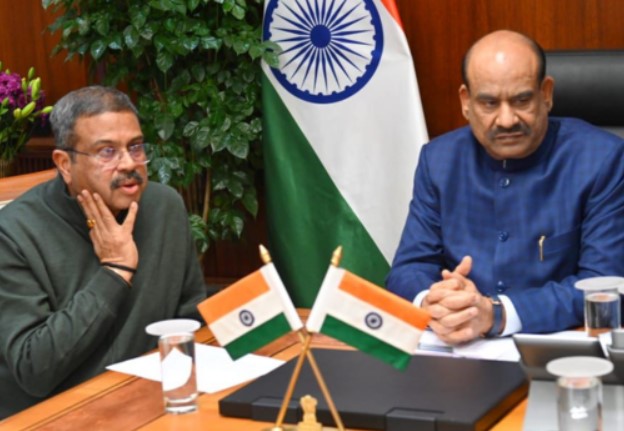
Lok Sabha Speaker Om Birla and Union Education Minister Dharmendra Pradhan on Monday jointly reviewed the progress of education-related initiatives in Rajasthan’s Kota–Bundi region. The high-level meeting focused on assessing infrastructure development, implementation of central education schemes, and ways to strengthen access to quality education across schools and higher education institutions in the area. Kota, already known nationally as a coaching hub, and Bundi, with its growing educational needs, were both discussed in detail during the review.
I am writing about this development because policy reviews like these directly influence how education reaches students on the ground. When senior leaders step in to take stock of regional education systems, it signals intent beyond paperwork. For parents, teachers, and students in the Kota–Bundi belt, such reviews matter as they often translate into better facilities, improved teacher support, and stronger alignment with national education goals. With Rajasthan playing a key role in India’s education landscape, understanding what was discussed and why it matters helps readers see how policy decisions connect to everyday learning outcomes.
Focus areas discussed during the review
During the review, both leaders examined how centrally sponsored schemes are being implemented across the region. Emphasis was laid on strengthening school education while also improving the quality of higher education institutions.
Key focus areas included
- Infrastructure development in schools and colleges
- Availability and training of teachers
- Use of digital tools and smart classrooms
- Progress under the National Education Policy 2020
Special attention was given to ensuring that rural and semi-urban areas in Bundi receive the same level of academic support as larger cities.
Kota’s role as an education hub
Kota’s reputation as a national coaching centre was also discussed, especially in the context of student well-being and balanced academic growth. The leaders underlined the need to combine academic excellence with mental health support and value-based learning.
There was also discussion on strengthening government institutions so that quality education is not limited only to private coaching ecosystems.
Centre–state coordination in education
The review highlighted the importance of coordination between the central government, state authorities, and local administration. Effective implementation depends not just on funding but on timely execution and monitoring at every level.
Both leaders stressed
- Faster project approvals
- Regular monitoring of education schemes
- Accountability at institutional levels
This approach aims to ensure that policy benefits reach students without delay.