JOIN WHATSAPP
STORIES

National Mathematics Day Celebrated at Samanvay Library with Prof. Nandita Narain’s Inspiring Talk

National Mathematics Day Celebrated at Samanvay Library with Prof. Nandita Narain’s Inspiring Talk

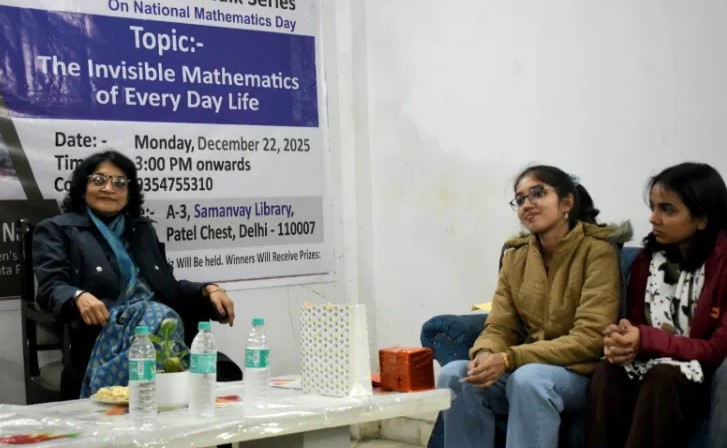
Samanvay Library recently marked National Mathematics Day with a special and engaging talk that brought together students, teachers, and curious learners under one roof. The event focused on making mathematics relatable and meaningful, moving beyond textbooks and exams. The highlight of the programme was an interactive session led by Nandita Narain, who spoke about how mathematical thinking quietly shapes everyday decisions, from budgeting at home to understanding social data and public policy.

I am writing about this event because such initiatives show how community spaces like libraries can play a powerful role in education outside classrooms. At a time when many students see mathematics as difficult or intimidating, conversations like these help break that fear. Celebrating National Mathematics Day through dialogue and real-life examples makes the subject more accessible and reminds us why logical thinking and numerical understanding are essential life skills, not just academic requirements.

About the National Mathematics Day Event

The talk was organised by Samanvay Library as part of its ongoing effort to promote learning through discussions and public lectures. National Mathematics Day, observed every year to honour Srinivasa Ramanujan’s birth anniversary, provided the perfect occasion to host a session that connected mathematics with daily life experiences.

Students from different age groups, educators, and local residents attended the event, turning it into a lively exchange of ideas rather than a one-way lecture.

Key Themes from Prof. Nandita Narain’s Talk

During her address, Prof. Narain highlighted how mathematics is often misunderstood as a subject limited to classrooms and examinations. She explained that mathematical reasoning plays a role in many aspects of society and personal life.

Some of the key points discussed included:

  • How basic mathematical thinking helps in making informed everyday decisions
  • The role of mathematics in social sciences, economics, and public policy
  • Why understanding numbers is crucial in an age driven by data and information
  • The need to remove fear and anxiety associated with learning mathematics

Her simple language and real-world examples made complex ideas easy to grasp, especially for young students.

Why Such Talks Matter for Students and Educators

Events like this help students see mathematics as a useful and living subject rather than a burden. For educators, it offers new ways to present concepts beyond traditional teaching methods.

The interaction also encouraged students to ask questions freely, creating a comfortable space for curiosity and discussion. This kind of exposure can inspire learners to explore mathematics further, whether as a subject of study or as a practical tool in everyday life.


Leave a Comment

End of Article

Maharashtra Faces Alarming Child Malnutrition Crisis, High Court Seeks Answers

Maharashtra Faces Alarming Child Malnutrition Crisis, High Court Seeks Answers

More than 1.37 lakh children in Maharashtra are still suffering from malnutrition, a matter that has now drawn serious attention from the judiciary. The issue came before the Bombay High Court after a newspaper report highlighted shocking figures related to child and maternal deaths in the state. According to the data placed before the court, 32,226 children below the age of five and 2,861 mothers have died in Maharashtra over the last two-and-a-half years, with malnutrition cited as a major contributing factor.

I am writing about this issue because these numbers are not just statistics, they reflect a deep and continuing public health crisis. Despite multiple welfare schemes and nutrition programmes, thousands of families are still struggling to provide basic nourishment to children and mothers. When such data reaches the High Court, it becomes clear that this is not a routine administrative lapse but a systemic problem that needs urgent attention from policymakers and authorities.

What the Bombay High Court Was Told

The matter came up before the Bombay High Court after taking suo motu cognisance of a media report on malnutrition-related deaths. The court was informed that a significant number of children identified as severely or moderately malnourished are still awaiting effective intervention.

The figures presented shocked the court, especially considering that Maharashtra is one of the country’s economically stronger states with extensive public health infrastructure.

Scale of Child and Maternal Deaths

As per the information highlighted:

  • 32,226 children under five years of age died in the last two-and-a-half years
  • 2,861 maternal deaths were recorded during the same period
  • Malnutrition was cited as a major contributing factor in many cases
  • Over 1.37 lakh children are currently identified as malnourished

These numbers point towards gaps in early detection, follow-up treatment, and nutrition delivery systems.

Why Malnutrition Remains a Persistent Problem

Health experts say malnutrition is not caused by lack of food alone. It is often linked to:

  • Poverty and food insecurity
  • Poor maternal health and anaemia
  • Inadequate access to healthcare facilities
  • Lack of awareness about nutrition
  • Irregular monitoring at the grassroots level

In tribal and rural areas, these problems are even more severe due to connectivity and staffing issues.

Government Schemes and Ground Reality

Maharashtra runs several nutrition and health schemes through anganwadis and public health centres. However, the court was told that implementation remains uneven. In many cases, children identified as malnourished are not followed up properly, and referral systems do not function as intended.

The court has sought explanations from the state authorities on what corrective measures are being taken and how existing programmes are being monitored.

Why This Issue Matters to Everyone

Child malnutrition has long-term consequences that go beyond immediate health risks. It affects physical growth, brain development, learning ability, and future productivity. Maternal malnutrition, on the other hand, increases risks during childbirth and directly impacts newborn health.

When such a large number of deaths are linked to nutrition gaps, it raises serious questions about accountability and policy execution.

What the High Court Expects Next

The High Court has indicated that it will closely monitor the state’s response and action plan. Authorities may be asked to submit detailed reports on:

  • Identification and treatment of malnourished children
  • Availability of nutrition supplements
  • Staffing and monitoring at anganwadi centres
  • Steps taken to prevent further deaths

The court’s involvement is expected to push for stricter oversight and faster corrective action.

Leave a Comment

End of Article

Loading more posts...