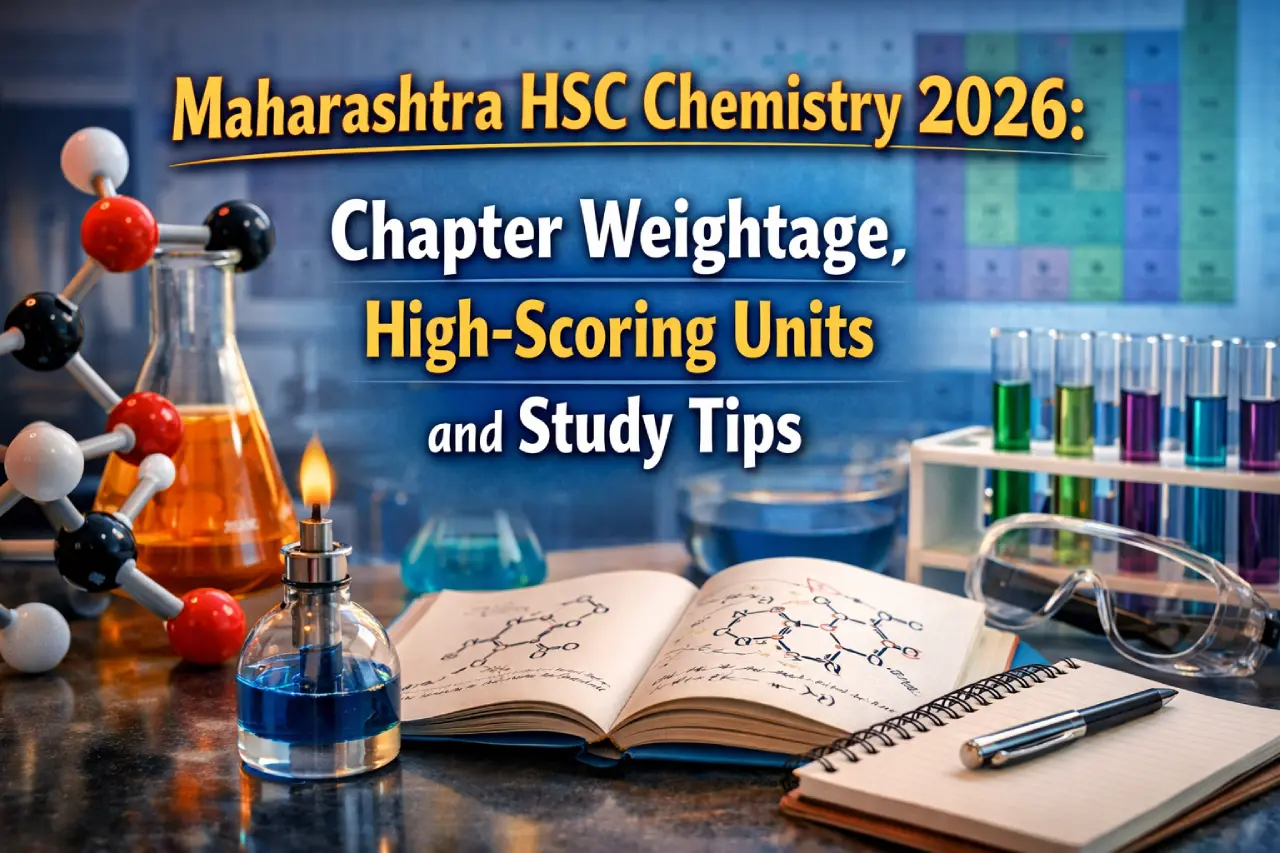
As Maharashtra HSC students begin serious preparation for the 2026 board exams, Chemistry remains one of the most important and scoring subjects in the Science stream. Understanding the chapter-wise weightage for Chemistry can help students plan their study time more effectively and avoid unnecessary stress before exams. While the exact question paper can vary, past trends give a clear idea of which chapters usually carry more marks.
I am writing about Maharashtra HSC 2026 Chemistry chapter-wise weightage because many students study all chapters with equal intensity, which is not always practical. Knowing which units are more important helps students focus on high-weightage chapters first, revise smartly, and improve overall performance. This approach is especially useful during the last few months of preparation when time is limited.
Maharashtra HSC Chemistry Exam Pattern 2026
The HSC Chemistry exam is conducted by the Maharashtra State Board of Secondary and Higher Secondary Education. The paper generally includes theory questions, numericals, short answers, and application-based problems.
The syllabus is divided into Physical, Organic, and Inorganic Chemistry, with questions asked from all three sections. Practical-based questions are also included in the theory paper.
Maharashtra HSC 2026 Chemistry Chapter Wise Weightage (Expected)
Based on previous years’ trends, the expected chapter-wise weightage for Chemistry is outlined below. This is indicative and meant for guidance only.
| Unit / Chapter | Expected Weightage |
|---|---|
| Solid State | Low to Moderate |
| Solutions | Moderate |
| Ionic Equilibria | High |
| Chemical Thermodynamics | Moderate |
| Electrochemistry | High |
| Chemical Kinetics | Moderate |
| Elements of Groups 16, 17, 18 | Low to Moderate |
| Transition and Inner Transition Elements | Moderate |
| Coordination Compounds | High |
| Halogen Derivatives | Moderate |
| Alcohols, Phenols and Ethers | Moderate |
| Aldehydes, Ketones and Carboxylic Acids | High |
| Amines | Moderate |
| Biomolecules | Low to Moderate |
| Polymers | Low |
| Green Chemistry | Low |
Chapters with numericals and reaction mechanisms usually carry higher weightage.
High-Scoring Chapters Students Should Not Miss
Some chapters are known to be scoring if prepared properly:
- Ionic Equilibria
- Electrochemistry
- Coordination Compounds
- Aldehydes, Ketones and Carboxylic Acids
These chapters often include structured questions and numericals, making them easier to score with practice.
How to Use Chapter Wise Weightage for Smart Preparation
Instead of reading chapters randomly, students should:
- Start with high-weightage chapters
- Practise numericals and reaction-based questions daily
- Revise diagrams, formulas, and definitions regularly
- Allocate time weekly for low-weightage but easy chapters
I personally feel that once high-weightage chapters are strong, confidence automatically improves before exams.
Importance of Practicals and Textbook Questions
Many theory questions are directly or indirectly based on textbook examples and practical experiments. Students should not ignore:
- In-text questions
- Exercise numericals
- Practical chemistry concepts used in theory
Solving previous years’ question papers alongside chapter-wise preparation gives a clear idea of question patterns.