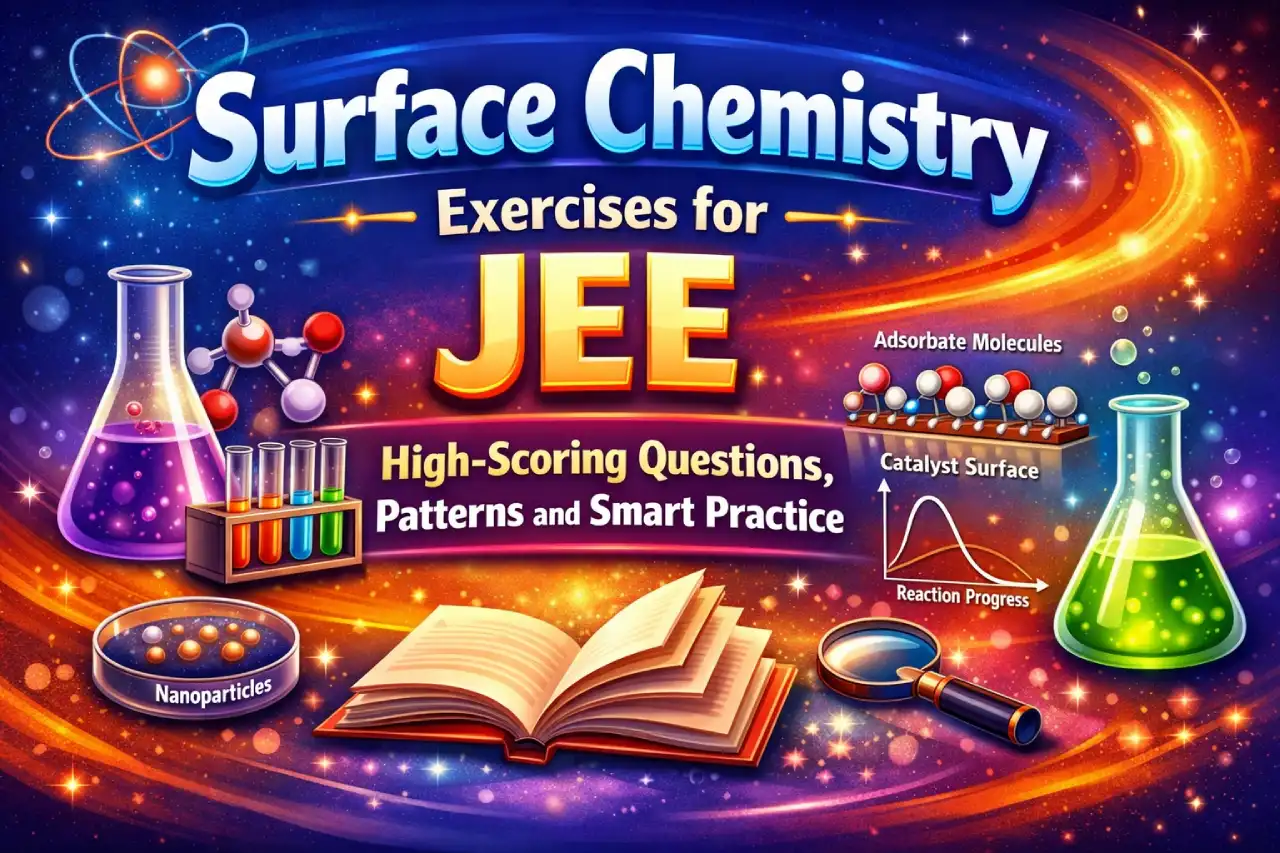
Surface Chemistry is one chapter where regular practice matters more than just reading theory. The exercise PDF shared here is designed exactly for that purpose. It brings together solved examples, single-correct and multiple-correct MCQs, assertion–reason questions, matrix match sets, comprehension passages, and previous year JEE questions, all focused on how surface chemistry is actually tested in competitive exams.
I am writing about this topic because many students feel confident after studying theory but lose marks when similar ideas are twisted into numerical or logic-based questions. This exercise module helps bridge that gap. It trains students to recognise patterns, apply laws correctly, and avoid common traps that appear repeatedly in JEE Main and Advanced papers.
What Makes This Surface Chemistry Exercise PDF Important
This PDF is not a random question bank. It follows a clear progression from basic concept-checking questions to advanced, application-based problems. Each section is structured to test understanding of adsorption, colloids, emulsions, catalysis, and micelles in multiple ways.
The exercises focus on:
- Physical vs chemical adsorption
- Colloidal charge, stability, and coagulation
- Gold number and protective colloids
- Emulsions, gels, and micelles
- Freundlich adsorption isotherm
- Real-life and industrial applications
Solved Examples That Build Conceptual Clarity
The opening solved examples explain why certain answers are correct instead of just stating them. For instance, questions on minimum gold number clearly show why gelatin has higher protective power, while adsorption examples explain the role of temperature, pressure, and surface area step by step.
These solved problems act as a warm-up and help students understand how to approach longer exercise sections confidently.
MCQs That Reflect Real JEE Thinking
The single-correct MCQs are carefully framed to test precision. Many options look similar, but only one fits the concept fully. Questions on chemisorption, physisorption, coagulation value, and catalytic action repeatedly test whether the student understands definitions along with conditions.
Multiple-correct questions take this further by checking depth of knowledge. For example, questions on colloidal charge, Tyndall effect, and Brownian motion often require eliminating incorrect statements rather than selecting obvious ones.
Strong Focus on Colloids and Coagulation
A large portion of the exercise PDF revolves around colloidal chemistry. Students are repeatedly tested on:
- Lyophilic vs lyophobic sols
- Origin of charge on colloidal particles
- Role of electrolytes in coagulation
- Hardy–Schulze rule
- Flocculation value and coagulating power
Real-life examples like purification of water using alum, curdling of milk, formation of deltas, and blood coagulation help connect theory with application.
Download this Surface Chemistry (Exercise) PDF: Click Here
Assertion–Reason and Matrix Match Sections
The assertion–reason questions are especially useful for understanding cause-effect relationships. They force students to check not just whether statements are true, but whether the logic linking them is valid.
Matrix match questions help students connect terms like:
- Peptisation and sol formation
- Dialysis and purification
- Tyndall effect and light scattering
- Electrophoresis and electric field
These questions improve analytical thinking, which is essential for JEE Advanced.
Comprehension and Passage-Based Questions
The comprehension sections simulate real JEE passages. Topics like artificial rain, smoke screens, gels, micelles, and colloidal charge behaviour are explained in paragraph form, followed by logic-based questions.
These passages test reading ability, concept application, and interpretation skills, not just memory.
Subjective and Previous Year Questions
The subjective section is useful for students preparing descriptive answers or oral tests. Questions like cleansing action of soap, activation of adsorbents, and difference between homogeneous and heterogeneous catalysis are explained using core principles.
The inclusion of previous year JEE questions makes this PDF even more valuable. It shows how frequently certain ideas repeat and which topics deserve extra attention.
How I Recommend Using This Exercise PDF
From my experience, this exercise set works best when used in stages:
- First, attempt questions without looking at answers
- Identify patterns in mistakes
- Revise the related concept
- Reattempt similar problems
This approach turns practice into real improvement instead of random question solving.