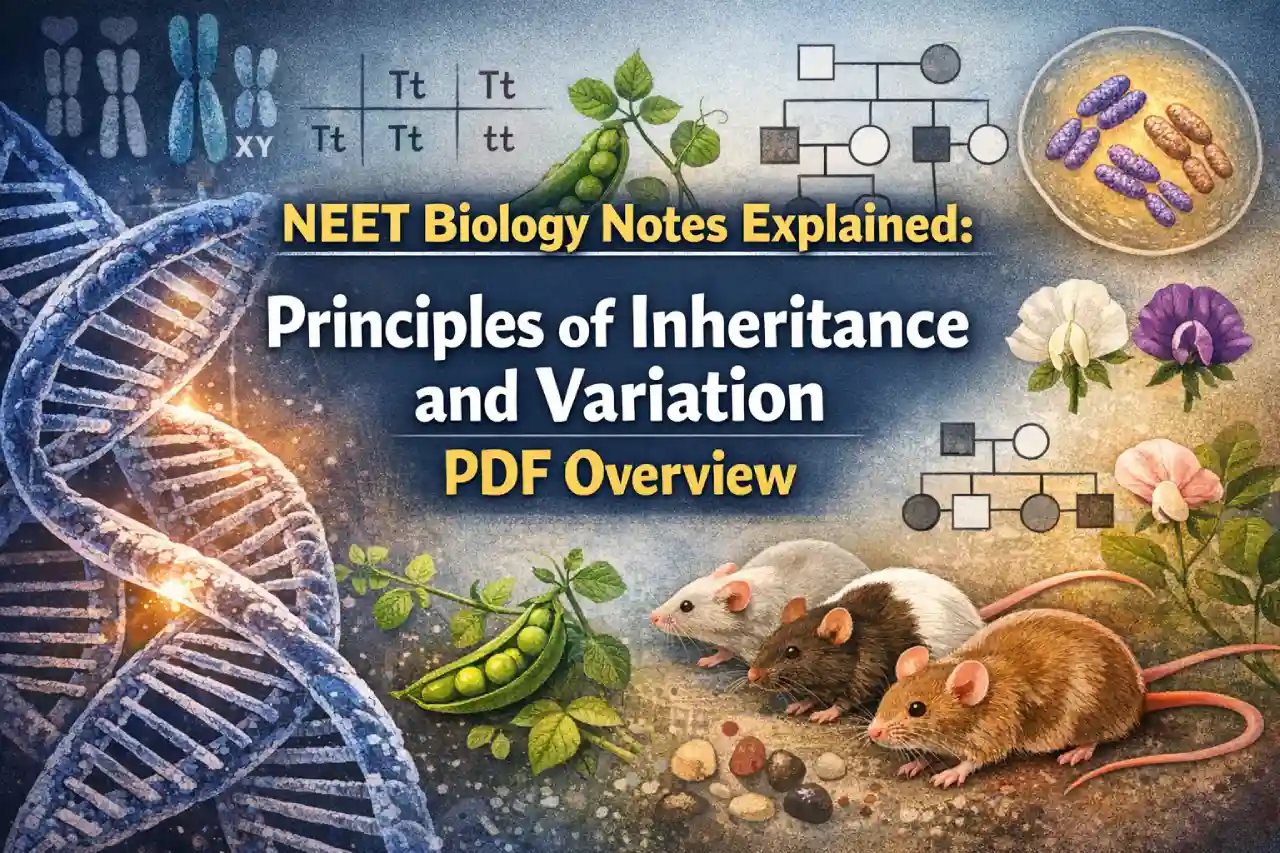
The uploaded PDF is a NEET Biology preparation document focused completely on the chapter Principles of Inheritance and Variation. It is structured as a question-based study resource and follows the NCERT syllabus closely. The content is meant for revision and exam practice rather than detailed theory reading.
This explanation is written to clearly describe what is included in the PDF and how the content is organised. Many students use such PDFs for practice but are unsure about the exact topics covered. This article explains only the material that appears in the PDF, without adding any outside concepts.
Overall Structure of the PDF
The PDF is divided into three major sections. All sections are MCQ-based and focus on conceptual clarity, numerical accuracy, and previous-year exam patterns. There are no long descriptive explanations, only objective questions meant for competitive exams like NEET, AIPMT, and KVPY.
Section A: Mendelism and Basic Inheritance
This section focuses on classical genetics based on Mendel’s work. The questions in this part cover Mendel’s experiments on pea plants, dominant and recessive traits, genes and alleles, and inheritance of single and two traits.
Topics tested include monohybrid crosses, dihybrid crosses, test crosses, and back crosses. The PDF includes questions on phenotypic and genotypic ratios such as 3:1, 1:1, and 9:3:3:1. Mendel’s laws of dominance, segregation, and independent assortment are tested through application-based questions.
Non-Mendelian Inheritance in Section A
Within the same section, the PDF also includes questions on inheritance patterns that do not follow simple dominance. These include incomplete dominance, codominance, multiple alleles, pleiotropy, and heterosis.
Human blood group inheritance and flower colour inheritance are used as question contexts. The focus remains on identifying ratios, allele combinations, and correct inheritance patterns.
Section B: Gene Interaction and Chromosomal Behaviour
Section B moves beyond simple inheritance and focuses on how genes behave together. The PDF includes MCQs on polygenic inheritance, continuous variation, lethal genes, and different types of gene interaction such as complementary genes, supplementary genes, duplicate genes, and epistasis.
This section also covers chromosomal theory concepts. Questions test knowledge of linkage, crossing over, recombination frequency, gene mapping, and linkage groups. Several problems involve calculating distances between genes using recombination percentages.
Download this PDF: Click Here
Sex Determination and Sex-Linked Inheritance
A significant portion of Section B is dedicated to sex determination mechanisms. The PDF includes questions on XX–XY system in humans, XO system in grasshopper, and ZW system in birds.
Sex-linked inheritance is tested through questions on colour blindness, haemophilia, holandric inheritance, sex-influenced traits, and pedigree-based analysis. These questions focus on identifying inheritance patterns and predicting affected offspring.
Section C: Mutation and Genetic Disorders
Section C deals with mutations and human genetic disorders. The PDF includes questions on gene mutation, chromosomal mutation, non-disjunction, aneuploidy, polyploidy, Barr body, and Lyon’s hypothesis.
Genetic disorders covered in the questions include Down’s syndrome, Turner’s syndrome, Klinefelter’s syndrome, Patau’s syndrome, Edward’s syndrome, sickle cell anaemia, phenylketonuria, albinism, and colour blindness. The questions test causes, chromosomal numbers, inheritance type, and enzyme deficiencies.
Previous-Year Exam Questions
The PDF contains a large number of previous-year questions from NEET, AIPMT, and KVPY. These questions are mixed throughout the document and are clearly meant for exam-oriented practice rather than concept explanation.
Nature and Purpose of the PDF
Based on its content, this PDF is a revision and practice resource. It is fully MCQ-based and designed to test understanding, speed, and accuracy. It does not include solved answers, detailed theory, or diagrams. The document is most useful after completing NCERT reading.