
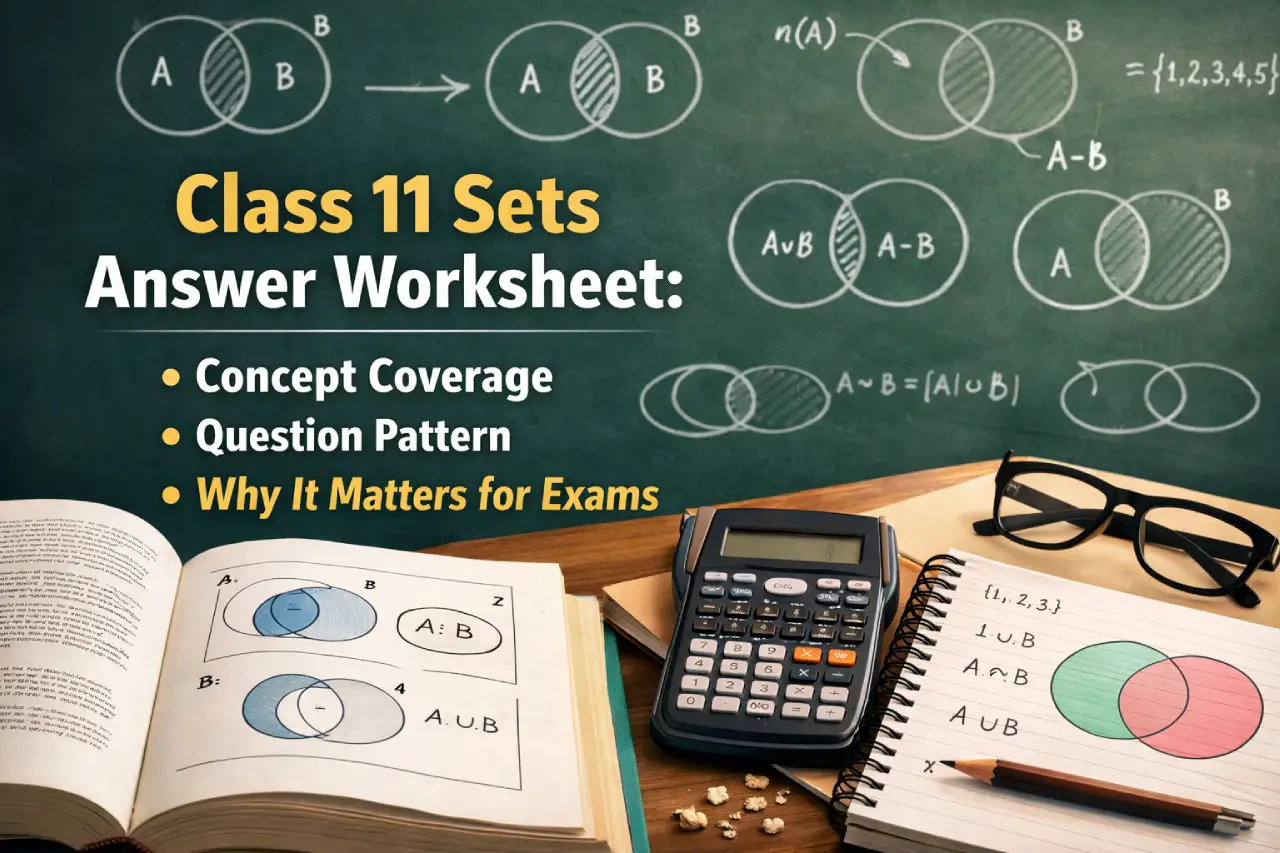
This mathematics worksheet on Sets, prepared for Class 11 CBSE students, is designed mainly for board exam preparation and to build a strong conceptual base for later chapters. It contains 50 multiple-choice questions, all strictly aligned with NCERT theory. The worksheet covers fundamental ideas such as definition of sets, representation methods, subsets, power sets, operations on sets, complements, and logical identities. Overall, it reflects the type of direct yet concept-based MCQs that students regularly encounter in school-level examinations Sets WS.
I am writing about this worksheet because the chapter on Sets often looks easy but turns out to be a silent scoring trap. Many students lose marks due to confusion between subset conditions, complements, or basic set identities. A worksheet like this helps convert textbook theory into exam-ready understanding. By analysing the questions carefully, students can clearly see which formulas, identities, and logical ideas are tested again and again, helping them avoid common mistakes in exams.
Structure of the Sets Worksheet
The worksheet consists of 50 MCQs, with each question carrying one mark. The questions move from basic definitions to application-based problems involving logic and counting. While most questions are direct, the options are closely framed, which tests conceptual clarity and careful reading rather than guesswork.
The overall difficulty level ranges from easy to moderate, making it suitable for revision, self-assessment, and last-minute practice before exams.
Basics of Sets and Their Representation
Several questions focus on the foundational idea of what qualifies as a set. Students are tested on:
- Well-defined and ill-defined collections
- Roster form and set-builder form
- Null set and singleton set
- Identifying valid sets from given descriptions
These questions ensure that students clearly understand the definition of a set, which is the backbone of the entire chapter Sets WS.
Subsets, Proper Subsets and Power Sets
A large portion of the worksheet tests understanding of subsets and power sets. Questions include:
- Finding the number of subsets of a given set
- Identifying proper and improper subsets
- Comparing subsets of two different sets
- Applying formulas like 2ⁿ and 2ⁿ − 1
These are high-scoring questions but require accuracy in applying formulas correctly.
Download this Sets Answer PDF File: Click Here
Operations on Sets
The worksheet gives strong emphasis to operations on sets, such as:
- Union of sets
- Intersection of sets
- Difference of sets
- Complement of a set
Many questions are based on standard identities like
A ∩ (A ∪ B) = A
and conditions such as A ∪ B = A or A ∩ B = B. These problems test logical understanding rather than memorisation.
Complement and Universal Set Concepts
Several MCQs involve complements of sets with respect to a universal set. Students are asked to evaluate expressions involving A′, (A′)′, and combinations of union and intersection with complements.
These questions are important because small logical slips in complement-based problems often lead to incorrect answers in exams.
Set-Builder and Interval-Based Questions
The worksheet includes questions written in set-builder notation and interval form, especially involving real numbers. These questions test the ability to convert mathematical conditions into correct set notation and interpret inequalities correctly.
Such problems help students prepare for later chapters like relations, functions, and coordinate geometry.
Counting and Application-Based Problems
Some questions go beyond basic definitions and involve logical counting, such as:
- Comparing number of subsets of different sets
- Finding values of variables using subset conditions
- Problems involving distribution of elements across multiple sets
These questions improve reasoning ability and test deeper conceptual understanding.
What Students Can Learn from This Worksheet
From analysing this worksheet, a few key points become clear:
- NCERT definitions are the base of almost all questions
- Set identities must be understood logically
- Subset and power set formulas need careful handling
- Complement-based questions demand attention to detail
- Regular practice reduces mistakes in scoring chapters
Overall, this Class 11 Sets worksheet is a reliable practice resource that helps students secure marks from a fundamental chapter. It strengthens clarity, confidence, and accuracy, which are essential for performing well in board examinations and higher-level mathematics.

















