JOIN WHATSAPP
STORIES

MP Board Exam 2026 Schedule Updated: New Dates for Class 10 and 12 Papers Announced

MP Board Exam 2026 Schedule Updated: New Dates for Class 10 and 12 Papers Announced

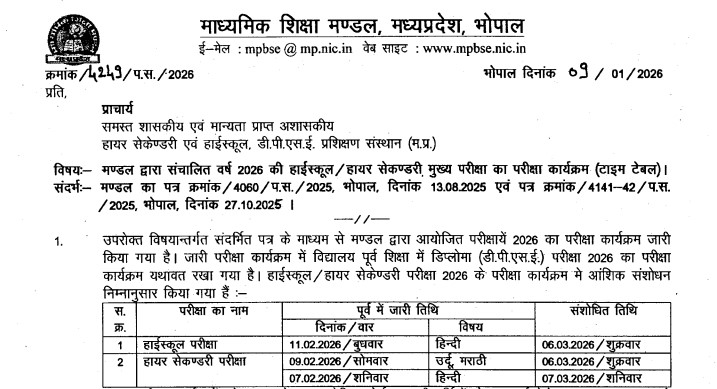
The Madhya Pradesh Board of Secondary Education has officially revised the exam dates for a few Class 10 and Class 12 board papers scheduled in 2026. The updated timetable affects selected language papers for both High School and Higher Secondary examinations. Students who were preparing as per the earlier dates should now take note of the revised schedule and adjust their revision plans accordingly. The changes have been made public through an official notification to avoid confusion and ensure smooth conduct of examinations.

I am writing about this update because even small changes in board exam dates can cause unnecessary stress if students and parents are not informed in time. Board exams are already a high-pressure phase, and clarity on dates plays a big role in planning revision and mental preparation. This article clearly explains what has changed, which exams are affected, and what students should do next so that no one is caught off guard.

MP Board Exam Date Revision: What Changed

The exam date revision has been announced by the Madhya Pradesh Board of Secondary Education. According to the revised schedule, some language papers for Class 10 and Class 12, which were earlier planned in February, have now been shifted to early March 2026.

The board has advised students to follow only the revised dates and not rely on the older timetable.

Revised MP Board Class 10 and 12 Exam Dates 2026

Below is a clear comparison of the previously scheduled dates and the revised dates announced by MPBSE.

S. No.Name of ExaminationSubjectPreviously Scheduled DateRevised Date
1High School Examination (Class 10)Hindi11.02.2026 (Wednesday)06.03.2026 (Friday)
2Higher Secondary Examination (Class 12)Urdu / Marathi09.02.2026 (Monday)06.03.2026 (Friday)
3Higher Secondary Examination (Class 12)Hindi07.02.2026 (Saturday)07.03.2026 (Saturday)

Students should note that only these specific papers have been rescheduled. Other exam dates remain unchanged unless notified separately.

Why the MP Board Revised the Exam Dates

While the board has not gone into detailed reasons, such changes are usually made to manage logistics, avoid clashes, or ensure fair conduct of examinations. From experience, boards often revise dates to accommodate administrative or academic requirements that come up after the initial timetable is released.

The important thing for students is that the board has announced the changes well in advance.

What Students Should Do Now

Students appearing for MP Board exams in 2026 should take these steps:

  • Update their personal exam timetable with the revised dates
  • Inform parents and teachers about the changes
  • Adjust revision plans for Hindi, Urdu, or Marathi papers
  • Keep checking the official MPBSE website for further updates

There is no need to panic, as the revised dates actually give students more preparation time.

Advice for Class 10 and 12 Students

From my point of view, date changes can be used positively if handled calmly. The extra gap before exams can help students strengthen weak areas, revise writing practice, and improve time management. Instead of rushing, students should use this time wisely and stick to a structured study plan.

Where to Check Official Updates

Students are advised to rely only on official notices released by MPBSE and information shared by their schools. Avoid rumours or unofficial social media posts that may cause confusion.

Check this Official Notification: Click Here

Leave a Comment

End of Article

Maharashtra Launches Genome Sequencing Drive to Tackle Drug-Resistant Infections

Maharashtra Launches Genome Sequencing Drive to Tackle Drug-Resistant Infections

Maharashtra has taken a major step in the fight against antimicrobial resistance with the start of genome sequencing of drug-resistant bacteria across key hospitals in the state. The initiative focuses on carbapenem-resistant bacteria, among the most dangerous pathogens due to their limited treatment options. The project is part of a larger international study and is being rolled out at select medical institutions in Pune and Mumbai, marking a significant advancement in India’s public health research efforts.

I am writing about this development because antimicrobial resistance is a silent but growing threat that affects everyday healthcare, from routine surgeries to critical care. Many people hear the term but do not fully understand how serious the problem is. Genome sequencing of resistant bacteria can help doctors, researchers, and policymakers stay ahead of evolving infections and make better decisions to protect patients in the long run.

What the Genome Sequencing Project Is About

The study involves whole-genome sequencing of carbapenem-resistant bacteria to understand how these organisms evolve, spread, and resist existing antibiotics. This advanced technique allows scientists to map the complete genetic structure of bacteria and identify mutations responsible for resistance.

The project is being led by Johns Hopkins University under its Global Action in Healthcare Network–Antimicrobial Resistance in India initiative, commonly referred to as GAIHN-AMR.

International Collaboration and Funding

This is a multi-country research project funded by the Centers for Disease Control and Prevention, USA. India is among seven countries participating in the study, highlighting the global scale of the antimicrobial resistance problem.

By sharing data across countries, researchers aim to identify global patterns, compare resistance trends, and develop coordinated strategies to combat the spread of superbugs.

Hospitals Involved in Maharashtra

In India, the project is being implemented at three major hospitals in Maharashtra:

  • BJ Medical College and Sassoon General Hospital, Pune
  • Dr DY Patil Medical College Hospital and Research Centre, Pune
  • P D Hinduja Hospital and Medical Research Centre, Mumbai

These hospitals handle large patient volumes, making them ideal centres for studying resistant infections in real-world clinical settings.

Why Carbapenem-Resistant Bacteria Are a Big Concern

Carbapenems are considered last-resort antibiotics. When bacteria become resistant to them, treatment options become extremely limited. Infections caused by such bacteria often lead to longer hospital stays, higher medical costs, and increased risk of death.

Understanding the genetic makeup of these bacteria helps researchers trace infection sources and design more targeted treatment and prevention strategies.

How This Will Help India’s Healthcare System

Genome sequencing data can support hospitals and health authorities in multiple ways:

  • Early detection of emerging resistant strains
  • Better infection control practices in hospitals
  • Improved antibiotic usage policies
  • Evidence-based public health interventions

From my point of view, this shift towards data-driven healthcare is essential if India wants to stay prepared for future health challenges.

A Step Towards Smarter Antibiotic Use

One of the long-term goals of the project is to promote responsible antibiotic use. By clearly identifying resistance patterns, doctors can avoid unnecessary or ineffective antibiotics and choose treatments that are more likely to work.

This approach also supports national and global efforts to slow down the spread of antimicrobial resistance.

Leave a Comment

End of Article

Loading more posts...