JOIN WHATSAPP
STORIES

Maharashtra HSC Exam 2026 Update: Class 12 Hall Tickets Released, What Students Should Know

Maharashtra HSC Exam 2026 Update: Class 12 Hall Tickets Released, What Students Should Know

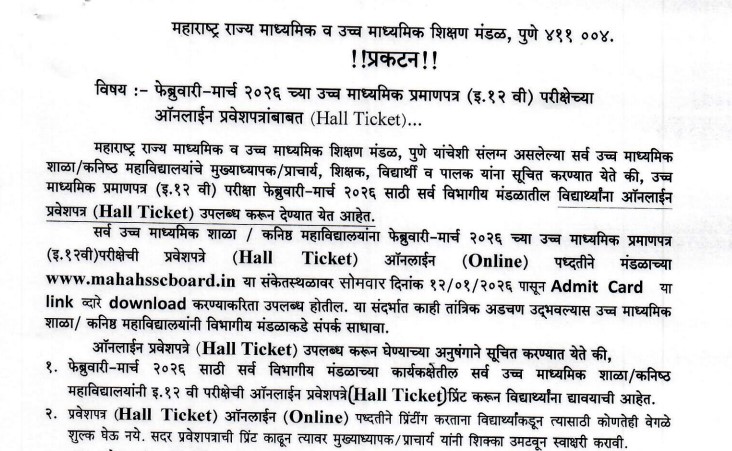
The Maharashtra State Board has officially released the admit cards for the HSC Class 12 board examinations 2026. The hall tickets are now available for download through the official website, and the process began on Monday, January 12, 2026. The Class 12 examinations are scheduled to be held during February and March 2026. As per the standard procedure, school principals are responsible for downloading the admit cards and distributing them to students after due verification.

I am writing about this update because the release of the HSC admit card is a crucial moment for lakhs of students across Maharashtra. Many students and parents are often unsure about how and when the hall tickets will be issued, especially since students cannot download them directly. This article clearly explains the process, what details students should check, and what to do if there is any error, so that students can focus on exam preparation without unnecessary stress.

About the Maharashtra HSC Board Examination

The Higher Secondary Certificate examination is conducted every year by the Maharashtra State Board of Secondary and Higher Secondary Education, Pune. The HSC exam is an important academic milestone for students, as Class 12 results play a key role in college admissions, entrance exams, and career planning.

Maharashtra HSC Class 12 Admit Card 2026 Release Details

According to the official notification, the HSC Class 12 hall tickets have been released for all streams, including Science, Arts, and Commerce.

Key highlights include:

  • Exam Name: Maharashtra Board HSC (Class 12) Examination 2026
  • Exam Period: February–March 2026
  • Admit Card Release Date: January 12, 2026
  • Mode of Download: Through school login only
  • Official Website: mahahsscboard.in

Check Official Notification: Click Here

Students must collect their hall tickets from their respective schools.

How to Download Maharashtra HSC Hall Ticket 2026

The admit cards can only be downloaded by school authorities. The process is as follows:

  • School principals log in to the official MSBSHSE portal
  • Download Class 12 hall tickets for enrolled students
  • Verify student details carefully
  • Stamp and sign the admit cards
  • Distribute hall tickets to students

Students are advised to contact their school administration if they have not received their admit card.

Details to Check on the Hall Ticket

Once students receive their hall ticket, they should immediately check the following details:

  • Student’s name and photograph
  • Roll number and seat number
  • Subject-wise exam dates
  • Examination centre name and address
  • Important exam-day instructions

Any discrepancy should be reported to the school without delay.

Important Instructions for Students

Students appearing for the HSC exam 2026 should keep these points in mind:

  • Carry the original hall ticket to the exam centre every day
  • Reach the exam centre well before reporting time
  • Follow all instructions printed on the admit card
  • Do not write or damage the hall ticket in any way

Without a valid admit card, entry into the examination hall will not be permitted.

Leave a Comment

End of Article

Maharashtra Launches Genome Sequencing Drive to Tackle Drug-Resistant Infections

Maharashtra Launches Genome Sequencing Drive to Tackle Drug-Resistant Infections

Maharashtra has taken a major step in the fight against antimicrobial resistance with the start of genome sequencing of drug-resistant bacteria across key hospitals in the state. The initiative focuses on carbapenem-resistant bacteria, among the most dangerous pathogens due to their limited treatment options. The project is part of a larger international study and is being rolled out at select medical institutions in Pune and Mumbai, marking a significant advancement in India’s public health research efforts.

I am writing about this development because antimicrobial resistance is a silent but growing threat that affects everyday healthcare, from routine surgeries to critical care. Many people hear the term but do not fully understand how serious the problem is. Genome sequencing of resistant bacteria can help doctors, researchers, and policymakers stay ahead of evolving infections and make better decisions to protect patients in the long run.

What the Genome Sequencing Project Is About

The study involves whole-genome sequencing of carbapenem-resistant bacteria to understand how these organisms evolve, spread, and resist existing antibiotics. This advanced technique allows scientists to map the complete genetic structure of bacteria and identify mutations responsible for resistance.

The project is being led by Johns Hopkins University under its Global Action in Healthcare Network–Antimicrobial Resistance in India initiative, commonly referred to as GAIHN-AMR.

International Collaboration and Funding

This is a multi-country research project funded by the Centers for Disease Control and Prevention, USA. India is among seven countries participating in the study, highlighting the global scale of the antimicrobial resistance problem.

By sharing data across countries, researchers aim to identify global patterns, compare resistance trends, and develop coordinated strategies to combat the spread of superbugs.

Hospitals Involved in Maharashtra

In India, the project is being implemented at three major hospitals in Maharashtra:

  • BJ Medical College and Sassoon General Hospital, Pune
  • Dr DY Patil Medical College Hospital and Research Centre, Pune
  • P D Hinduja Hospital and Medical Research Centre, Mumbai

These hospitals handle large patient volumes, making them ideal centres for studying resistant infections in real-world clinical settings.

Why Carbapenem-Resistant Bacteria Are a Big Concern

Carbapenems are considered last-resort antibiotics. When bacteria become resistant to them, treatment options become extremely limited. Infections caused by such bacteria often lead to longer hospital stays, higher medical costs, and increased risk of death.

Understanding the genetic makeup of these bacteria helps researchers trace infection sources and design more targeted treatment and prevention strategies.

How This Will Help India’s Healthcare System

Genome sequencing data can support hospitals and health authorities in multiple ways:

  • Early detection of emerging resistant strains
  • Better infection control practices in hospitals
  • Improved antibiotic usage policies
  • Evidence-based public health interventions

From my point of view, this shift towards data-driven healthcare is essential if India wants to stay prepared for future health challenges.

A Step Towards Smarter Antibiotic Use

One of the long-term goals of the project is to promote responsible antibiotic use. By clearly identifying resistance patterns, doctors can avoid unnecessary or ineffective antibiotics and choose treatments that are more likely to work.

This approach also supports national and global efforts to slow down the spread of antimicrobial resistance.

Leave a Comment

End of Article

Loading more posts...