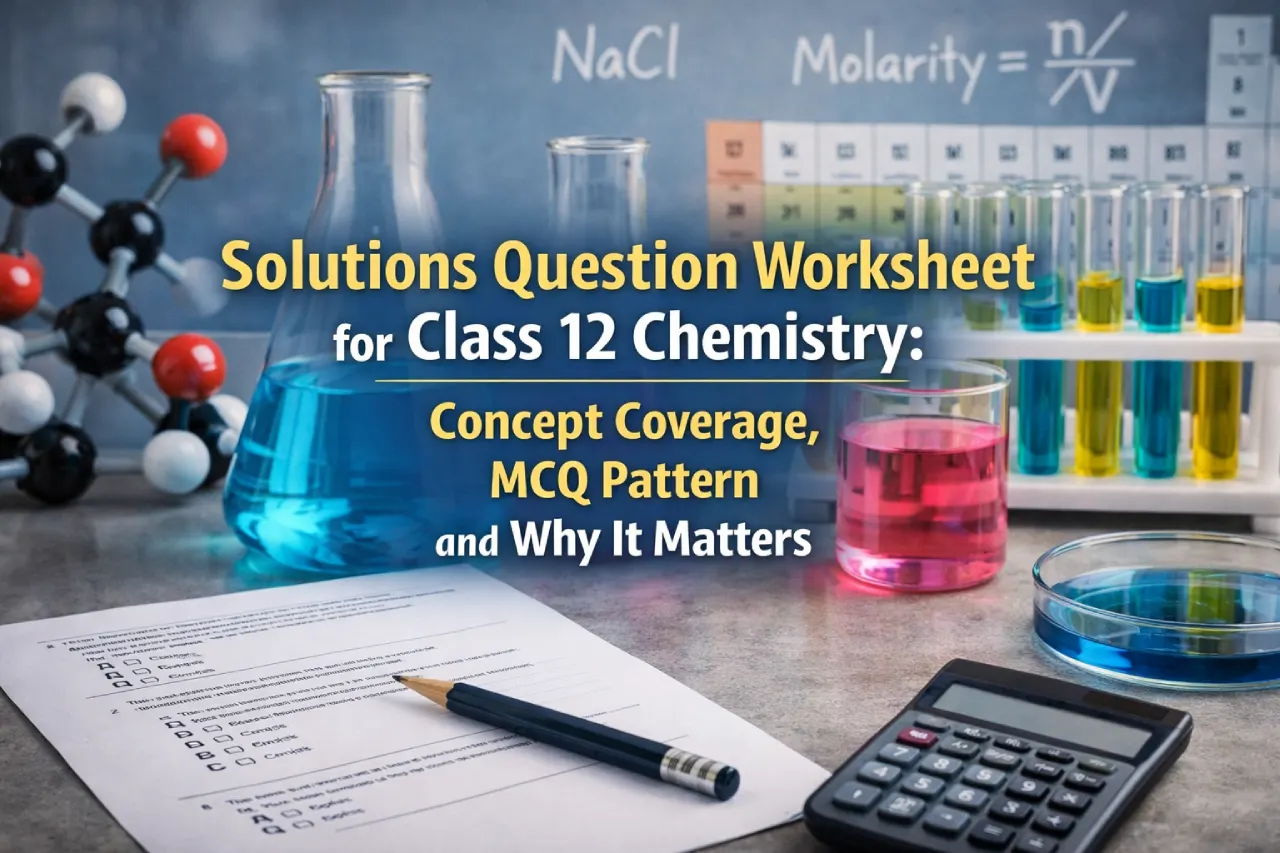
This Class 12 Chemistry worksheet on Solutions is designed mainly for CBSE board exam preparation and concept-based revision. The worksheet contains a large set of 75 multiple-choice questions, all strictly aligned with NCERT. It covers concentration terms, types of solutions, vapour pressure, Raoult’s law, Henry’s law, ideal and non-ideal solutions, colligative properties, osmotic pressure, Van’t Hoff factor, azeotropes, and real-life applications like pressure cookers, antifreeze, and osmosis. Overall, the worksheet reflects the exact mix of numerical, conceptual, and reasoning-based MCQs students face in Class 12 exams Solutions WS 1.
I am writing about this worksheet because the chapter on Solutions is often considered formula-heavy, but students still lose marks due to conceptual confusion. Errors usually happen while choosing the correct concentration unit, interpreting colligative properties, or applying Raoult’s and Henry’s laws in MCQs. A structured worksheet like this helps convert NCERT theory into exam-ready understanding. By carefully analysing these questions, students can clearly see which areas are repeatedly tested and how one-mark questions are framed from standard textbook lines.
Structure of the Solutions Worksheet
The worksheet consists of 75 MCQs, each carrying one mark. The questions range from direct definition-based items to numerical problems and application-based situations. Many questions appear simple but are designed to test clarity of concepts rather than lengthy calculations.
The overall difficulty level ranges from easy to moderate, making the worksheet suitable for both revision and self-assessment before exams.
Concentration Terms and Units
A significant number of questions focus on different ways of expressing concentration, such as:
- Molarity, molality, normality, mole fraction
- Units independent of temperature
- Relationship between molarity and molality
- Numerical problems based on dilution and titration
These questions test whether students can correctly select and apply the appropriate concentration term in different situations Solutions WS 1.
Types of Solutions and Solubility
The worksheet includes MCQs on different types of solutions, including:
- Gas in gas, gas in liquid, liquid in solid, and solid in solid
- Examples like hydrogen in palladium and alloys
- Factors affecting solubility of gases in liquids
- Effect of pressure and temperature on gas solubility
Such questions are frequently asked as direct one-mark MCQs.
Vapour Pressure and Raoult’s Law
Several questions are based on vapour pressure concepts, including:
- Relative lowering of vapour pressure
- Raoult’s law for non-volatile solutes
- Ideal and non-ideal solutions
- Positive and negative deviation from Raoult’s law
- Azeotropes and their boiling behaviour
These questions require conceptual clarity rather than memorisation.
Download this Solutions PDF File: Click Here
Henry’s Law and Gas Solubility
Henry’s law is another important area covered in the worksheet. Questions test understanding of:
- Henry’s law constant and its significance
- Relationship between solubility and pressure
- Gases with higher and lower solubility
- Practical applications such as scuba diving and high-altitude sickness
This section links chemistry concepts with real-life examples.
Colligative Properties
A major portion of the worksheet focuses on colligative properties. Students are tested on:
- Lowering of vapour pressure
- Elevation of boiling point
- Depression of freezing point
- Osmotic pressure
Questions also compare solutions based on number of solute particles and degree of dissociation.
Van’t Hoff Factor and Abnormal Molar Mass
Several MCQs involve the Van’t Hoff factor, including:
- Dissociation of electrolytes like NaCl and BaCl₂
- Association of molecules such as dimerisation and tetramerisation
- Effect of Van’t Hoff factor on colligative properties
These questions are common in exams and require careful logical reasoning.
Osmosis and Isotonic Solutions
The worksheet includes multiple questions on osmosis and osmotic pressure, such as:
- Behaviour of plant and animal cells in hypotonic and hypertonic solutions
- Isotonic solutions and their properties
- Practical examples like blood cells, saline solutions, and dialysis
These questions test application of concepts in biological and real-life contexts.
Real-Life Applications and Conceptual Questions
Many MCQs connect theory with daily-life observations, including:
- Use of pressure cookers
- Antifreeze action of ethylene glycol
- Why soda bottles fizz when opened
- Why raw mango shrinks in salt solution
Such questions make the chapter more relatable and scoring.
What Students Can Learn from This Worksheet
From analysing this worksheet, a few clear points emerge:
- Correct choice of concentration unit is crucial
- Colligative properties depend only on number of particles
- Van’t Hoff factor must be handled carefully
- Raoult’s law deviations are high-weight topics
- Real-life examples are frequently used in MCQs
Overall, this Class 12 Solutions worksheet is a strong practice resource for board exams. It helps students revise formulas, strengthen concepts, and improve confidence in handling MCQs from this foundational physical chemistry chapter.