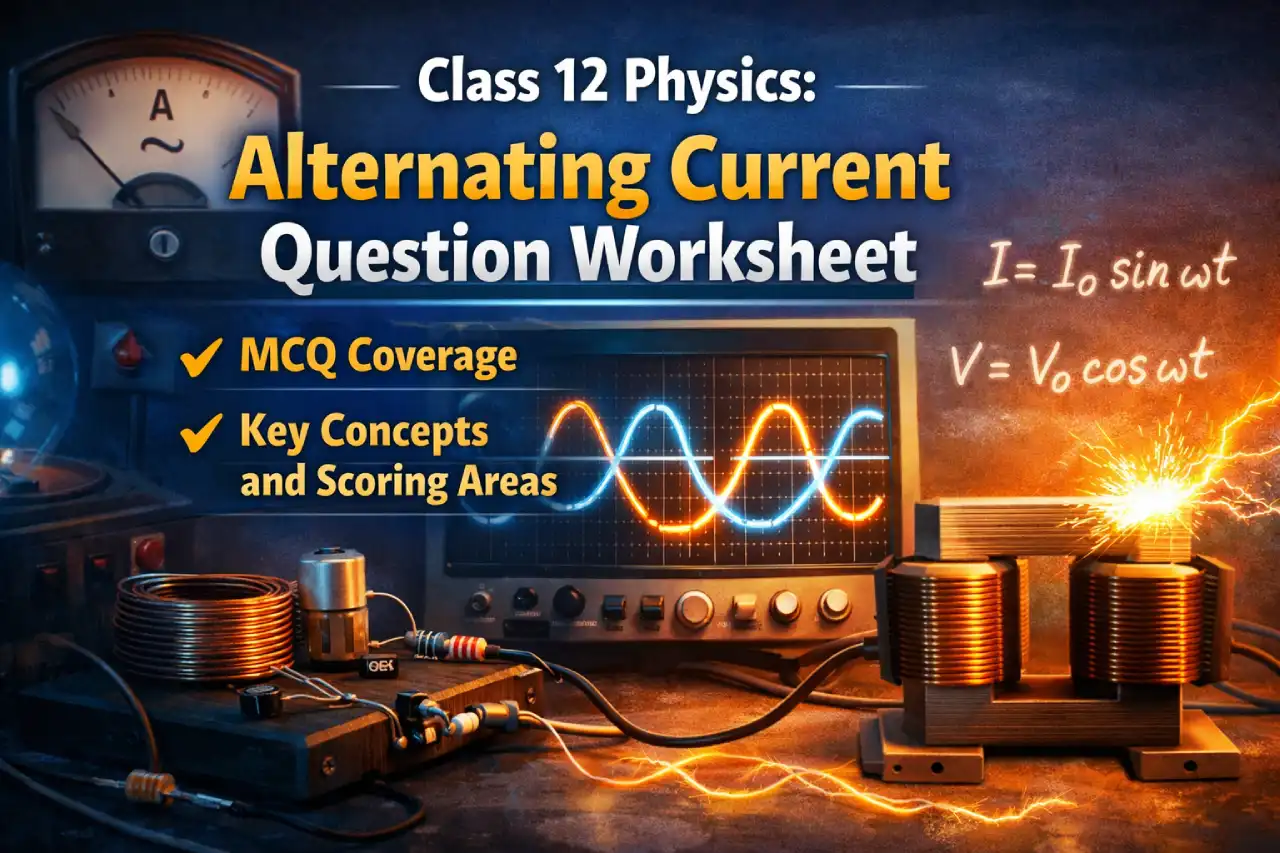
This Class 12 Physics worksheet on Alternating Current is designed mainly for CBSE board exam preparation and objective-based revision. The worksheet contains 75 multiple-choice questions, all framed strictly from NCERT concepts. It covers AC basics, instantaneous and rms values, reactance and impedance, LCR series circuits, resonance, power and power factor, transformers, choke coils, energy in inductors, and practical applications like domestic supply and power transmission. Overall, the worksheet reflects the exact type of numerical, conceptual, and reasoning-based MCQs students face in Class 12 board exams Alternating Current.
I am writing about this worksheet because Alternating Current is one chapter where students often know formulas but struggle with interpretation. Confusion between peak and rms values, phase difference, resonance conditions, and transformer relations leads to unnecessary mistakes. A well-structured worksheet like this helps convert textbook theory into exam-ready understanding. By analysing these questions carefully, students can clearly see how NCERT lines are turned into one-mark MCQs and where common traps are set in exams.
Structure of the Alternating Current Worksheet
The worksheet consists of 75 MCQs, each carrying one mark. The questions range from direct concept checks to numerical problems and application-based reasoning. Many questions are short but test clarity of fundamentals rather than lengthy calculations.
The overall difficulty level ranges from moderate to high, making this worksheet suitable for revision after completing the chapter.
AC Basics and RMS Values
Several questions focus on the fundamentals of alternating current, including:
- Instantaneous value of current and voltage
- Peak value and rms value relations
- Average value of AC over a complete cycle
- Interpretation of AC waveforms
These questions ensure students clearly understand what AC quantities actually represent.
Reactance, Impedance and Phase Difference
A major portion of the worksheet tests understanding of reactance and impedance. Topics include:
- Inductive and capacitive reactance
- Dependence of reactance on frequency
- Impedance in LCR series circuits
- Phase relation between current and voltage
Such MCQs are frequently asked and require conceptual clarity more than memorisation.
LCR Circuits and Resonance
The worksheet strongly emphasises LCR series circuits. Students are tested on:
- Resonant frequency conditions
- Behaviour of circuit at resonance
- Voltage across L, C and R at resonance
- Effect of changing L or C on resonance
These questions are important both for board exams and competitive exams.
Download this Alternating Current PDF File: Click Here
Power, Power Factor and Energy Concepts
Several MCQs deal with power in AC circuits, including:
- Average power in AC circuits
- Power factor and its significance
- Conditions for maximum power transfer
- Energy stored in inductors
These questions help students understand why power behaves differently in AC compared to DC.
Transformers and Practical Applications
A large section of the worksheet focuses on transformers. Questions cover:
- Step-up and step-down transformers
- Turns ratio and voltage ratio
- Current relation in primary and secondary
- Efficiency of transformers
- Core material and losses
These are high-scoring areas if NCERT theory is revised properly.
Choke Coils and AC Circuit Applications
The worksheet includes questions on choke coils and real-life applications, such as:
- Why choke is preferred over resistance
- Limiting current without power loss
- Domestic AC supply values
- Use of AC in power transmission
These MCQs connect theory with real-world electrical systems.
Frequency Dependence and Circuit Behaviour
Several questions test how AC circuits respond to change in frequency, including:
- Variation of reactance with frequency
- Behaviour of LC and LCR circuits
- Selectivity and sharpness of resonance
Such questions require logical reasoning based on formulas.
What Students Can Learn from This Worksheet
From analysing this worksheet, a few important points clearly emerge:
- RMS values are more important than peak values in exams
- Phase difference determines power consumption
- Resonance is a high-weight scoring topic
- Transformer relations must be handled carefully
- Regular MCQ practice reduces calculation and concept errors
Overall, this Class 12 Alternating Current worksheet is a strong revision resource. It helps students strengthen fundamentals, improve numerical accuracy, and gain confidence in handling one-mark MCQs from one of the most important chapters in Class 12 Physics.