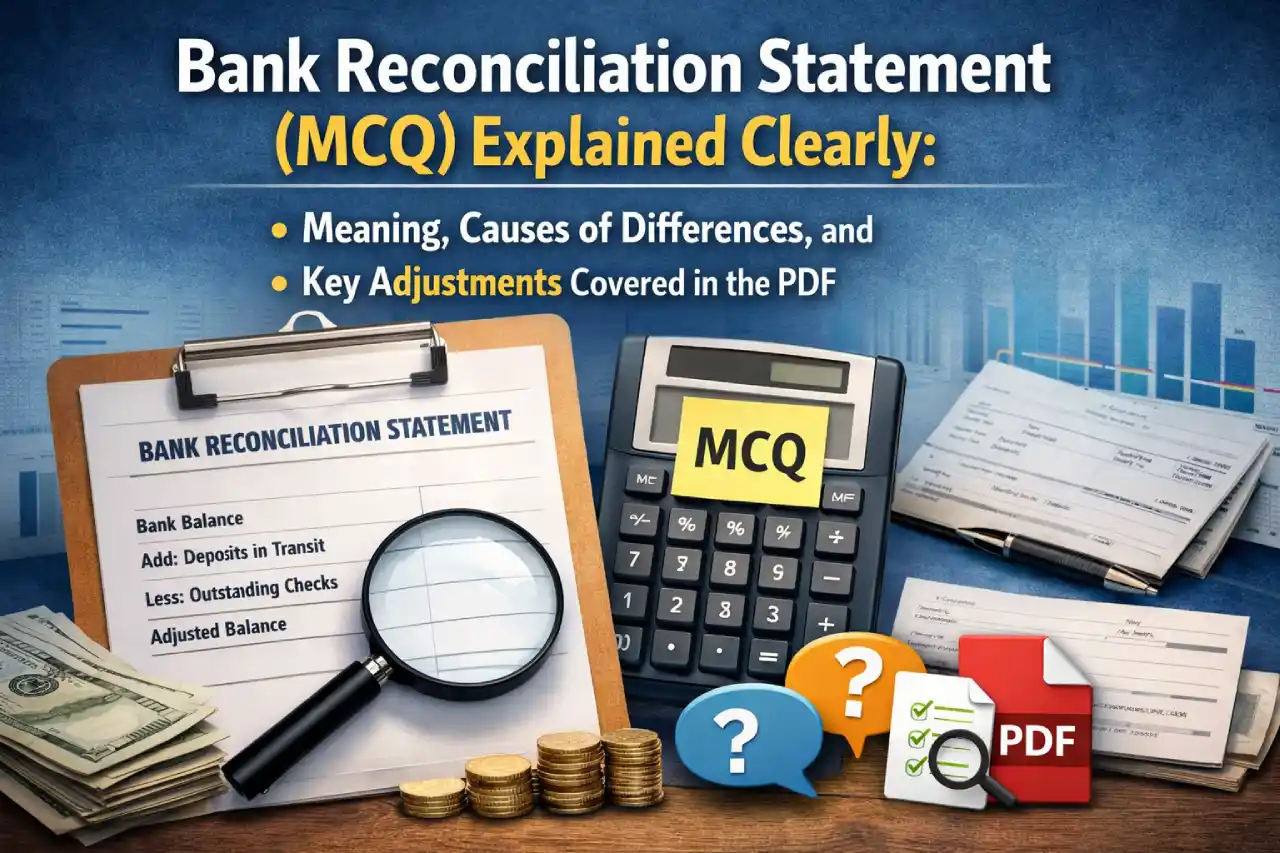
This PDF is a detailed question-based study document on Bank Reconciliation Statement (BRS) from Accountancy. It contains a large set of objective questions covering the meaning, purpose, preparation, causes of differences between Cash Book and Pass Book, treatment of specific items, favourable and unfavourable balances, overdraft situations, and common errors. The entire PDF is exam-oriented and focuses on testing conceptual clarity and practical adjustment logic rather than descriptive theory. Bank Reconciliation Statement Q…
I am writing about this PDF because Bank Reconciliation Statement is one of those topics where students often get confused, not due to theory, but because of adjustments and signs. This PDF clearly highlights what is actually asked in exams by repeatedly testing the same concepts in different situations. Understanding exactly what this PDF covers helps students prepare smartly, avoid confusion, and gain confidence in solving practical problems related to bank reconciliation.
Meaning of Bank Reconciliation Statement as Covered in the PDF
According to the PDF, a Bank Reconciliation Statement is a statement prepared on a particular date to reconcile the balance of bank as shown by the Cash Book with the balance shown by the Pass Book. It is a separate statement and not part of the double entry system.
The PDF repeatedly clarifies that BRS is prepared by the account holder or business firm, not by the bank.
Purpose of Preparing a Bank Reconciliation Statement
The PDF highlights that the main purpose of preparing a BRS is:
- To ascertain the causes of difference between Cash Book and Pass Book balances
- To find out the actual bank balance
- To ensure correctness of accounting records
- To detect errors and delays in recording transactions
It also notes that non-reconciliation may result in non-reflection of the true cash position.
Cash Book and Pass Book Relationship
The PDF clearly explains that:
- Cash Book is maintained by the business
- Pass Book is a copy of the customer’s account maintained in the bank’s books
A debit balance in the Cash Book generally corresponds to a credit balance in the Pass Book, while an overdraft appears differently in both.
Causes of Difference Between Cash Book and Pass Book
A major portion of the PDF focuses on causes of difference, which include:
Timing Differences
- Cheques issued but not presented for payment
- Cheques deposited but not yet credited
- Deposits in transit
- Outstanding cheques
These are the most common reasons and are repeatedly tested.
Entries Recorded Only by the Bank
- Bank charges
- Interest charged or allowed by bank
- Direct deposits by customers
- Direct payments made by bank under standing instructions
- Collection of bills or dividends
These items require adjustment in the Cash Book.
Errors and Omissions
- Wrong posting in Cash Book or Pass Book
- Casting errors in bank column of Cash Book
- Entries recorded with wrong amounts
- Entries omitted in one of the books
The PDF clearly distinguishes timing differences from errors.
Download this Bank Reconciliation Statement PDF File: Click Here
Favourable and Unfavourable Balances
The PDF includes many questions clarifying these concepts:
- Favourable balance as per Cash Book means debit balance
- Credit balance in Pass Book represents bank balance
- Unfavourable balance generally refers to bank overdraft
Understanding these terms is essential before making adjustments.
Starting Point for Bank Reconciliation Statement
The PDF repeatedly states that a BRS can be prepared by taking:
- Balance as per Cash Book, or
- Balance as per Pass Book
Adjustments depend entirely on which balance is taken as the starting point. The same item may be added in one case and deducted in another.
Treatment of Common Items in BRS
The PDF extensively tests the treatment of items such as:
- Cheques issued but not presented
- Cheques deposited but not cleared
- Bank charges not recorded
- Interest charged or allowed by bank
- Direct deposits by customers
- Dishonour of cheques or bills
- Errors like double debit or credit
It clearly shows that timing differences do not require Cash Book adjustment, while errors and bank entries do.
Overdraft Situations
Several questions in the PDF deal specifically with overdraft cases. It explains how adjustments change when the balance is overdrawn and how additions and deductions must be carefully handled to avoid sign mistakes.
Nature of Bank Reconciliation Statement
The PDF clearly states that:
- BRS is a memorandum statement
- It is not part of ledger or journal
- It does not form part of final accounts
- It is prepared whenever bank statements are received
Its role is verification, not record-keeping.
Importance of Bank Reconciliation Statement
According to the PDF, BRS:
- Highlights reasons for difference in balances
- Helps detect fraud and errors
- Shows actual bank position
- Improves internal control over cash and bank transactions
These points are tested repeatedly as significance-based questions.