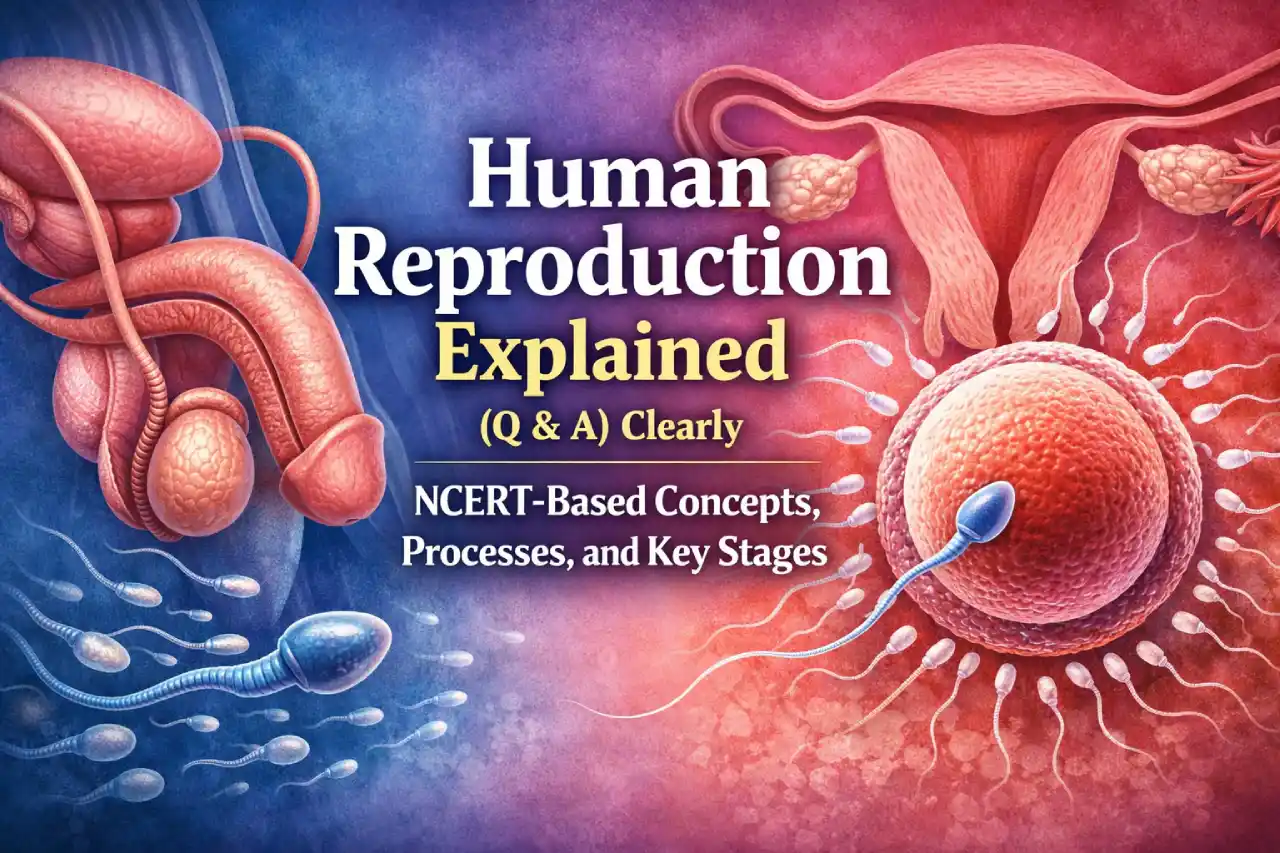
Human reproduction is a well-organised biological process that ensures continuity of life through the formation of male and female gametes, fertilisation, and development of a new individual. The uploaded PDF explains this topic in a structured NCERT-based manner, covering male and female reproductive systems, gamete formation, menstrual cycle, fertilisation, pregnancy, and childbirth. Each section builds logically on the previous one, helping students understand how different organs and hormones work together.
I am writing about this topic because human reproduction is one of the most important chapters for students preparing for board exams and competitive tests. Many learners struggle because the topic is vast and process-driven. This article presents the same information in a simpler, readable format without changing facts, making it easier to revise, recall, and understand the biological sequence described in the PDF.
Male Reproductive System
The male reproductive system consists of testes, accessory ducts, glands, and external genitalia. Testes are the primary sex organs responsible for sperm production and secretion of male hormones called androgens. They are located in the scrotum, which maintains a temperature lower than body temperature to support sperm formation.
Inside the testes, seminiferous tubules are the sites of spermatogenesis. Sertoli cells provide nutrition to developing germ cells, while Leydig cells produce testosterone. Sperms move through rete testis, vasa efferentia, epididymis, vas deferens, ejaculatory duct, and finally exit through the urethra.
Accessory glands such as seminal vesicles, prostate gland, and bulbourethral glands contribute fluids that form seminal plasma. This fluid provides nourishment, enzymes, and an alkaline medium to support sperm motility.
Female Reproductive System
The female reproductive system includes ovaries, oviducts, uterus, cervix, vagina, and external genitalia. Ovaries are the primary sex organs that produce ova and female hormones like estrogen and progesterone.
Each ovary contains follicles at different stages of development. The oviduct, also called the fallopian tube, has regions like infundibulum, fimbriae, ampulla, and isthmus. Fertilisation normally takes place in the ampullary-isthmic junction.
The uterus has three layers:
- Perimetrium (outer layer)
- Myometrium (muscular middle layer)
- Endometrium (inner lining)
The endometrium plays a crucial role in implantation and pregnancy.
Download this HUMAN REPRODUCTION PDF File: Click Here
Gametogenesis: Spermatogenesis and Oogenesis
Gametogenesis is the process of formation of male and female gametes. In males, spermatogenesis begins at puberty and occurs continuously. Spermatogonia undergo mitosis and meiosis to form haploid sperms.
Oogenesis begins during embryonic development in females. Primary oocytes remain arrested in prophase I until puberty. Each menstrual cycle leads to the maturation of one follicle, releasing a secondary oocyte during ovulation.
Unlike spermatogenesis, oogenesis produces one functional ovum and polar bodies.
Menstrual Cycle
The menstrual cycle is a monthly sequence of changes in the ovaries and uterus, usually lasting about 28 days. It has four phases:
- Menstrual phase
- Follicular (proliferative) phase
- Ovulatory phase
- Luteal (secretory) phase
Hormones like FSH, LH, estrogen, and progesterone regulate the cycle. A sudden decline in progesterone leads to menstruation if fertilisation does not occur. Menarche marks the beginning of menstruation, while menopause signals its permanent end.
Fertilisation and Implantation
Fertilisation occurs when a sperm fuses with the ovum in the ampullary-isthmic junction. The acrosome of the sperm releases enzymes that help penetrate the ovum. Fusion of haploid nuclei forms a diploid zygote.
The zygote undergoes cleavage to form blastomeres, then morula, and later a blastocyst. Implantation happens when the blastocyst embeds itself into the endometrium of the uterus.
Pregnancy and Embryonic Development
Pregnancy involves the development of the embryo into a foetus. The placenta forms to provide oxygen, nutrients, and hormonal support. It also removes waste materials from the foetus.
Major organ systems develop during the first trimester. By the end of eight weeks, most organs are formed. Hormones like hCG, estrogen, progesterone, and relaxin help maintain pregnancy.
Parturition and Lactation
Parturition, or childbirth, is initiated by a neuroendocrine mechanism involving oxytocin. Strong uterine contractions lead to the expulsion of the foetus.
Lactation follows childbirth. Colostrum, the first milk produced, is rich in antibodies and provides immunity to the newborn. Hormones like prolactin and oxytocin regulate milk production and release.