
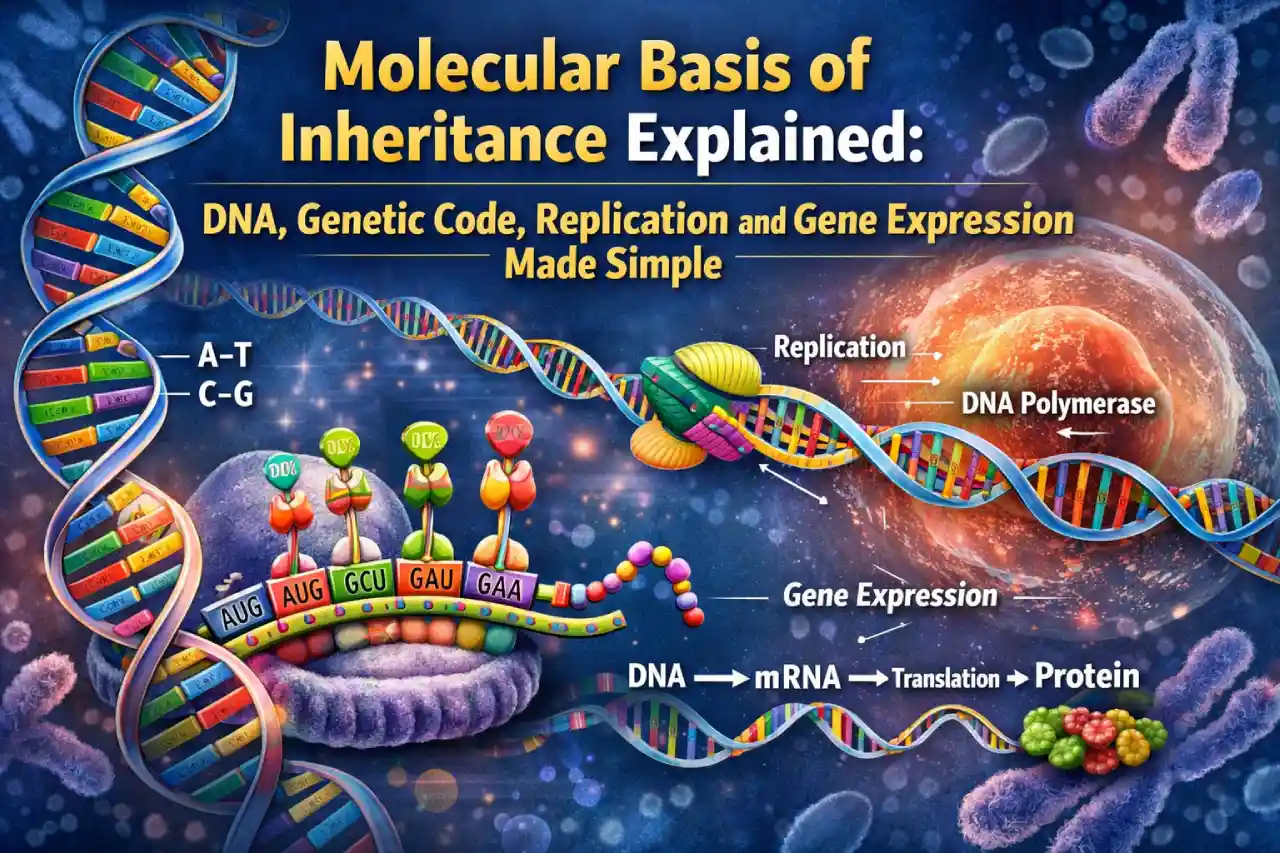
The PDF you shared focuses on the Molecular Basis of Inheritance, a core biology chapter that explains how genetic information is stored, copied, and expressed in living organisms. It starts from the basic structure of DNA and RNA and gradually builds up to complex ideas like replication, transcription, translation, gene regulation, and modern concepts such as DNA fingerprinting and the Human Genome Project. The chapter is clearly aligned with senior secondary and competitive exam requirements, especially NEET.
I am writing about this topic because understanding the molecular basis of inheritance helps students connect classical genetics with real biological processes happening inside cells. Many learners memorise facts without understanding how DNA actually controls traits, diseases, and evolution. This PDF brings all those ideas together in a logical sequence, making it important not just for exams, but also for building strong fundamentals in biology.
What the Molecular Basis of Inheritance Covers
The chapter begins by explaining nucleic acids as the genetic material. It introduces DNA and RNA, their nucleotide structure, and how nucleotides link together to form long polynucleotide chains. The discovery of DNA as the genetic material is discussed through key experiments by Griffith, Avery–MacLeod–McCarty, and finally Hershey and Chase, which conclusively proved that DNA carries hereditary information.
Structure of DNA and the Double Helix Model
A major section of the PDF explains the double helix structure of DNA proposed by Watson and Crick. It details complementary base pairing, antiparallel strands, hydrogen bonding, and the physical dimensions of the DNA helix. The importance of Chargaff’s rules and how base pairing ensures accurate replication is also clearly described.
Packaging of DNA and Chromatin Organisation
The PDF explains how long DNA molecules are packed inside cells. In prokaryotes, DNA forms a nucleoid, while in eukaryotes it is wrapped around histone proteins to form nucleosomes. Concepts such as euchromatin, heterochromatin, histone octamers, and chromatin condensation are covered to show how DNA structure affects gene activity.
Download this MOLECULAR BASIS OF INHERITANCE PDF File: Click Here
DNA Replication and Its Experimental Proof
Replication is explained as a semi-conservative process, where each new DNA molecule contains one parental and one newly synthesised strand. The Meselson and Stahl experiment is discussed in detail to demonstrate experimental proof. The role of enzymes like DNA polymerase, ligase, and the concept of leading and lagging strands are also included.
Transcription and Formation of RNA
The chapter moves on to transcription, explaining how genetic information is copied from DNA to RNA. It describes transcription units, promoters, terminators, and differences between prokaryotic and eukaryotic transcription. RNA processing steps such as splicing, capping, and polyadenylation are clearly explained for eukaryotic cells.
Genetic Code and Protein Synthesis
A detailed section is devoted to the genetic code, its features like triplet nature, degeneracy, universality, and start and stop codons. Translation is explained step by step, including the role of mRNA, tRNA, ribosomes, initiation, elongation, and termination. The adapter role of tRNA and peptide bond formation are also covered.
Regulation of Gene Expression and Operon Concept
The PDF explains how gene expression is regulated, especially in prokaryotes through the operon model. The lac operon is used as a classic example to show induction and repression of genes in response to environmental conditions.
Human Genome Project and DNA Fingerprinting
Towards the end, the chapter discusses the Human Genome Project, its goals, methods, and major findings. It also explains DNA fingerprinting, including VNTRs, polymorphism, and applications in forensics, medicine, and evolutionary studies.

















