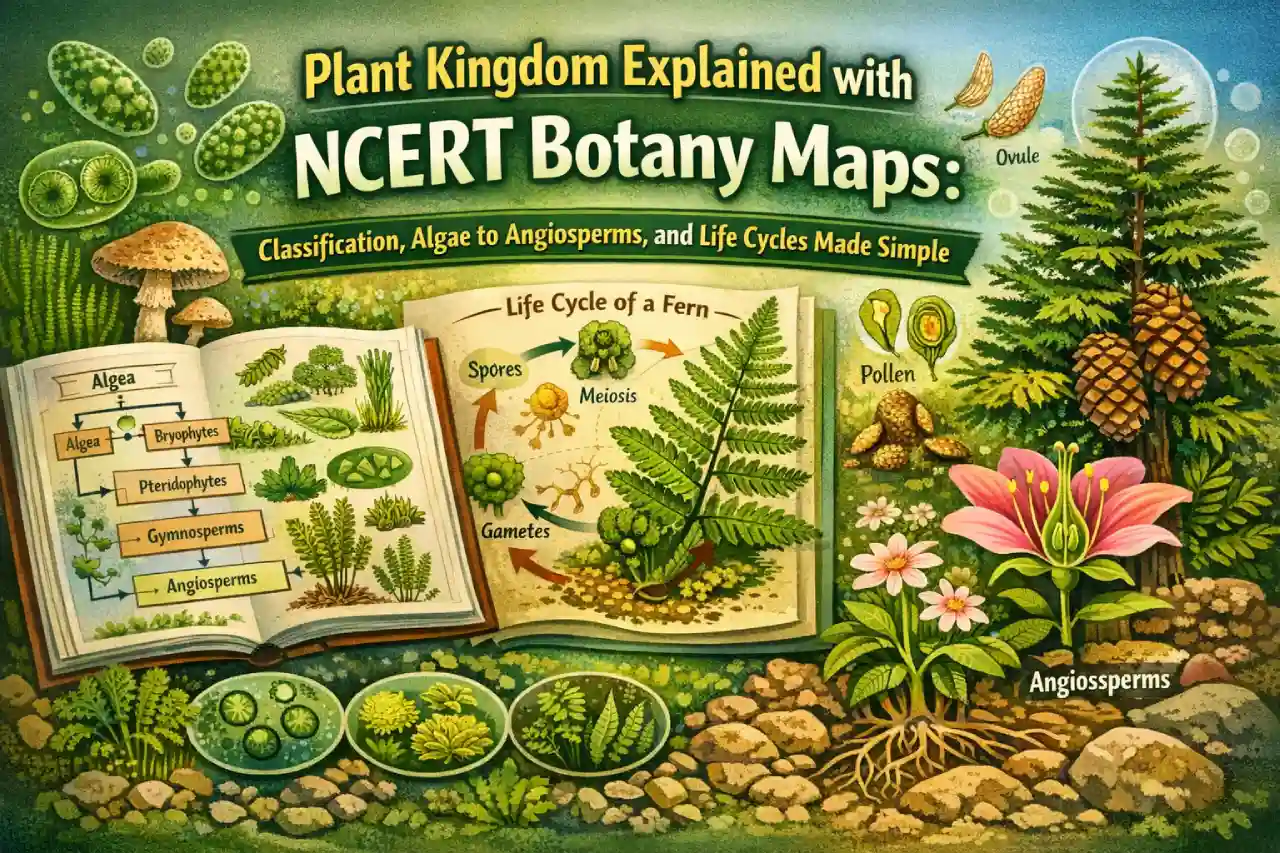
The Plant Kingdom chapter presented through NCERT-style botany maps and structured notes. It explains how plants are classified, the basis of different classification systems, and the major plant groups ranging from algae to angiosperms. The content is concise but wide-ranging, covering characteristics, reproduction, economic importance, and life-cycle patterns of different plant groups in a clear, exam-oriented format.
I am writing about this topic because the Plant Kingdom chapter often feels vast and confusing for students, especially when multiple groups and technical terms are involved. These botany maps simplify the chapter by presenting key points visually and logically, making it easier to revise and remember. Understanding this chapter properly is important not just for board exams but also for competitive exams, where direct concept-based questions are commonly asked Botany – Map – Samples
Introduction to Plant Kingdom and Taxonomy
The PDF begins by explaining how our understanding of the plant kingdom has evolved over time. Earlier classifications included fungi, cyanobacteria, and other organisms, but modern systems have clearly separated them based on cell structure and nutrition. Today, the plant kingdom mainly includes algae, bryophytes, pteridophytes, gymnosperms, and angiosperms.
It also introduces taxonomy as the science of classification and briefly outlines its main branches, such as identification, nomenclature, and classification, which help organise plant diversity systematically.
Classification Systems in Plants
The document clearly explains different classification systems used in botany.
Artificial classification is based on superficial features like colour, habit, or number of leaves and flowers. Though simple, it often separates closely related plants.
Natural classification considers overall similarities, including anatomy, embryology, and phytochemistry. The system proposed by Bentham and Hooker is highlighted here.
Phylogenetic classification is based on evolutionary relationships and common ancestry, making it the most scientifically accepted approach today.
Modern approaches like numerical taxonomy, cytotaxonomy, and chemotaxonomy are also discussed, showing how computers, chromosomes, and chemical constituents help resolve classification problems.
Algae: Characteristics and Economic Importance
Algae are described as simple, chlorophyll-bearing, autotrophic organisms mostly found in aquatic habitats. The PDF explains their wide range of forms, from unicellular to large marine kelps, and their modes of reproduction, including vegetative, asexual, and sexual methods.
The economic importance of algae is strongly emphasised. Algae contribute significantly to oxygen production, form the base of aquatic food chains, and are used as food, fertilisers, and industrial products like agar, algin, and carrageenan.
Download this Botany – Map – Samples PDF File: Click Here
Major Classes of Algae
The three main classes of algae are explained in a comparative manner.
Chlorophyceae or green algae contain chlorophyll a and b, store food as starch, and have cellulose cell walls.
Phaeophyceae or brown algae are mostly marine, contain fucoxanthin pigment, store food as laminarin and mannitol, and have algin-rich cell walls.
Rhodophyceae or red algae contain phycoerythrin pigment, store food as floridean starch, and show complex life cycles with non-motile gametes.
Bryophytes: Amphibians of the Plant Kingdom
Bryophytes are called amphibians of the plant kingdom because they live on land but depend on water for sexual reproduction. The PDF explains that their dominant plant body is the gametophyte and they lack true roots, stems, and leaves.
Mosses and liverworts are discussed separately, highlighting structures like protonema, leafy stage, rhizoids, and gemmae. Their ecological role in soil formation, water retention, and preventing erosion is also clearly mentioned.
Pteridophytes: First Vascular Land Plants
Pteridophytes are presented as the first terrestrial plants to develop vascular tissues. They possess true roots, stems, and leaves, with the sporophyte being the dominant generation.
The PDF explains sporangia, sporophylls, strobili, and the formation of spores. It also highlights heterospory in plants like Selaginella and Salvinia, which is considered an important evolutionary step towards seed habit.
Gymnosperms: Naked Seed Plants
Gymnosperms are described as seed-bearing plants with naked seeds not enclosed in fruits. Examples like Cycas and Pinus are used to explain their structure, including roots, stems, leaves, and cones.
The document explains their adaptations to dry conditions, heterosporous nature, wind pollination, and reduced gametophytes. Features like monoecious and dioecious conditions are also clearly covered.
Angiosperms: Flowering Plants
Angiosperms are introduced as the largest and most diverse group of plants. The PDF explains key features such as flowers, fruits, seeds enclosed within ovaries, and double fertilisation, which is unique to angiosperms.
The division into monocots and dicots is explained using characters like cotyledons, leaf venation, and floral parts. The smallest angiosperm, Wolffia, is also mentioned as an important exam point.
Plant Life Cycles and Alternation of Generations
The final section explains different life-cycle patterns found in plants. Haplontic, diplontic, and haplo-diplontic life cycles are explained with examples from algae, bryophytes, pteridophytes, gymnosperms, and angiosperms.
The concept of alternation of generations is clearly described, showing how gametophyte and sporophyte phases alternate during the plant life cycle.