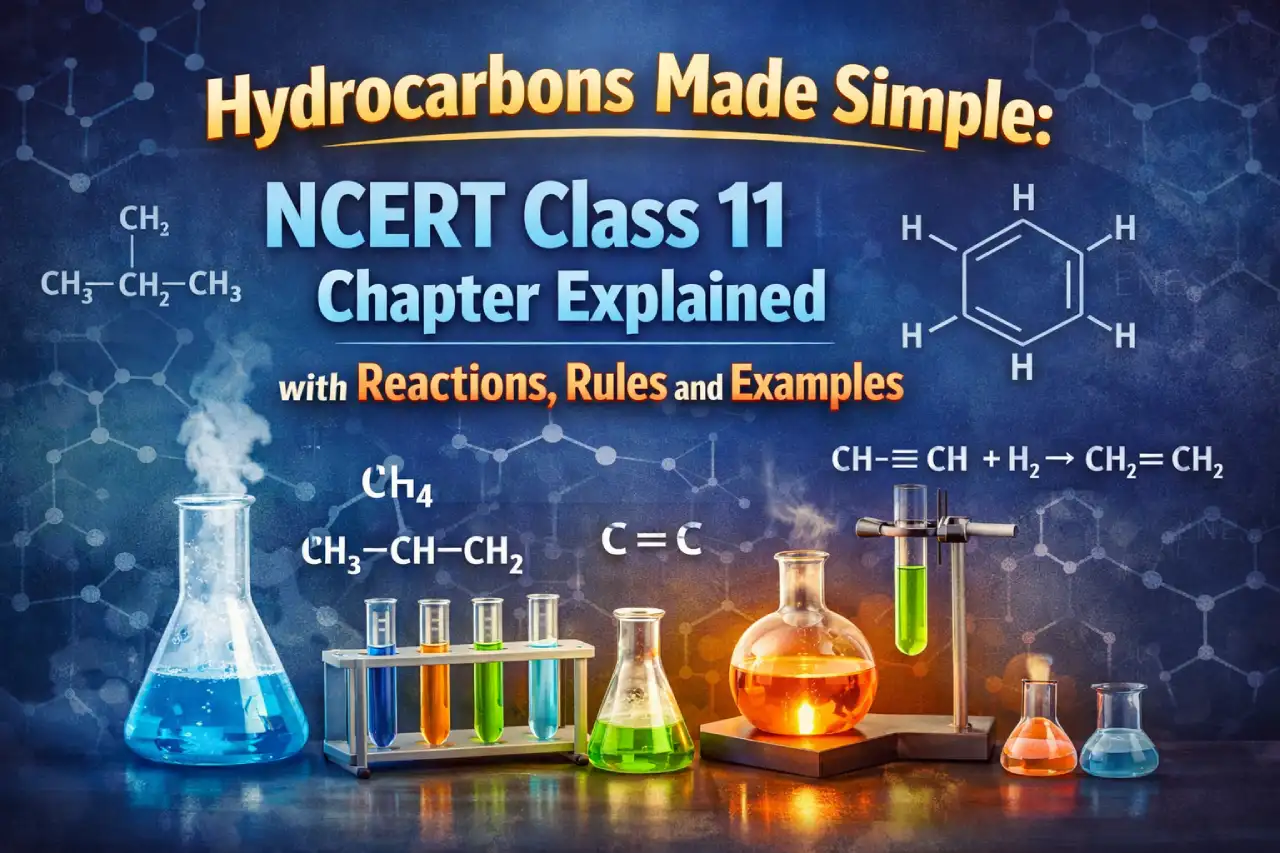
Hydrocarbons form one of the most important chapters in NCERT Class 11 Chemistry, and the PDF you uploaded covers this topic in a detailed, exam-oriented manner. It explains hydrocarbons as organic compounds made only of carbon and hydrogen and walks through their classification into alkanes, alkenes, alkynes, and aromatic hydrocarbons. The content is presented with definitions, general formulae, reactions, mechanisms, tables, and a large set of practice questions aligned with CBSE, JEE, and NEET syllabi.
I am writing about this topic because hydrocarbons are not just a scoring chapter but also a foundation for understanding organic chemistry as a whole. Many students struggle here due to the number of reactions, rules like Markovnikov and Kharash effect, and the shift from factual learning to concept-based application. This PDF brings everything together in a structured way, making it important for students who want clarity as well as exam readiness.
Introduction to Hydrocarbons
The PDF begins by defining hydrocarbons as compounds containing only carbon and hydrogen atoms. It highlights their economic and practical importance, noting that natural gas and petroleum are major sources of aliphatic hydrocarbons, while coal is an important source of aromatic hydrocarbons. Petroleum is described as a complex mixture, mainly containing alkanes, cycloalkanes, and aromatic compounds, setting the base for further classification and study.
Classification of Hydrocarbons
Hydrocarbons are classified into three main categories based on the type of carbon–carbon bonds present.
Saturated hydrocarbons contain only single bonds and include alkanes and cycloalkanes.
Unsaturated hydrocarbons contain double or triple bonds and include alkenes and alkynes.
Aromatic hydrocarbons are special cyclic compounds, mainly based on the benzene ring, showing unique stability and reaction behaviour.
This classification is repeatedly used throughout the chapter to explain differences in properties and reactions.
Alkanes: Saturated Hydrocarbons
Alkanes are explained as saturated hydrocarbons with the general formula CnH2n+2. Methane is introduced as the first member, commonly known as marsh gas. The PDF explains why alkanes were earlier called paraffins due to their low reactivity.
Detailed sections cover IUPAC nomenclature, listing methane to decane in tabular form. Methods of preparation include hydrogenation of unsaturated hydrocarbons, reduction of alkyl halides, Wurtz reaction, decarboxylation using soda lime, and Kolbe’s electrolytic method.
Physical properties such as state, solubility, and boiling point trends are clearly explained, followed by chemical reactions like halogenation, combustion, controlled oxidation, aromatisation, and reaction with steam.
Alkenes: Unsaturated Hydrocarbons with Double Bonds
Alkenes are introduced as hydrocarbons containing at least one carbon–carbon double bond, with the general formula CnH2n. Ethene is discussed as the first member and the origin of the term olefins is explained.
The PDF covers nomenclature rules, methods of preparation from alkynes, alkyl halides, and alcohols, and both physical and chemical properties. A major focus is given to addition reactions such as hydrogenation, halogenation, and addition of hydrogen halides.
Markovnikov’s rule is clearly stated, along with Anti-Markovnikov addition or Kharash effect, which applies specifically to HBr in the presence of peroxides. Polymerisation of alkenes is also explained with examples.
Download this CHEMISTRY 11 – HYDROCARBONS PDF File: Click Here
Alkynes: Hydrocarbons with Triple Bonds
Alkynes are described as unsaturated hydrocarbons with the general formula CnH2n−2 and at least one triple bond. Ethyne, commonly known as acetylene, is introduced as the first stable member.
The PDF explains preparation methods such as from calcium carbide and vicinal dihalides. Physical and chemical properties are discussed in detail, including addition reactions with hydrogen, halogens, hydrogen halides, water, and oxidation. Special emphasis is given to polymerisation of ethyne to form benzene under specific conditions.
Aromatic Hydrocarbons and Benzene
Aromatic hydrocarbons, also called arenes, are explained with benzene as the central compound. The PDF discusses nomenclature, structure, and resonance, highlighting why benzene is unusually stable despite high unsaturation.
Methods of preparation of benzene include cyclic polymerisation of ethyne, decarboxylation of aromatic acids, and reduction of phenol. Physical properties such as non-polar nature and sooty flame combustion are listed.
Chemical reactions like nitration, halogenation, sulphonation, and Friedel–Crafts alkylation are explained, along with the role of activating and deactivating groups in electrophilic substitution reactions.
Important Rules, Reactions and Exam Highlights
The summary section in the PDF consolidates key concepts such as cracking, reforming, Grignard reagents, Baeyer’s test, geometric isomerism, aromaticity based on the (4n+2) π-electron rule, and differences between substitution and addition reactions.
The latter part of the PDF includes NCERT line-by-line questions, assertion–reason questions, matrix match, and extensive topic-wise MCQs, making it highly useful for competitive exam practice.