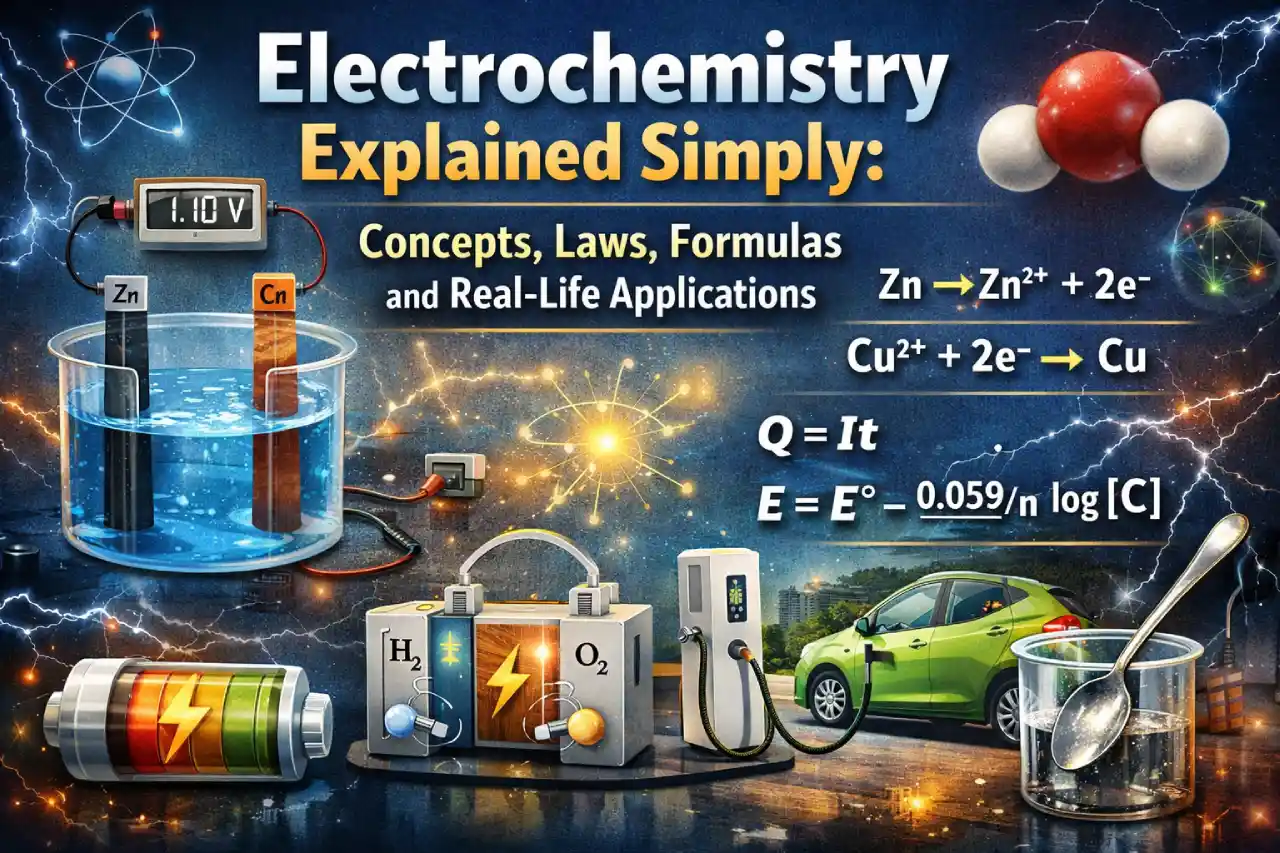
Electrochemistry is one of those chemistry chapters that quietly connects many parts of science together. It explains how chemical reactions can produce electricity and how electricity can drive chemical reactions. From batteries and fuel cells to corrosion and electroplating, the ideas covered in electrochemistry play a major role in everyday life as well as in industrial processes.
I am writing this article because many students find electrochemistry heavy due to formulas, graphs, and multiple concepts like conductance, electrode potential, and electrochemical cells. When broken down in simple language and logical order, the chapter becomes much easier to understand and revise. This article brings together all the important points from the PDF in one organised, student-friendly guide.
What Is Electrochemistry?
Electrochemistry is the branch of chemistry that deals with the relationship between electrical energy and chemical energy and their interconversion.
It mainly covers two broad areas:
- Electrolysis (use of electricity to cause chemical change)
- Electrochemical cells (use of chemical reactions to produce electricity)
Both these ideas are at the heart of modern technology such as batteries, corrosion prevention, and fuel cells.
Types of Conductors
Electrical conduction can occur in two main ways:
Metallic (Electronic) Conductors
These conduct electricity through the movement of electrons. Examples include copper, aluminium, and silver.
There is no chemical change during conduction, only heat is produced.
Electrolytic Conductors
These conduct electricity through the movement of ions in molten state or aqueous solution.
Examples: acids, bases, and salts in solution.
Non-electrolytes like sugar solution or alcohol do not conduct electricity.
Strong and Weak Electrolytes
Strong electrolytes completely dissociate into ions in solution.
Examples: HCl, NaOH, KCl
Weak electrolytes partially dissociate.
Examples: CH₃COOH, NH₄OH
Strong electrolytes show higher conductivity because they produce more ions.
Ohm’s Law and Resistance
Ohm’s law states:
V = IR
Where
V = potential difference
I = current
R = resistance
Resistance depends on:
- Length of conductor
- Cross-sectional area
- Nature of material
Resistivity (ρ) is given by:
R = ρl / A
Conductance and Specific Conductance
Conductance (G) is the reciprocal of resistance.
G = 1 / R
Specific conductance (κ) is the conductance of a solution contained between electrodes 1 cm apart with area 1 cm².
κ = G × cell constant
Specific conductance increases with:
- Increase in concentration
- Increase in temperature
- Higher ionic mobility
Download this CLASS 12 – ELECTROCHEMISTRY PDF File: Click Here
Molar Conductance
Molar conductance (λm) is the conductance of all ions produced by one mole of electrolyte in solution.
λm = κ × 1000 / M
Where M is molarity.
On dilution:
- Specific conductance decreases
- Molar conductance increases
At infinite dilution, molar conductance reaches a maximum value called limiting molar conductance (λm°).
Kohlrausch’s Law of Independent Migration of Ions
At infinite dilution, each ion contributes independently to the total molar conductance.
λm° = λ°(cation) + λ°(anion)
Applications:
- Calculate limiting molar conductance of weak electrolytes
- Find degree of dissociation
- Determine dissociation constant
Faraday’s Laws of Electrolysis
First Law
The mass of substance deposited is proportional to the quantity of electricity passed.
W = ZIt
Second Law
For the same quantity of electricity, masses deposited are proportional to equivalent weights.
Combined equation:
W = (E × I × t) / 96500
Electrochemical Cells
Devices that convert chemical energy into electrical energy or vice versa.
Two main types:
- Electrolytic cells
- Galvanic (voltaic) cells
Daniell Cell (Example of Galvanic Cell)
Zn | Zn²⁺ || Cu²⁺ | Cu
- Oxidation at anode (Zn)
- Reduction at cathode (Cu)
Overall reaction:
Zn + Cu²⁺ → Zn²⁺ + Cu
Electrode Potential
The potential difference between electrode and its ion solution.
- Oxidation potential: tendency to lose electrons
- Reduction potential: tendency to gain electrons
Standard electrode potential (E°) is measured under:
- 1M concentration
- 25°C
- 1 atm pressure
Standard hydrogen electrode (SHE) is taken as zero reference.
Electrochemical Series
Arrangement of elements in order of increasing reduction potential.
Uses:
- Predict feasibility of reactions
- Compare oxidising and reducing power
- Decide which metal will corrode first
Nernst Equation
Used to calculate electrode potential at non-standard conditions.
E = E° − (0.0591 / n) log Q
Applications:
- Find equilibrium constant
- Calculate pH
- Determine solubility product
Relationship Between Cell Potential and Gibbs Free Energy
ΔG = −nFEcell
At standard conditions:
ΔG° = −nF E°cell
If ΔG is negative, the reaction is spontaneous.
Concentration Cells
Cells where electrical energy is produced due to difference in concentration of same electrolyte.
Ecell = (0.0591 / n) log (C₂ / C₁)
Commercial Cells
Primary Cells (Non-rechargeable)
- Dry cell
- Mercury cell
- Alkaline dry cell
Secondary Cells (Rechargeable)
- Lead storage battery
- Nickel-cadmium battery
Fuel Cell
Hydrogen-oxygen fuel cell:
2H₂ + O₂ → 2H₂O
Advantages:
- High efficiency
- Pollution free
- Continuous supply of electricity
Corrosion
Slow destruction of metals due to chemical or electrochemical reactions with environment.
Example: Rusting of iron
Prevention methods:
- Painting and coating
- Galvanisation
- Cathodic protection
Important Formulas at a Glance
- V = IR
- G = 1 / R
- λm = κ × 1000 / M
- W = EIt / 96500
- E = E° − (0.0591 / n) log Q
- ΔG = −nFE