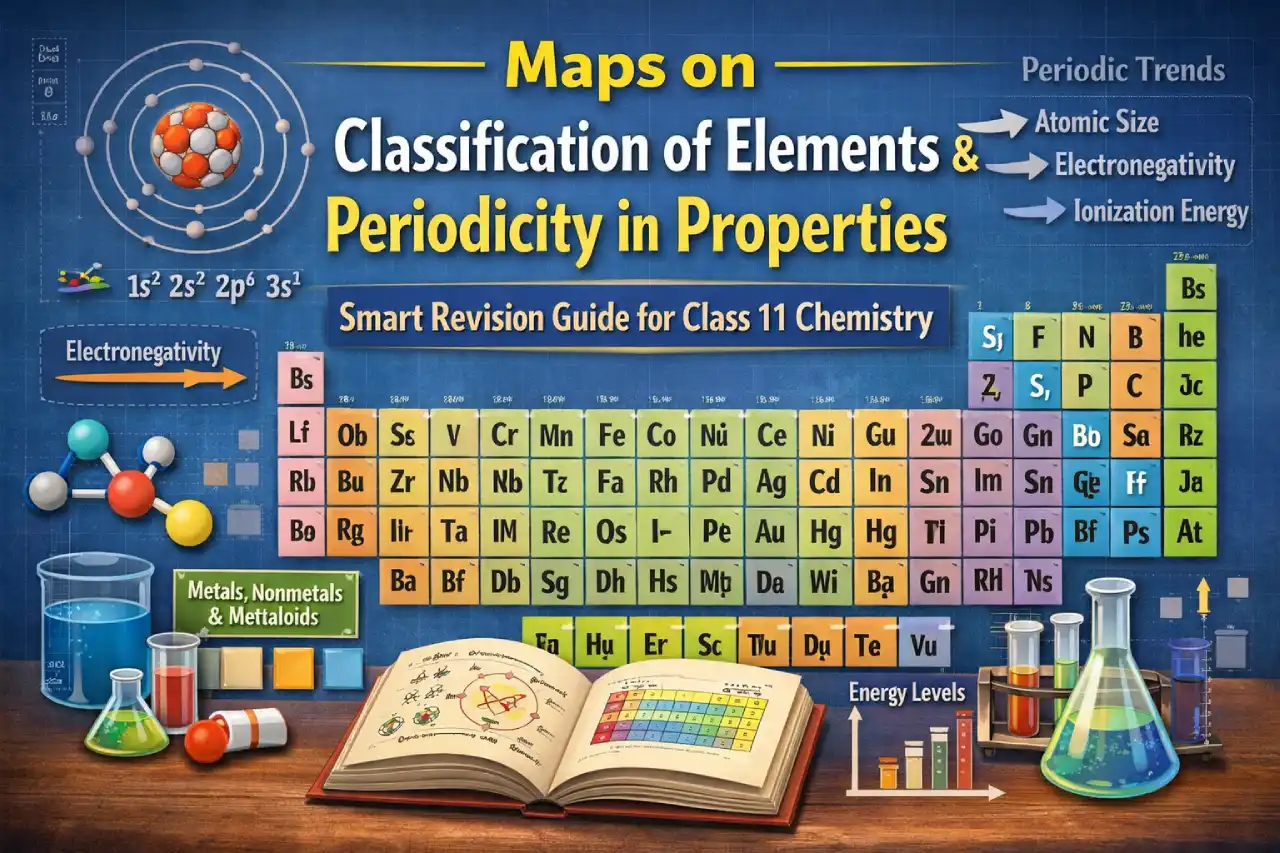
The chapter Classification of Elements and Periodicity in Properties forms the backbone of inorganic chemistry. It explains how elements are arranged in the periodic table and why their physical and chemical properties show regular patterns. The PDF you shared presents this entire chapter in a concise, map-based format, making it easier for students to revise key concepts quickly before exams.
I am writing about this PDF because many Class 11 students struggle to connect theory with trends and examples from the periodic table. A well-organised map format helps in visual learning, faster recall, and concept clarity. Whether you are preparing for school exams, competitive tests, or quick revision, this resource can save time and improve understanding.
Overview of the PDF Content
The PDF is designed as an NCERT map for Chapter 3: Classification of Elements and Periodicity in Properties. It covers historical development, modern periodic law, electronic configuration, block classification, important terminologies, and trends in physical and chemical properties, all in a structured visual layout.
Key areas included are:
- Genesis of periodic classification
- Modern periodic law and table
- Nomenclature of elements with atomic number above 100
- Electronic configuration patterns
- Important definitions and terminologies
- Periodic trends in properties
Genesis of Periodic Classification
The PDF explains how scientists gradually developed ideas to organise elements:
- Dobereiner’s Triads
Middle element has atomic mass approximately equal to the average of the other two, and similar properties.
Examples: Li–Na–K, Ca–Sr–Ba, Cl–Br–I. - Law of Octaves (Newlands)
Every eighth element shows properties similar to the first when arranged in increasing atomic mass. - Lothar Meyer’s Contribution
Plotted atomic volume, melting point, and boiling point against atomic mass and observed periodic repetition. - Mendeleev’s Periodic Law
Properties of elements are periodic functions of their atomic weights.
He predicted unknown elements like Eka-aluminium (Gallium) and Eka-silicon (Germanium).
Modern Periodic Law and Table
The PDF highlights the modern concept:
- Modern Periodic Law:
Physical and chemical properties of elements are periodic functions of their atomic numbers. - Elements are arranged into 7 periods and 18 groups.
- Classification into blocks:
- s-block: Group 1 and 2
- p-block: Group 13 to 18
- d-block: Group 3 to 12 (transition metals)
- f-block: Lanthanides and actinides (inner transition elements)
Electronic Configuration Patterns
General outer electronic configurations given in the map:
| Block | General Configuration |
|---|---|
| s-block | ns¹–² |
| p-block | ns² np¹–⁶ |
| d-block | (n–1)d¹–¹⁰ ns⁰–² |
| f-block | (n–2)f¹–¹⁴ (n–1)d⁰–¹ ns² |
Understanding these patterns helps in predicting valency, oxidation states, and chemical behaviour.
Important Terminologies Explained
The PDF clearly defines key terms:
- Atomic Radius: Half the distance between nuclei of two similar atoms.
- Covalent Radius: Half the bond distance between two identical non-metal atoms.
- Metallic Radius: Half the distance between metal cores in a metallic crystal.
- Ionization Enthalpy: Energy required to remove an electron from an isolated gaseous atom.
- Electron Gain Enthalpy: Energy change when an atom gains an electron.
- Electronegativity: Ability of an atom to attract shared electrons in a bond.
It also notes:
- Cations are smaller than parent atoms.
- Anions are larger than parent atoms.
- Isoelectronic species have the same number of electrons.
Download this Chemistry Map Samples PDF File: Click Here
Periodic Trends in Physical Properties
Across a period (left to right):
- Atomic radius decreases
- Ionization enthalpy increases
- Electronegativity increases
- Metallic character decreases
Down a group:
- Atomic radius increases
- Ionization enthalpy decreases
- Metallic character increases
These trends are visually represented in the map using arrows, making them easy to remember.
Periodic Trends in Chemical Properties
The PDF highlights:
- Valence of representative elements equals number of valence electrons or (8 – valence electrons).
- Second period elements show anomalous behaviour due to small size and high electronegativity.
- Diagonal relationship: Li with Mg, Be with Al.
Nature of oxides:
- Left side elements form basic oxides (e.g., Na₂O).
- Right side elements form acidic oxides (e.g., Cl₂O₇).
- Middle elements form amphoteric oxides (e.g., Al₂O₃).
Why This PDF Is Useful for Students
- Covers entire chapter in a compact format
- Ideal for last-minute revision
- Helps in quick recall of trends and facts
- Useful for board exams and competitive exams
- Saves time compared to lengthy notes