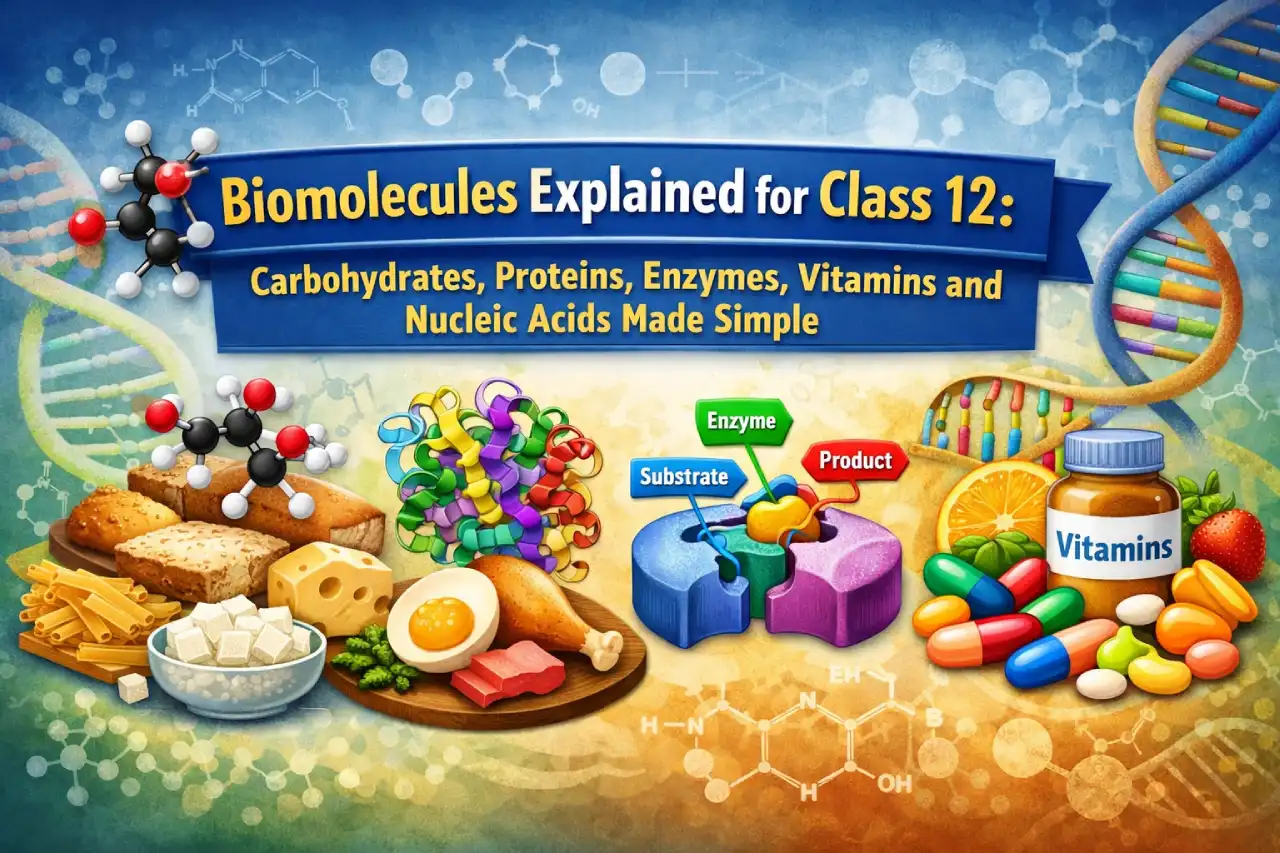
Biomolecules form the chemical foundation of life. From the sugar that gives us instant energy to the DNA that carries genetic information, every living system depends on these organic compounds. The uploaded PDF focuses on Chapter 14 – Biomolecules for Class 12 Chemistry and explains the four major classes of biomolecules: carbohydrates, proteins, enzymes and vitamins, and nucleic acids. It also includes objective questions, short answers, long answers, and conceptual explanations aligned with NCERT patterns.
I am writing about this topic because biomolecules remain one of the most scoring yet concept-heavy chapters in Class 12 Chemistry. Many students memorise reactions and definitions but struggle to connect concepts. This article simplifies the key ideas from the PDF in a structured and practical way so learners can revise faster, understand better, and approach exams with more confidence.
What Are Biomolecules?
Biomolecules are organic compounds naturally present in living organisms. They are essential for growth, energy, repair, and reproduction. Broadly, biomolecules are divided into four major categories:
- Carbohydrates
- Proteins
- Enzymes and Vitamins
- Nucleic Acids
Each group has a distinct structure and function but works in coordination inside the body.
Carbohydrates: The Primary Energy Source
Carbohydrates are optically active polyhydroxy aldehydes or ketones, or compounds that produce these units on hydrolysis.
Classification of Carbohydrates
Carbohydrates are divided into three main types:
- Monosaccharides
- Disaccharides
- Polysaccharides
Monosaccharides
These are the simplest carbohydrates and cannot be further hydrolysed.
Examples:
- Glucose
- Fructose
- Ribose
Glucose is an aldohexose and exists mainly in the pyranose (six-membered ring) form. Fructose is a ketohexose and often forms a furanose (five-membered ring) structure.
Disaccharides
Formed by two monosaccharide units joined by a glycosidic linkage.
Examples:
| Disaccharide | Components | Reducing Nature |
|---|---|---|
| Sucrose | Glucose + Fructose | Non-reducing |
| Maltose | Glucose + Glucose | Reducing |
| Lactose | Glucose + Galactose | Reducing |
Sucrose is called invert sugar because on hydrolysis it gives glucose and fructose, and the optical rotation changes from dextrorotatory to laevorotatory.
Polysaccharides
Large polymers of monosaccharides.
Examples:
- Starch – plant storage carbohydrate
- Glycogen – animal storage carbohydrate (stored in liver and muscles)
- Cellulose – structural carbohydrate in plant cell walls
Starch and glycogen have α-glycosidic linkages, while cellulose has β-glycosidic linkages.
Proteins: Building Blocks of Life
Proteins are polymers of α-amino acids linked by peptide bonds.
Types of Amino Acids
- Essential amino acids – cannot be synthesised in the body
- Non-essential amino acids – synthesised in the body
Levels of Protein Structure
- Primary structure – sequence of amino acids
- Secondary structure – α-helix and β-pleated sheet
- Tertiary structure – overall 3D folding
- Quaternary structure – association of multiple chains
The α-helix structure is stabilised by hydrogen bonding.
Denaturation of Proteins
When proteins are exposed to high temperature or extreme pH, their secondary and tertiary structures are destroyed. Example: coagulation of egg white on boiling.
Download this CLASS 12 – BIOMOLECULES PDF File: Click Here
Enzymes and Vitamins
Enzymes
Enzymes are biological catalysts and are protein in nature. They speed up biochemical reactions by lowering activation energy.
Examples:
| Enzyme | Function |
|---|---|
| Invertase | Hydrolysis of sucrose |
| Maltase | Hydrolysis of maltose |
| Pepsin | Digestion of proteins |
| Urease | Breakdown of urea |
| Zymase | Alcoholic fermentation |
Vitamins
Vitamins are accessory food factors required in small amounts.
Fat-Soluble Vitamins
- A, D, E, K
Water-Soluble Vitamins
- B-complex, C
Deficiency diseases include:
| Vitamin | Deficiency Disease |
|---|---|
| A | Night blindness, xerophthalmia |
| B1 | Beri-beri |
| B12 | Pernicious anaemia |
| C | Bleeding gums |
| D | Rickets, osteomalacia |
| K | Increased bleeding time |
Nucleic Acids: DNA and RNA
Nucleic acids are polymers of nucleotides. Each nucleotide contains:
- Nitrogenous base
- Pentose sugar
- Phosphate group
Types of Nucleic Acids
| Feature | DNA | RNA |
|---|---|---|
| Sugar | Deoxyribose | Ribose |
| Bases | A, T, G, C | A, U, G, C |
| Structure | Double-stranded | Single-stranded |
DNA stores genetic information and controls protein synthesis. RNA plays a direct role in translating genetic code into proteins.
Phosphodiester Linkage
Nucleotides are linked by phosphodiester bonds between 5′ and 3′ carbon atoms of sugars.
Important Exam-Oriented Points
- Glycogen structure is similar to amylopectin.
- Ribose and fructose form furanose rings.
- Only L-amino acids are found in proteins.
- Vitamin C must be supplied regularly because it is water-soluble.
- Purine bases: adenine and guanine.