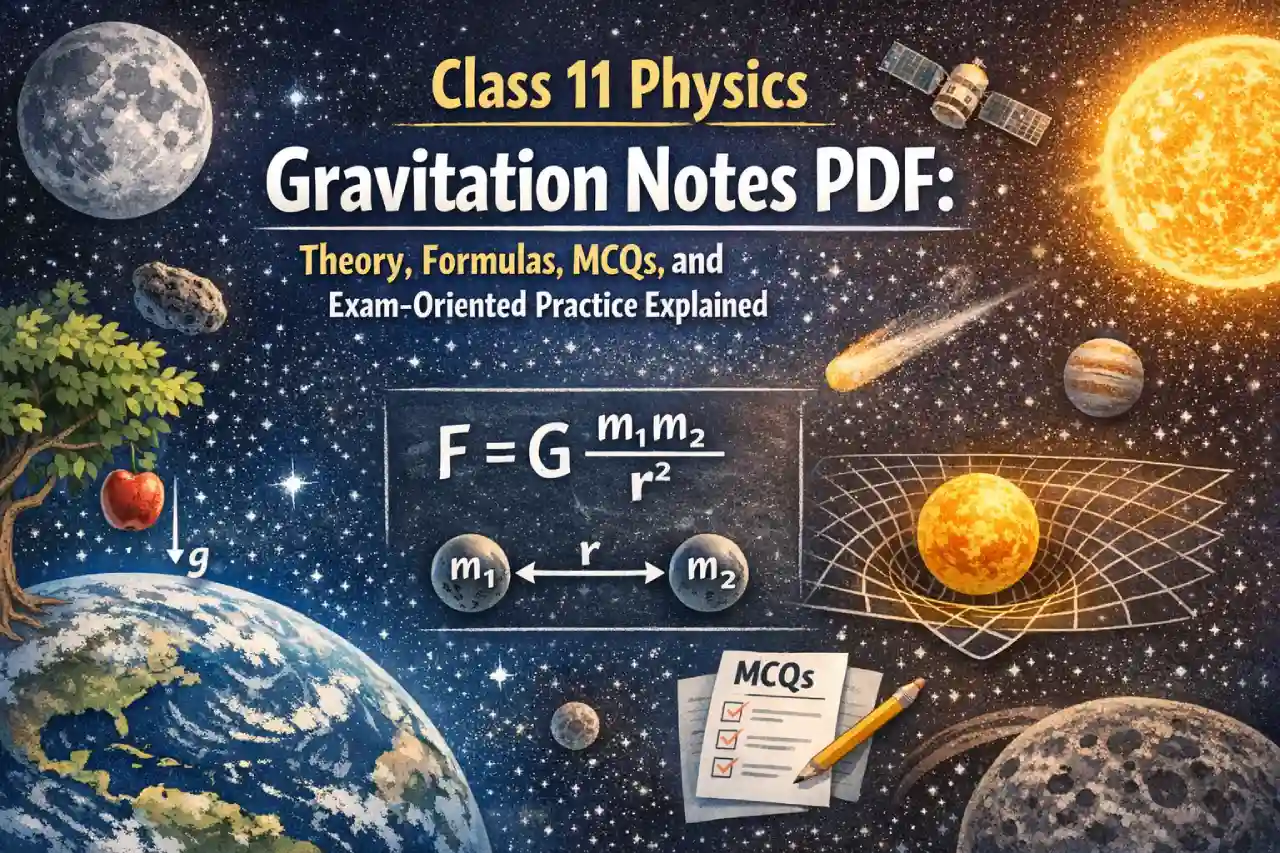
Gravitation is one of the most concept-rich chapters in Class 11 Physics and plays a crucial role in board exams as well as competitive exams like JEE and NEET. The uploaded PDF is a Physics Smart Booklet based on the updated 2024 NCERT syllabus and is specially designed for CBSE, JEE, and NEET aspirants. It combines detailed theory, clear diagrams, important formulas, NCERT-based MCQs, topic-wise practice questions, and previous year NEET-style questions, all focused on Chapter 8 – Gravitation.
I am writing about this PDF because students often struggle to balance theory and problem practice in this chapter. Gravitation involves laws, derivations, numerical applications, and real-life concepts like satellites and escape velocity. This booklet brings everything together in a single, organised resource, which saves time and improves conceptual clarity. Knowing what this PDF offers can help students plan their study better and revise more effectively. PHYSICS 11 – GRAVITATION
What This Gravitation Smart Booklet Contains
The PDF is structured as a complete learning and practice package. Each topic includes:
- Conceptual theory with diagrams
- Important formulas and results
- Solved examples and illustrations
- NCERT line-by-line questions
- Topic-wise MCQs
- NEET and entrance-exam oriented questions
This makes it suitable for both learning and revision.
Kepler’s Laws of Planetary Motion
The booklet explains all three of Kepler’s laws in a clear and simple manner.
- Law of orbits: Planets move in elliptical orbits with the Sun at one focus
- Law of areas: A line joining a planet and the Sun sweeps equal areas in equal intervals of time
- Law of periods: T² is proportional to a³
Examples are given to show how nearer planets move faster and how orbital speed varies for different planets.
Newton’s Law of Universal Gravitation
Newton’s law is introduced along with its mathematical form:
F = Gm₁m₂ / r²
The PDF explains:
- Meaning of universal gravitational constant G
- Dimensional formula of G
- Vector form of gravitational force
- Superposition principle
Important conceptual points such as gravitational force being the weakest force and shell theorem are also discussed.
Acceleration Due to Gravity (g)
Students will find detailed coverage of:
- Expression for g on the surface of earth
- Variation of g with height
- Variation of g with depth
- Effect of earth’s rotation on g
- Difference between gravitational acceleration and free-fall acceleration
The booklet also explains why g is maximum at the poles and minimum at the equator.
Gravitational Field and Gravitational Potential
The PDF defines gravitational field as force per unit mass and explains its direction and units.
Gravitational potential and potential energy are explained using:
- U = –Gm₁m₂ / r
- V = –GM / r
Tables are included showing potential and field due to point mass, ring, spherical shell, and solid sphere.
Download this PHYSICS 11 – GRAVITATION PDF File: Click Here
Escape Velocity and Black Holes
Escape velocity is defined as the minimum velocity needed to escape earth’s gravitational pull.
vₑ = √(2gR)
The booklet also introduces the idea of black holes and explains that when escape velocity equals the speed of light, even light cannot escape.
Satellites and Orbital Motion
Topics covered include:
- Orbital velocity of a satellite
- Time period of a satellite
- Energy of a satellite in circular orbit
- Geostationary satellites
- Communication satellites and remote sensing satellites
The role of Indian satellites such as INSAT is also mentioned.
Weightlessness and Its Effects
The booklet explains both physical and physiological effects of weightlessness, such as:
- Puffy face of astronauts
- Temporary increase in height
- No convection or sedimentation
- Increased importance of surface tension
These conceptual points are useful for theory-based questions.
Solved Illustrations and Numerical Problems
The PDF contains many solved examples related to:
- Field inside and outside spheres
- Motion through a tunnel inside earth
- Energy changes of satellites
- Variation of g problems
- Escape velocity based numericals
These examples help students understand the step-by-step approach.
NCERT Line-by-Line and Practice MCQs
A large section is dedicated to:
- NCERT-based conceptual questions
- Topic-wise MCQs
- Practice problems with answer keys
This makes the booklet highly useful for exam-oriented preparation.
Who Should Use This PDF
- Class 11 Physics students
- CBSE board aspirants
- JEE and NEET candidates
- Teachers and tutors