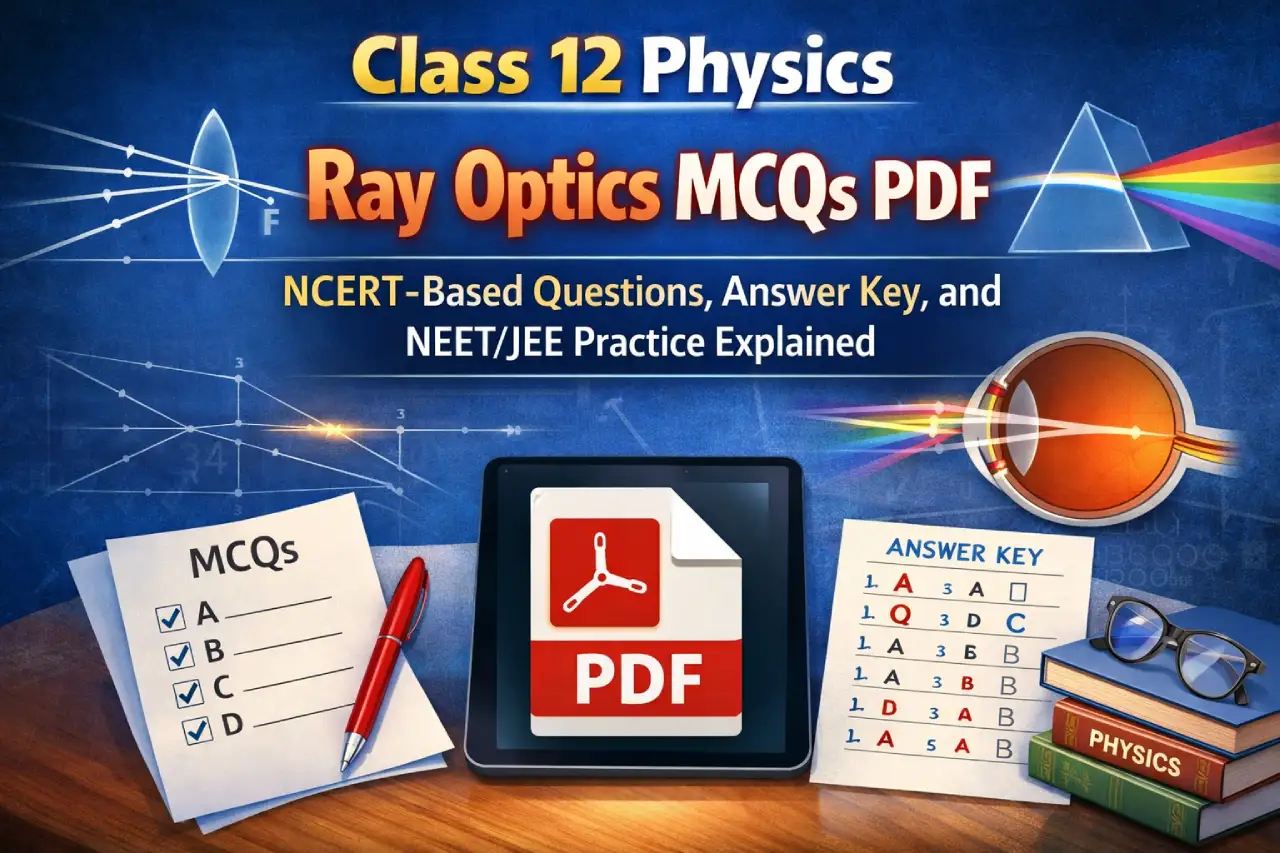
Ray Optics and Optical Instruments is one of the most important and scoring chapters in Class 12 Physics. It connects basic ideas of reflection and refraction with real-life applications like lenses, mirrors, prisms, microscopes, and telescopes. The uploaded PDF is a comprehensive MCQs question bank designed strictly on NCERT lines. It includes topic-wise multiple-choice questions, NCERT Exemplar problems, NEET-oriented questions, a complete answer key, and a detailed hints and solutions section, making it a powerful practice resource for board and competitive exam aspirants.
I am writing about this PDF because students often understand ray diagrams and formulas but struggle to apply them correctly in objective-type questions. Ray Optics requires both conceptual clarity and continuous practice. This PDF brings together a wide range of exam-level MCQs from every subtopic of the chapter, helping students strengthen fundamentals, improve speed, and build confidence for Class 12 boards, JEE, and NEET. RAY OPTICS
What This Ray Optics MCQs PDF Contains
The document is divided into two main exercises:
- Exercise 1: NCERT Based Topic-wise MCQs
- Exercise 2: NCERT Exemplar & NEET Questions
At the end, a consolidated answer key and a “Hints & Solutions” section are provided for self-evaluation and concept building.
Topics Covered in the PDF
The questions are organised according to NCERT subtopics, such as:
- Rectilinear propagation of light
- Reflection of light by spherical mirrors
- Refraction of light
- Total internal reflection
- Refraction at spherical surfaces and by lenses
- Combination of lenses and mirrors
- Refraction through a prism
- Optical instruments
This ensures complete coverage of the Class 12 Ray Optics syllabus.
Reflection of Light by Spherical Mirrors
The PDF contains MCQs on:
- Image formation by concave and convex mirrors
- Mirror formula and magnification
- Paraxial rays and ray diagrams
- Motion of object and image in mirrors
- Velocity of image and object
Conceptual questions test understanding of real and virtual images, erect and inverted images, and size of images in different cases.
Refraction of Light and Refractive Index
Students will find questions based on:
- Snell’s law
- Speed of light in different media
- Refractive index and its relation with wavelength and frequency
- Apparent depth and real depth
- Refraction through glass slabs and layered media
These MCQs help in mastering formula-based and reasoning-based problems.
Total Internal Reflection
A separate set of questions focuses on:
- Critical angle
- Conditions for total internal reflection
- Variation of critical angle with wavelength
- TIR in glass-air and water-air interfaces
These are very important for NEET and JEE.
Download this RAY OPTICS PDF File: Click Here
Lenses and Refraction at Spherical Surfaces
The PDF covers:
- Lens maker’s formula
- Thin lens formula
- Power of lens and combination of lenses
- Focal length in different media
- Cutting and rearrangement of lenses
- Image formation by convex and concave lenses
Numerical MCQs test students on power, focal length, and image position.
Prism and Minimum Deviation
Questions in this section include:
- Angle of minimum deviation
- Relation between angle of prism, deviation, and refractive index
- Dispersion of light
- Behaviour of different colours through prism
These are commonly asked in board and competitive exams.
Optical Instruments
The PDF includes MCQs on:
- Simple microscope
- Compound microscope
- Astronomical telescope
- Galilean telescope
- Magnifying power and resolving power
Students practise calculating magnification, focal lengths, and image positions.
Answer Key and Hints & Solutions
After the exercises, a complete answer key is provided in tabular form.
The “Hints & Solutions” section explains selected questions step by step, including formula application and reasoning, which is extremely useful for self-study.
How This PDF Helps Students
- Strengthens conceptual understanding
- Improves numerical problem-solving skills
- Builds exam temperament
- Saves time by providing topic-wise MCQs
- Helps identify weak areas
Who Should Use This PDF
- Class 12 Physics students
- CBSE board aspirants
- NEET and JEE candidates
- Teachers and tutors