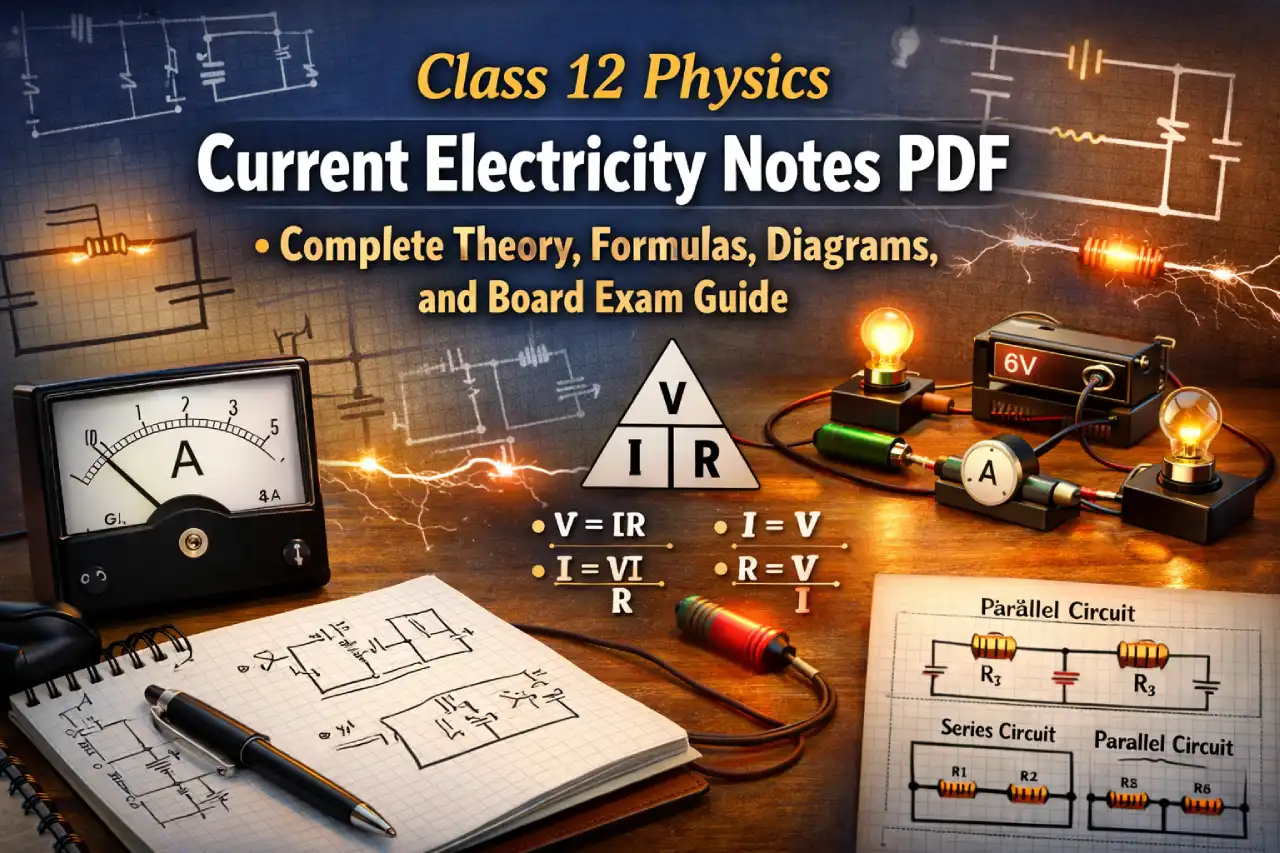
Current Electricity is one of the most important chapters in Class 12 Physics because it builds the foundation for understanding circuits, electrical devices, and practical measurements. The uploaded PDF is a detailed study resource that covers electric current, drift velocity, Ohm’s law, resistance, resistivity, combination of resistors, cells and their internal resistance, Kirchhoff’s laws, Wheatstone bridge, metre bridge, potentiometer, heating effect of current, and electric power. It also includes diagrams, derivations, tables, and important formulas arranged in a structured manner. CLASS 12 – CURRENT ELECTRICITY
I am writing about this PDF because this chapter is not just theoretical; it is highly application-based and very scoring in board as well as competitive exams. Many students struggle with concepts like drift velocity, internal resistance, and potentiometer derivations. This document explains them step by step with formulas and clear circuit diagrams. Knowing what is covered in this PDF can help students revise smarter and avoid confusion during exam preparation.
Overview of Current Electricity Chapter
As mentioned in the chapter objectives section, the PDF begins with the basic idea of electric current and gradually moves towards advanced applications like Wheatstone bridge and potentiometer. The structure is concept-wise and formula-oriented, making it suitable for quick revision.
Major topics covered include:
- Electric current and current carriers
- Drift velocity and mobility
- Ohm’s law and V–I characteristics
- Electrical resistance and resistivity
- Series and parallel combinations
- Internal resistance of a cell
- Kirchhoff’s laws
- Wheatstone bridge and metre bridge
- Potentiometer and its applications
- Heating effect of current
- Electric power and energy
Electric Current and Drift Velocity
The PDF defines electric current as the time rate of flow of charge through a cross-section. It clearly states that current is a scalar quantity and gives the basic relation:
I = dq/dt
On page 1, the explanation of drift velocity is given with derivation. It shows that when an electric field is applied, free electrons acquire an average drift velocity opposite to the direction of the electric field. The important formula derived is:
vd = eEτ/m
Here, τ is relaxation time. The PDF also explains that although drift velocity is very small (of the order 10⁻⁴ m/s), current propagates almost at the speed of light because it is an electromagnetic effect.
Ohm’s Law and Electrical Resistance
Ohm’s law is clearly stated as:
V = IR
The V–I graph for a metallic conductor is shown as a straight line, while non-ohmic devices like vacuum tubes and semiconductors show non-linear characteristics. On page 5, the colour code table for carbon resistors is provided with a memory sentence to remember colour order. This is very useful for practical exams.
Resistance is shown to depend on:
- Length (directly proportional)
- Area of cross-section (inversely proportional)
- Nature of material
- Temperature
Resistivity is defined as an intrinsic property and given by:
ρ = m/(ne²τ)
The document also explains temperature coefficient of resistance and its positive value for metals and negative value for semiconductors.
Combination of Resistors
The PDF clearly differentiates between series and parallel combinations.
In series:
- Current is same
- Total resistance = R1 + R2 + R3
- Net resistance is greater than the largest individual resistance
In parallel:
- Potential difference is same
- 1/Rp = 1/R1 + 1/R2 + 1/R3
- Net resistance is less than the smallest resistance
These concepts are supported with circuit diagrams in the scanned pages.
Download this CLASS 12 – CURRENT ELECTRICITY PDF File: Click Here
Cells, EMF and Internal Resistance
On page 6, the PDF defines EMF as the potential difference across the terminals of a cell in open circuit. It also differentiates between EMF and terminal potential difference in a comparison table.
For a closed circuit:
E = V + ir
The maximum power transfer theorem is clearly stated:
Maximum power is delivered when external resistance equals internal resistance.
The formula given is:
Pmax = E²/4r
This concept is extremely important for numerical problems.
Kirchhoff’s Laws
The document explains both laws clearly:
Kirchhoff’s Current Law: Algebraic sum of currents at a junction is zero.
Kirchhoff’s Voltage Law: Algebraic sum of potential differences around a closed loop is zero.
These laws are based on conservation of charge and conservation of energy.
Wheatstone Bridge and Metre Bridge
The PDF explains the balanced condition of Wheatstone bridge as:
P/Q = R/S
A neat diagram of the bridge is shown, and applications like measuring unknown resistance are mentioned.
The metre bridge is explained as the practical form of Wheatstone bridge. The relation used is:
R/S = l/(100 − l)
Knowing l and R, unknown resistance S can be calculated.
Potentiometer and Its Applications
On page 10 and 11, the principle of potentiometer is given as:
Potential difference across a uniform wire is directly proportional to its length.
V ∝ l
Applications explained include:
- Comparison of EMFs of two cells
- Determination of internal resistance of a cell
The relation E1/E2 = l1/l2 is derived clearly.
The concept of sensitiveness of potentiometer is also explained, stating that it can be increased by decreasing potential gradient.
Heating Effect of Current and Electric Power
On page 12, Joule’s heating law is given:
H = I²Rt
Different conditions are shown in a table explaining how heat depends on current, voltage, resistance, and time.
Electric power is defined as:
P = VI = I²R = V²/R
The document also explains practical examples like power consumption of bulbs and calculation of resistance using rated voltage and power.
The commercial unit of electrical energy is clearly defined:
1 kWh = 3.6 × 10⁶ J
Practical Devices and Materials
The last section explains materials used for specific purposes:
- Tungsten for bulb filament
- Nichrome for heating elements
- Manganin and constantan for resistance boxes
- Fuse wire with low melting point
These points are important for short answer questions.