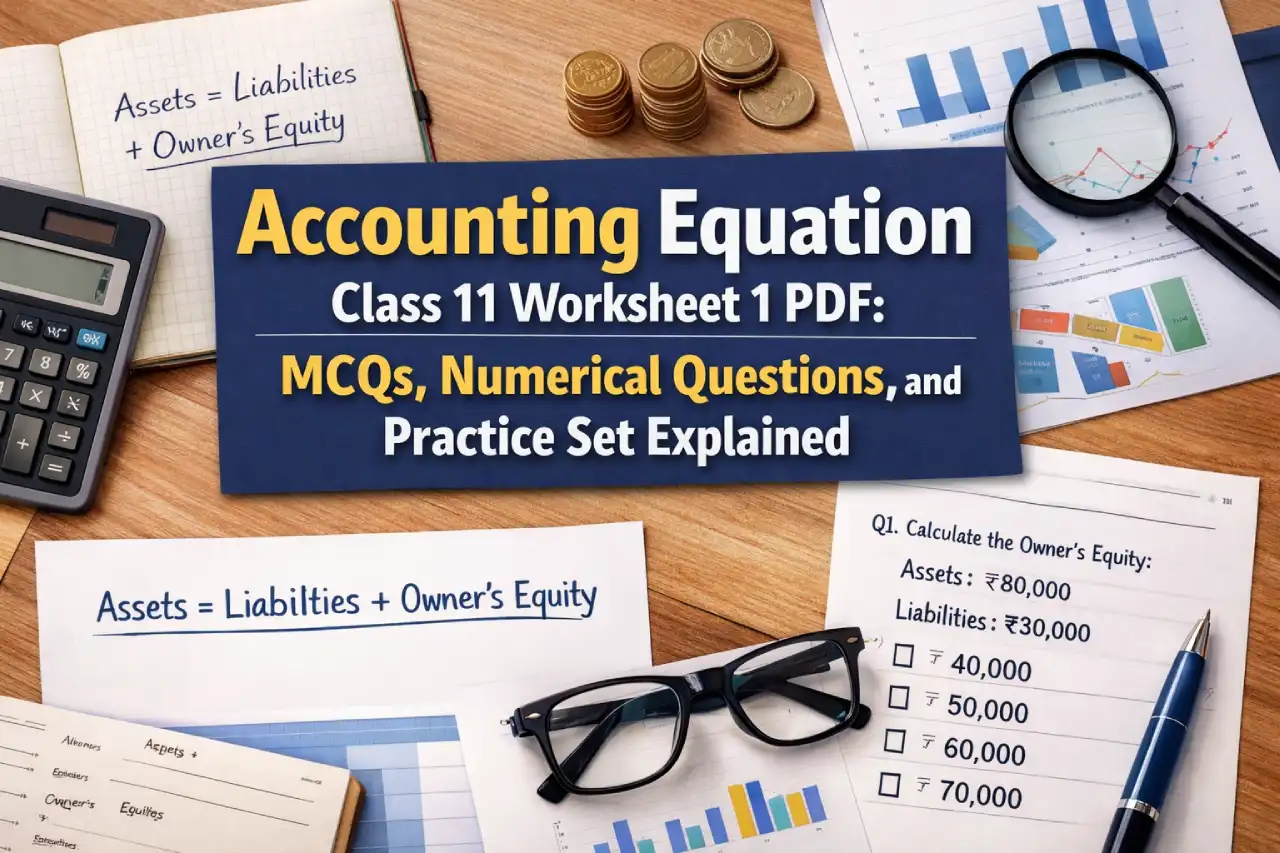
Accounting Equation is the foundation of the entire accounting system and one of the first topics taught in Class 11 Accountancy. The uploaded Accounting Equation WS 1 PDF is a comprehensive worksheet designed as a practice set for CBSE Class 11 students. It contains objective questions, match-the-column exercises, multiple-choice questions, conceptual questions, and numericals that test understanding of assets, liabilities, and capital and their inter-relationship.
I am writing about this worksheet because many students understand the formula of accounting equation but struggle when applying it to real transactions. This worksheet provides a wide variety of practice questions that help students learn how every business transaction affects assets, liabilities, and capital. By using this worksheet regularly, students can strengthen their fundamentals and become confident in solving accounting problems.
What This Accounting Equation Worksheet PDF Contains
The worksheet is organised into a series of short-answer and objective-type questions based entirely on the Accounting Equation concept.
It includes:
- Match the columns
- Multiple-choice questions
- One-mark conceptual questions
- Numerical problems based on assets, liabilities, and capital
- Transaction-based questions
All questions are aligned with the CBSE Class 11 syllabus.
Understanding the Accounting Equation
The worksheet repeatedly reinforces the fundamental accounting equation:
Assets = Liabilities + Capital
It also highlights that the accounting equation is known as the fundamental equation because it shows the equality between what a business owns and what it owes.
Several MCQs in the worksheet test this basic idea, such as identifying the correct components that remain equal in every situation.
Match the Columns Section
The first question in the worksheet is a match-the-columns exercise.
Examples include:
- Purchased goods for cash
- Capital brought in
- Paid rent
- Paid to creditors
Students have to match each transaction with its correct effect on assets, liabilities, and capital. This section helps in quickly revising the effect of common transactions.
Multiple Choice Questions
The worksheet contains many MCQs such as:
- A mathematical expression showing equality of assets and liabilities is known as accounting equation
- Salary is an expense for employer and income for employee
- Payment of expenses will decrease assets
- Capital increases if revenue increases
These MCQs test both theory and application.
Conceptual One-Mark Questions
Several short questions ask students to define or explain basic ideas, such as:
- What is accounting equation?
- What is owner’s equity?
- When is capital account debited?
- What is debit and credit?
These questions are useful for viva and board exam preparation.
Download this Accounting Equation WS 1 PDF File: Click Here
Transaction-Based Questions
A large portion of the worksheet focuses on analysing transactions and showing their effect on the accounting equation.
Examples include:
- If machinery is purchased for cash, indicate the effect on accounting equation
- If cash is received against services rendered, show the effect
- If payment is made to a creditor, explain how assets and liabilities change
- If proprietor withdraws cash for personal use, what happens to capital?
These questions build practical understanding.
Numerical Problems
The worksheet contains many numericals where students must calculate missing values using the accounting equation.
Examples include:
- Finding capital when total assets and liabilities are given
- Calculating creditors when assets and capital are known
- Finding total assets when capital and outside liabilities are given
These problems help students practise calculations step by step.
Profit and Capital Calculation Questions
Some questions involve finding closing capital and profit earned during the year using opening capital, assets, and liabilities.
This connects accounting equation with real business situations.
Why This Worksheet Is Useful
- Strengthens basic accounting concepts
- Improves transaction analysis skills
- Provides exam-oriented practice
- Covers objective and numerical questions
- Suitable for self-study