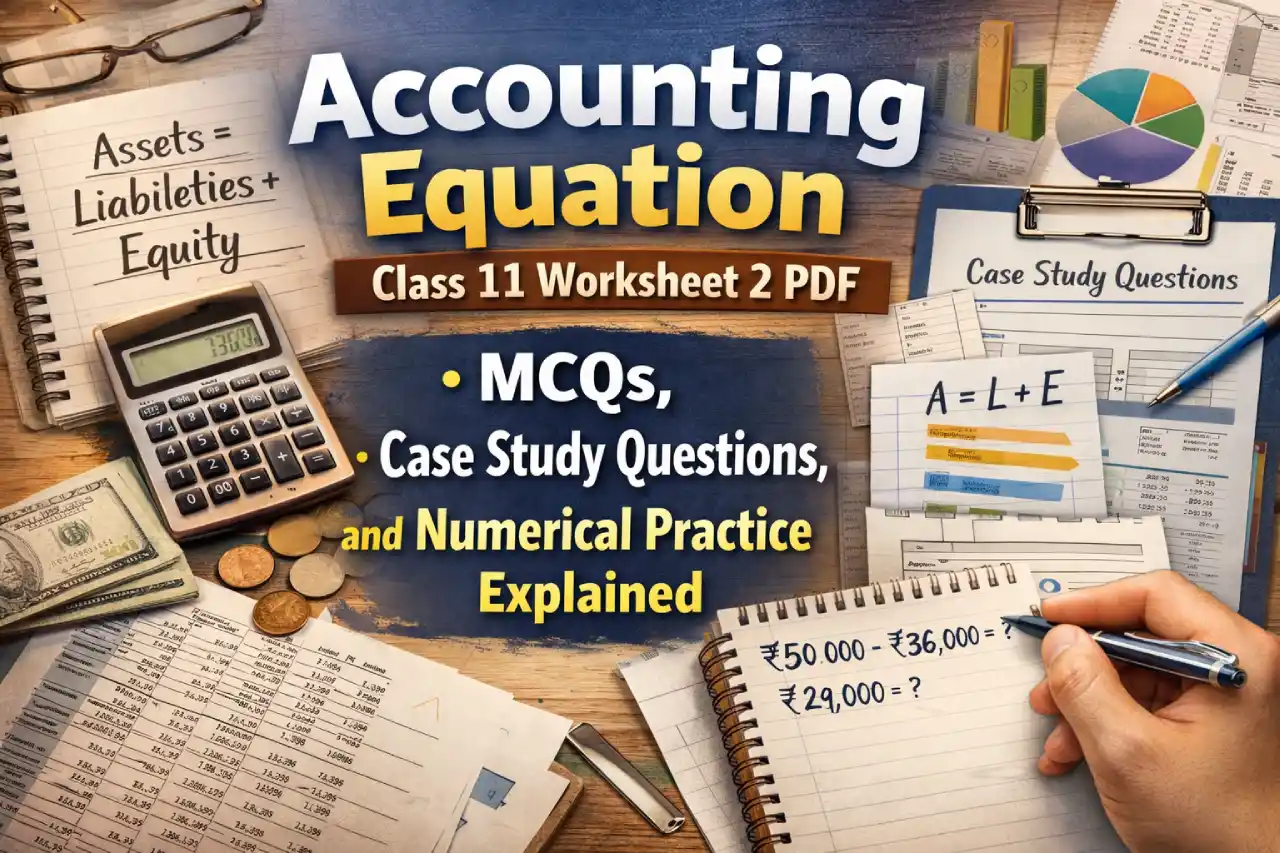
Accounting Equation is the backbone of financial accounting and a must-master topic for Class 11 students. The Accounting Equation WS 2 PDF is a comprehensive worksheet that focuses on strengthening students’ understanding of how every business transaction affects assets, liabilities, and capital. It includes a wide range of MCQs, numerical problems, case-study based questions, and conceptual items, all aligned with the CBSE Class 11 Accountancy syllabus.
I am writing about this worksheet because many students memorise the formula of accounting equation but struggle to apply it in real-life transaction scenarios. This worksheet pushes students to think analytically about each transaction and its dual effect. By practising with this PDF, students can develop strong fundamentals and gain confidence in handling accounting questions in exams.
What This Accounting Equation WS 2 PDF Contains
The worksheet is divided into multiple sections with objective and application-based questions.
It includes:
- Multiple-choice questions
- Transaction-based MCQs
- Numerical problems
- Case-study based questions
- Conceptual one-mark questions
These questions are designed to test both knowledge and application.
Core Concept Reinforced Throughout the Worksheet
The fundamental accounting equation used repeatedly is:
Assets = Liabilities + Capital
Students learn that this equation must remain balanced after every transaction. Many questions in the worksheet ask students to identify which side of the equation is affected and how.
Multiple Choice Questions (MCQs)
A large part of the worksheet consists of MCQs such as:
- Fresh capital introduction will increase both sides of equation by equal amount
- Accounting equation may be affected by cash purchases, credit purchases, cash receipts, and payments
- Collection of account receivable results in increase in one asset and decrease in another asset
- Payment to creditors in cash decreases an asset and decreases a liability
These MCQs help in quick revision of basic effects of transactions.
Transaction Analysis Questions
Several questions present real-life business situations and ask students to analyse the effect on the accounting equation.
Examples include:
- Purchase of machine by cash
- Repayment of loan with interest
- Owner withdrawing business assets for personal use
- Goods sold on credit at profit
Students must determine whether assets, liabilities, or capital increase or decrease.
Numerical Problems Based on Accounting Equation
The worksheet contains many numericals where students have to calculate missing values using the equation.
For example:
- Finding capital when assets and liabilities are given
- Finding assets when capital and liabilities are known
- Calculating owner’s equity from total assets and outside liabilities
These problems strengthen calculation skills.
Download this Accounting Equation WS 2 PDF File: Click Here
Profit, Loss, and Capital Adjustment Questions
Some questions require students to find profit or loss by comparing opening and closing capital after adjusting drawings and additional capital introduced.
This helps students understand the link between accounting equation and profit determination.
Case Study Based Questions
Towards the end, the worksheet includes case-study based questions describing real business situations such as:
- Pradhan Opticals dealing with credit sales, returns, and bad debts
- A bat manufacturing company purchasing land, returning goods, and receiving part payment
- A listed EV battery company receiving advances, delivering goods, and purchasing machinery
Students must apply accounting equation step by step to answer these questions.
Why This Worksheet Is Useful
- Builds strong foundation in accounting
- Improves transaction analysis skills
- Provides exam-oriented practice
- Covers objective, numerical, and case-study questions
- Suitable for self-study and revision