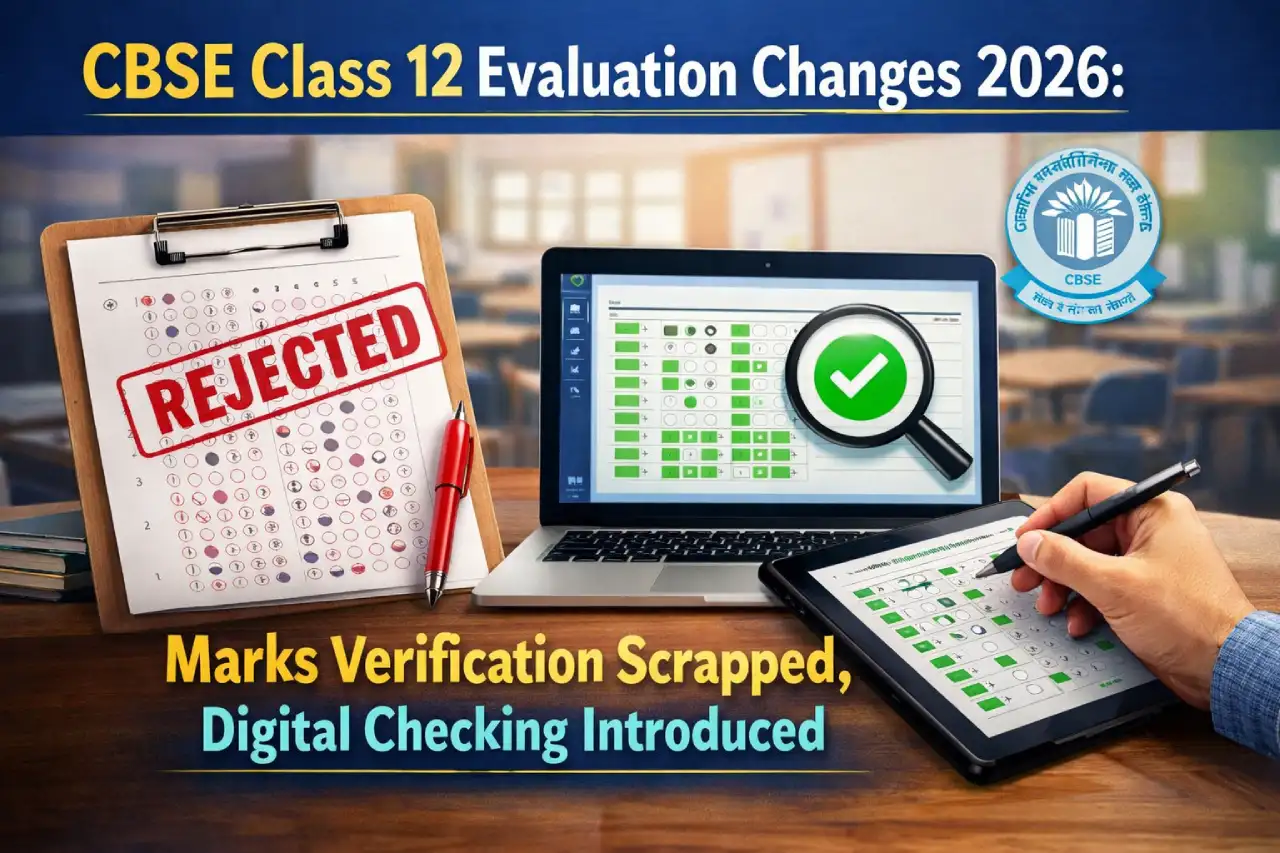
With nearly 46 lakh students preparing for the CBSE Class 10 and 12 board examinations, the Central Board of Secondary Education has announced major changes in its evaluation process. One of the most significant reforms is the discontinuation of marks verification for Class 12 answer sheets. At the same time, CBSE has confirmed that Class 12 answer scripts will now be assessed entirely through a digital evaluation system, a move aimed at improving accuracy, speed and transparency.
I am writing about this update because it directly affects how students will receive and review their results. For years, marks verification was one of the first steps students took after results were declared. With this option now removed for Class 12, it becomes important for students and parents to understand what has changed, why it has changed and how it may impact them.
Why CBSE Has Scrapped Marks Verification for Class 12
According to CBSE officials, the decision is linked to the shift towards complete digital evaluation of Class 12 answer scripts. Since answer sheets will be scanned and assessed on-screen, the chances of totaling mistakes or unchecked answers are expected to be extremely low.
In simple terms, CBSE believes that digital checking itself works as an in-built verification process.
What Is Digital Evaluation and How It Works
Under digital evaluation:
- Answer sheets are scanned after the exam
- Examiners check scanned copies on a secure digital platform
- Marks are entered directly into the system
- Automated checks reduce human errors
This system is designed to make evaluation faster and more consistent.
What Changes for Class 12 Students
For Class 12 students, this means:
- No separate marks verification option
- Faster declaration of results
- More uniform evaluation standards
However, students will still be able to apply for other post-result processes such as photocopy of answer sheet and re-evaluation, as per CBSE rules.
What About Class 10 Students
As of now, the scrapping of marks verification applies only to Class 12. Class 10 students may still have access to the existing post-result procedures, depending on CBSE’s official notification for that year.
Students are advised to check CBSE’s official circulars for exact details.
CBSE Warns Against Social Media Rumours
Alongside these reforms, CBSE has strongly cautioned students against believing rumours and fake claims circulating on social media platforms like YouTube and messaging apps.
The board has clarified that:
- There are no paper leaks
- Viral videos and messages about leaked papers are false
- Such rumours only increase stress and confusion
Students should rely only on official CBSE announcements.
Why CBSE Is Making These Changes
The main objectives behind the reforms are:
- Improve transparency in evaluation
- Reduce processing time
- Minimise human error
- Build trust in the assessment system
From my point of view, these steps show that CBSE is trying to modernise its processes in line with technology.
How Students Should Respond to This Change
Students should:
- Focus on exam preparation rather than rumours
- Write answers clearly and neatly
- Follow instructions on the question paper carefully
- Check only official CBSE websites and notices
There is no need to worry about the removal of marks verification.
Will This Affect College Admissions
For most students, this change will not affect college admissions. Universities mainly consider final marks and eligibility criteria. As long as results are accurate and timely, the admission process remains the same.
A Positive Step Towards Faster Results
Digital evaluation is expected to significantly reduce the time taken to declare results. This can help students plan admissions, entrance exams and future steps without long delays.