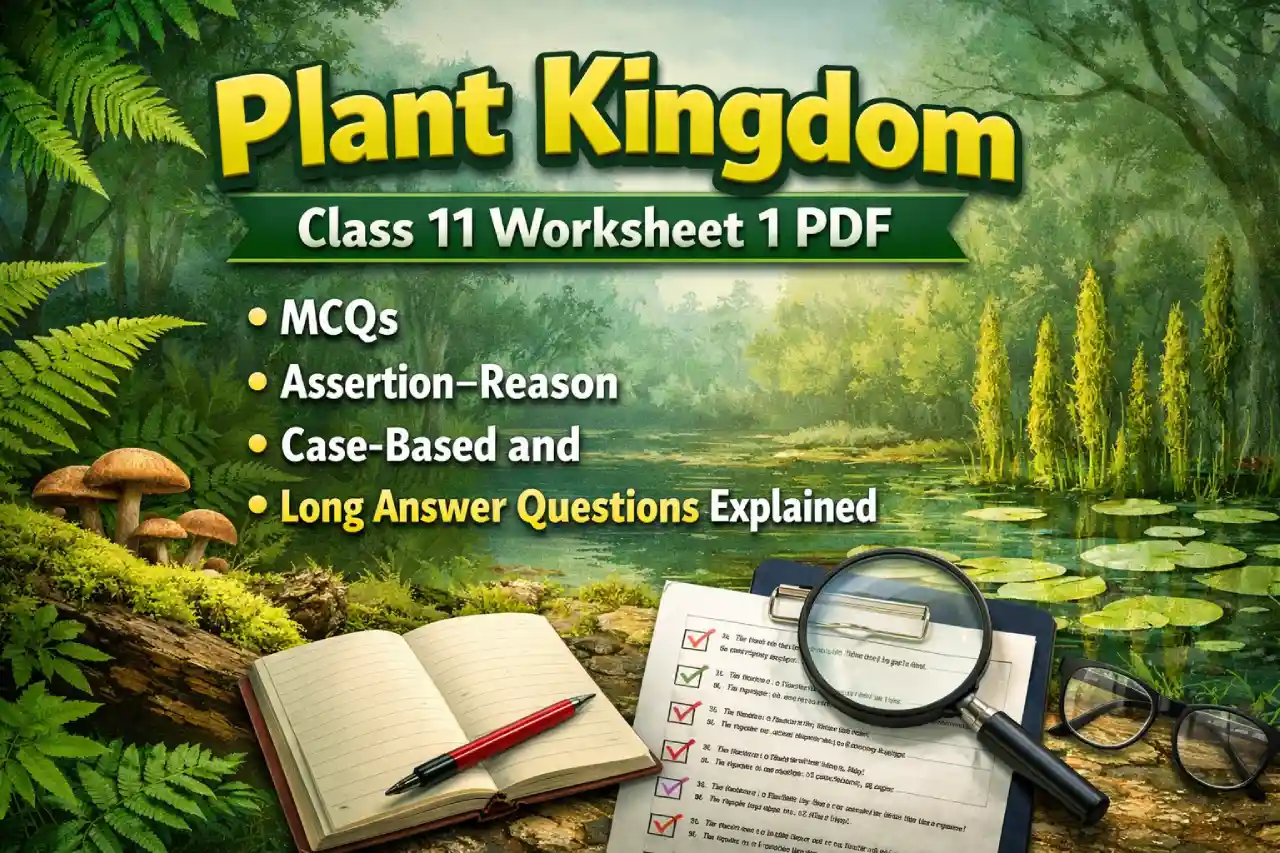
Plant Kingdom is one of the most important chapters in Class 11 Biology, as it introduces students to the diversity, classification, and life cycles of plants ranging from simple algae to advanced angiosperms. The uploaded Ch-3 Plant Kingdom WS 1 QUESTIONS PDF is a comprehensive worksheet that contains MCQs, assertion–reason questions, short answers, long answers, and case-based questions strictly based on the NCERT syllabus. It covers algae, bryophytes, pteridophytes, gymnosperms, and angiosperms in detail.
I am writing about this worksheet because Plant Kingdom is a concept-heavy chapter where students often get confused between characteristics of different plant groups. This worksheet provides a wide variety of exam-oriented questions that help in revising theory, strengthening concepts, and improving answer-writing skills. Understanding what this worksheet offers and how to use it effectively can make preparation more structured and result-oriented.
What This Plant Kingdom Worksheet PDF Contains
The worksheet is divided into multiple sections (A to E), each focusing on a specific type of question pattern.
It includes:
- Multiple-choice questions
- Assertion–Reason questions
- Very short answer questions
- Short answer questions
- Long answer and case-based questions
- Diagram-based questions
This ensures complete chapter-level practice.
Section A – MCQs on Algae and Lower Plants
Section A focuses mainly on algae, bryophytes, and basic plant characteristics.
Some important areas covered include:
- Holdfast, stipe, and frond as parts of brown algae plant body
- Types of sexual reproduction in algae such as isogamy, anisogamy, and oogamy
- Habitat and classification of algae
- Cyanobacteria classified under Monera
- Thallus nature of liverworts like Riccia
- Pteridophytes having vascular tissues, unlike mosses
These MCQs strengthen factual knowledge.
Assertion–Reason Questions
The worksheet includes assertion–reason questions on:
- Red snow formation by Chlamydomonas
- Brown algae (Phaeophyta) being highly evolved
- Food reserve variation in algae
- Oogamous reproduction in Phaeophyta
- Symbiotic association of Nostoc in Anthoceros
- Long-lived sporophyte of Anthoceros
- Carnivorous nature of Nepenthes khasiana
Students learn to analyse both statements and their relationship.
Section B – Image-Based and Application Questions
This section includes questions such as:
- Identification of algae from figures
- Symbiotic nature of lichen and survival of algal and fungal partners when separated
- Major producers in ocean ecosystem (phytoplankton)
These questions build application skills.
Section C – Short Answer Questions
This section tests understanding of:
- Pigments in Chlorophyceae
- Food reserve in Rhodophyceae and Phaeophyceae
- Protonema stage in moss
- Shape of liverwort plant body
- Cytotaxonomy
- Medicinal uses of algae
- Carbon fixation by algae
- Differences among Chlorophyceae, Phaeophyceae, and Rhodophyceae
- Why bryophytes are called amphibians of plant kingdom
These are frequently asked in exams.
Download this Ch-3 Plant kingdom WS 1 QUESTIONS PDF File: Click Here
Section D – Case-Based Questions on Bryophytes
The case study explains habitat, structure, and life cycle of bryophytes.
Questions based on this passage include:
- Structure of bryophyte plant body
- Nature of gametophyte and sporophyte
- Sex organs and their products
This helps in understanding alternation of generations.
Section E – Life Cycle and Reproduction
This section focuses on:
- Dominance of gametophyte in bryophytes
- Protonema stage in moss
- Requirement of water for fertilisation
- Haplontic, diplontic, and haplo-diplontic life cycles
Students learn how plant life cycles differ among groups.
Diagram-Based Questions
The worksheet asks students to draw labelled diagrams of:
- Male and female thallus of liverwort
- Gametophyte and sporophyte of Funaria
- Alternation of generations in angiosperms
These questions improve visual learning.
Why This Worksheet Is Useful
- Covers entire Plant Kingdom chapter
- Includes exam-oriented questions
- Improves conceptual clarity
- Strengthens answer-writing skills
- Useful for school and competitive exams