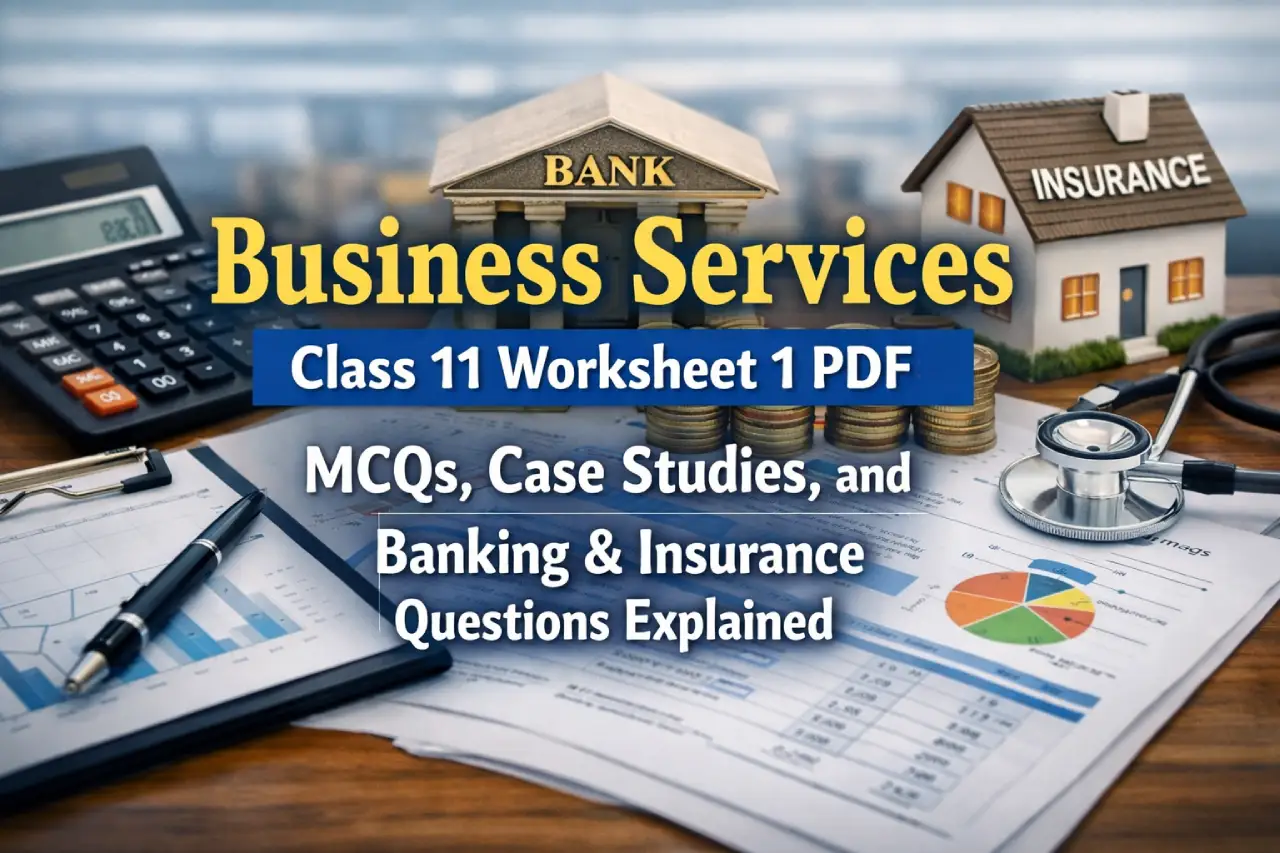
Business Services is one of the most scoring chapters in Class 11 Business Studies because it directly connects theory with real-life business practices. The uploaded Business Services WS 1 PDF is a well-structured worksheet that contains MCQs, case-study based questions, and application-oriented problems covering banking, insurance, warehousing, and modern banking services. It follows the CBSE syllabus closely and helps students practise different types of exam-oriented questions.
I am writing about this worksheet because many students understand definitions but struggle when concepts are tested through case studies and practical situations. This worksheet gives learners a chance to apply theoretical knowledge to real-life business scenarios. Knowing what this PDF contains and how to use it effectively can make preparation more organised and improve performance in Class 11 Business Studies.
What This Business Services WS 1 PDF Contains
The worksheet is divided into three main sections.
- Section A: Multiple-choice questions
- Section B: Case-study based questions on banking
- Section C: Case-study based questions on insurance, electronic banking, and plastic cards
This structure ensures both conceptual and application-based learning.
Section A – MCQs on Banking and Insurance
Section A includes objective questions covering a wide range of topics such as:
- Categories of banks (commercial banks, co-operative banks, specialised banks, central bank)
- Nature of services (intangibility, inseparability, involvement)
- Types of insurance (life, fire, marine, burglary, theft)
- Bank deposits (savings, fixed, recurring, current)
- Functions of banks
- Principles of insurance (indemnity, utmost good faith, contribution, subrogation, mitigation)
These MCQs help in quick revision of key concepts.
Banking Functions Covered in the Worksheet
The PDF highlights both primary and secondary functions of banks.
Primary functions include:
- Accepting deposits
- Advancing loans
Secondary functions include:
- Overdraft facility
- Electronic fund transfer
- Issuing cheques and drafts
- Agency and utility services
Students learn that bankers are often called manufacturers of money because they create credit.
Types of Bank Accounts Explained
The worksheet covers:
- Savings Account
- Current Account
- Fixed Deposit Account
- Recurring Deposit Account
- Multiple Option Deposit Account (MODA)
MODA is explained as an account where excess balance from savings is automatically transferred to fixed deposit while allowing withdrawals.
Download this Business Services WS 1 PDF File: Click Here
Case Study on Banking Services (Section B)
This case focuses on Ruksar, who opens a fashion designing centre and deposits her money in a bank.
Key concepts tested include:
- MODA account
- Overdraft facility
- Internet banking (e-banking)
- Comparison between savings and fixed deposit interest rates
This case helps students understand practical usage of bank accounts.
Insurance Concepts in Section C
Another case study is based on Sujeet, who insures his factory with two insurance companies.
Concepts tested include:
- Double insurance
- Principle of indemnity
- Principle of mitigation
- Principle of utmost good faith
- Principle of contribution
Students learn why claims may be rejected if fundamental principles are violated.
Electronic Fund Transfer Systems
The worksheet discusses systems like:
- RTGS (Real-Time Gross Settlement)
- NEFT (National Electronic Funds Transfer)
RTGS is explained as a system for high-value transactions with immediate transfer.
Plastic Cards and Digital Payments
Case studies explain:
- Debit card
- Credit card
- ATM card
- Metro card
- Advantages such as security, convenience, and faster transactions
These topics connect business services with digitalisation.
Why This Worksheet Is Useful
- Covers full chapter comprehensively
- Includes exam-oriented questions
- Improves application skills
- Strengthens conceptual clarity
- Useful for revision