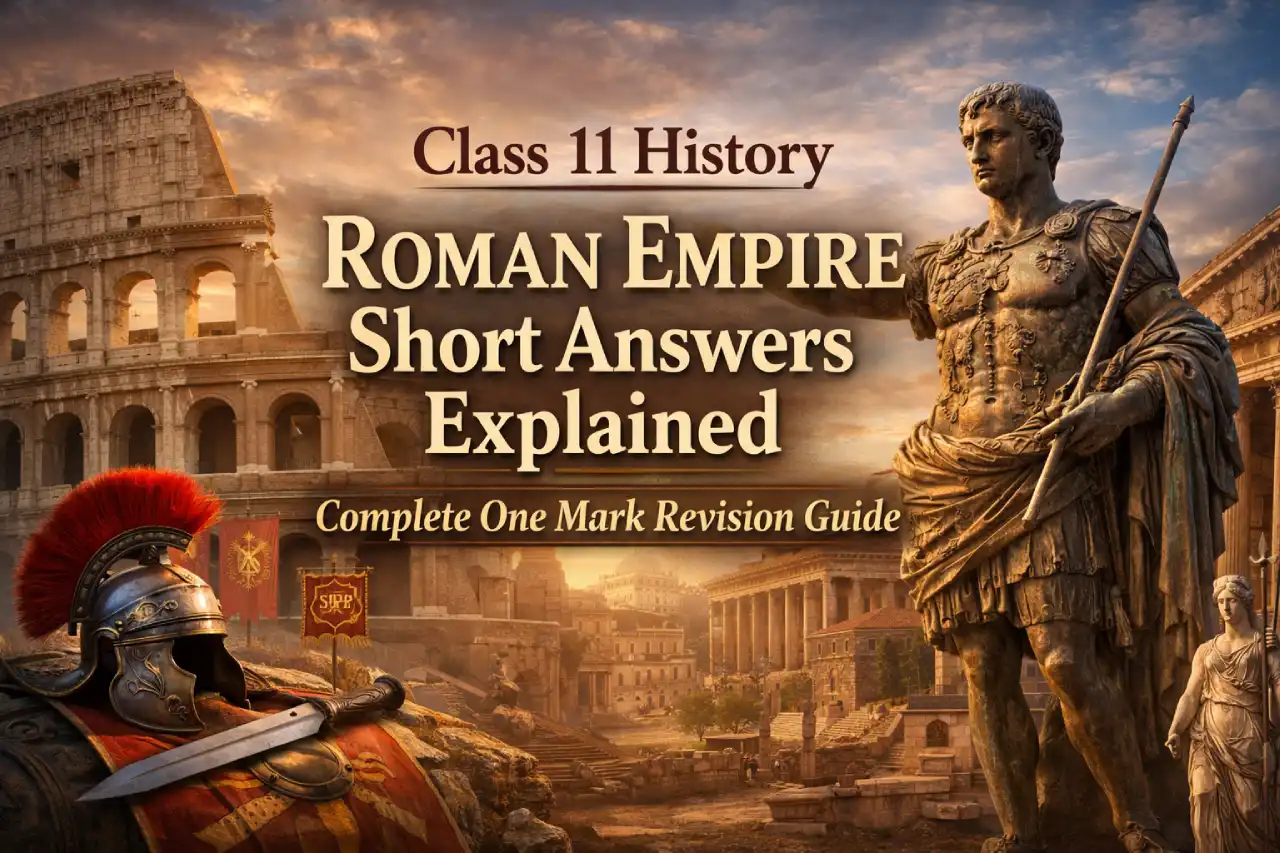
The Class 11 History chapter on the Roman Empire gives a detailed understanding of how a vast political system functioned across three continents. The material analysed here consists of short-answer and one-mark solutions that cover almost every important concept of the chapter. From Frankincense, Polytheism and Principate to Diocletian’s reforms, slavery, army structure and Late Antiquity, these answers help students revise the entire chapter in a crisp and focused way.
I am writing about this because students often ignore one-mark questions while preparing for History exams. They focus only on long answers and then lose simple marks in short sections. In my experience, if you can confidently answer direct factual questions, it means your basics are clear. This structured question set forces students to revise key terms, personalities and developments properly. That is why it becomes extremely useful during final revision.
Political Structure and the Principate
One of the most important developments in Roman history was the establishment of the Principate in 27 BCE. This was the system introduced by Augustus where he ruled as “first citizen” while keeping the outward structure of the Republic intact.
The three most important players in Roman political life were:
- The Emperor
- The Senate
- The Army
The Senate was composed mainly of wealthy landowners and office holders. The army was a paid professional force, and soldiers had to serve for a minimum of 25 years. Over time, the army gained enough power to influence the fate of emperors.
Boundaries and Geographical Spread
The Roman Empire stretched across three continents:
- Europe
- Asia
- North Africa
The northern boundary was formed by the rivers Rhine and Danube, while the Sahara Desert formed the southern boundary. A narrow strip of land along the Euphrates separated Rome from the Iranian Empire.
The Mediterranean Sea was considered the heart of the empire because it connected regions like Spain, Italy, North Africa and Syria.
Administration and Reforms
The Roman Empire is divided into two major phases:
- Early Empire
- Late Empire (Late Antiquity)
Diocletian introduced important reforms during the late period. He fortified frontiers, reorganised provinces, separated civilian and military functions and abandoned territories that had little strategic or economic value.
Later, Constantine introduced the solidus, a gold coin that became a stable part of the monetary system. These reforms were attempts to strengthen the empire during times of crisis.
Economy and Trade
The Roman economy had a strong infrastructure including harbours, mines, olive oil factories and quarries. Wheat, wine and olive oil were traded in huge quantities.
Sicily and Byzacium exported large quantities of wheat to Rome. Spanish olive oil was transported in containers known as Dressel 20, which became widely circulated in Mediterranean markets.
Frankincense, an aromatic resin used in incense and perfumes, was tapped from Boswellia trees. It was an important trade item.
The prosperity of different regions depended on how effectively they organised production and transport of goods.
Download this An Empire Three Continents WS 2 PDF File: Click Here
Social Classes and Slavery
Roman society was divided into:
- Patricians (aristocratic class)
- Plebeians (common people)
- Knights
- Slaves
Patricians were wealthy landowners and powerful members of the Senate. Plebeians were common citizens who often faced heavy taxation.
Slavery was deeply embedded in Roman society. Slave-breeding referred to encouraging slaves to have children so that the labour force could expand. Slaves were treated as property, and harsh punishments were common.
However, free labour was sometimes preferred because slaves had to be maintained throughout the year, making them expensive.
Religion and Cultural Changes
Roman religious culture was originally polytheistic. People worshipped multiple gods and built thousands of temples and shrines.
Major religious changes occurred during Late Antiquity:
- Christianity became the official religion in the fourth century.
- Islam rose in the seventh century.
These religious transformations reshaped Roman society and administration.
Literacy and Sources of History
Literacy levels varied across the empire. Soldiers, estate managers and officials were more likely to be literate.
Roman history is known through three main types of sources:
- Textual sources (histories and annals)
- Documentary sources (inscriptions and papyri)
- Material remains
These sources help historians understand political, economic and social life.
External Threats and Crisis
In the third century, the Roman Empire faced invasions from the Sasanians of Iran and Germanic tribes such as the Alamanni, Franks and Goths. Repeated invasions between 233 and 280 created instability.
Germanic groups later established post-Roman kingdoms in regions like Spain, Gaul and Italy. This marked the fragmentation of the western empire.
Social Life and Family Structure
Marriage in Roman society was generally arranged, and women were expected to obey their husbands. However, women retained rights over their natal family property in certain cases.
The father held strong legal authority over children. Urban life offered better facilities during famine compared to rural areas. During famine, city dwellers stored grain after harvest to survive harsh seasons.
Concept of Late Antiquity
Late Antiquity refers to the period of great crisis and transformation from the fourth to the seventh century. Emperors like Diocletian and Constantine tried to control decay and restore stability.
This period marked the transition from the classical Roman world to the early medieval world.