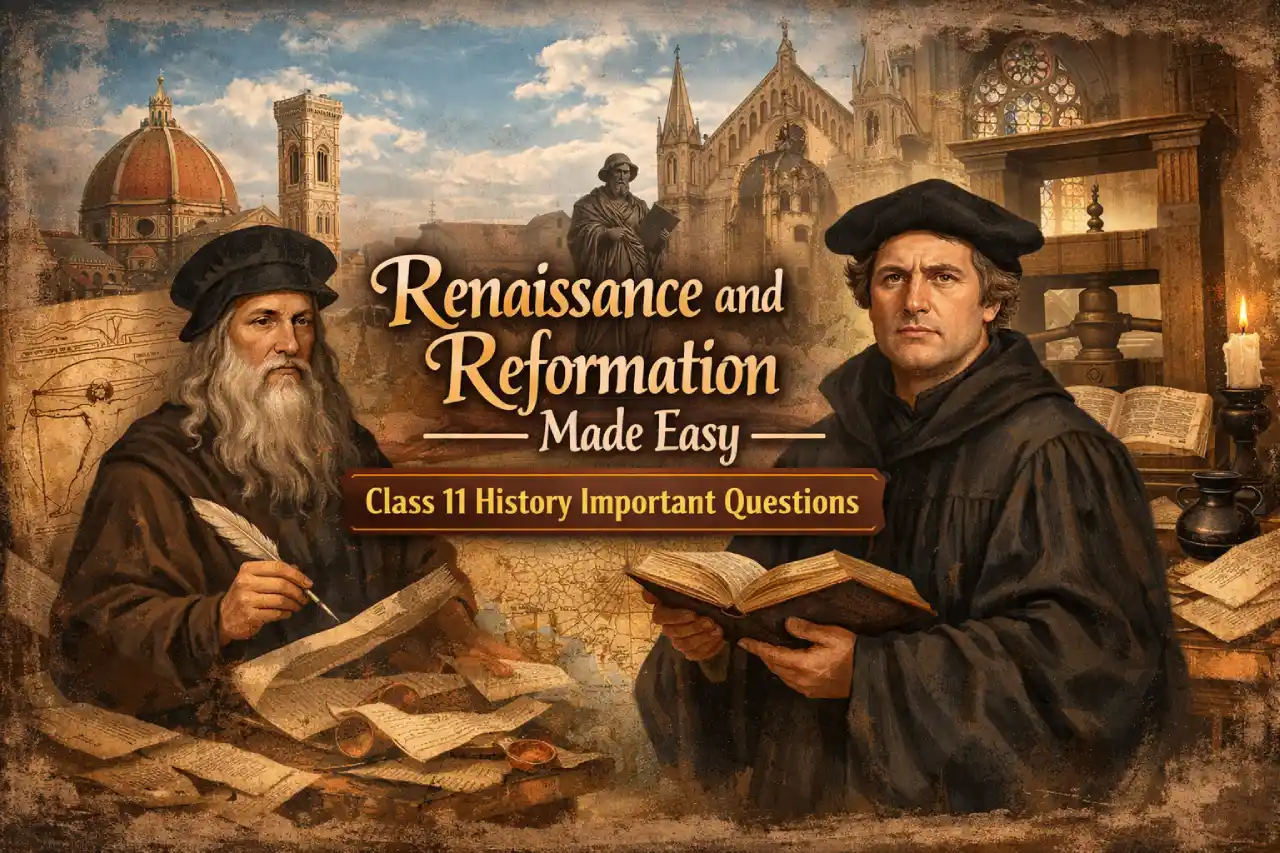
The Class 11 History chapter on changing cultural traditions focuses on the Renaissance, Humanism, scientific developments and the Protestant Reformation in Europe. The material analysed here includes multiple-choice questions, match-the-following, chronological ordering and source-based questions covering personalities like Leonardo da Vinci, Michelangelo, Martin Luther, Erasmus, Copernicus and Machiavelli. It also explores printing, town culture, universities, art innovations and the shift from medieval to modern thinking.
I am writing about this because this chapter is concept-heavy and full of names, dates and intellectual movements. Many students memorise facts but fail to connect how Humanism, science and religion transformed Europe. A structured worksheet like this actually helps in systematic revision. When you practise chronology, matching exercises and source-based questions together, the chapter becomes clearer and far more interesting. In my view, this is one of the most scoring and thought-provoking parts of Class 11 History.
Rise of Renaissance and Humanism
The literal meaning of Renaissance is “rebirth.” Historians generally trace its beginning to the 14th century. It originated in Italy and gradually spread across Europe.
Important Italian cities like Florence, Venice, Rome, Genoa, Padua and Mantua emerged as centres of art and learning. Earlier European universities were also established in Italian cities, which became hubs of intellectual growth.
Humanism was at the heart of the Renaissance. Humanists believed in:
- Studying classical Greek and Roman texts
- Focusing on human potential and dignity
- Encouraging debate and critical thinking
Francesco Petrarch is often regarded as the Father of Humanism. Giovanni Pico della Mirandola wrote On the Dignity of Man and emphasised the importance of debate in strengthening the mind.
Renaissance Art and Cultural Transformation
Art played a powerful role in spreading Renaissance ideas. Artists studied ancient Roman sculptures and revived the tradition of realistic representation.
Major developments in art included:
- Use of geometry to understand perspective
- Study of light and shadow for three-dimensional effect
- Use of oil paints for richer colour
Leonardo da Vinci painted Mona Lisa and The Last Supper. He was known as a Renaissance Man because he had many interests and skills, ranging from anatomy and botany to mathematics and engineering. He even designed a flying machine after studying birds.
Michelangelo was a sculptor, painter and architect. His works show the revival of classical human form.
Donatello broke new ground with life-like statues in the early 15th century.
Invention of Printing and Spread of Knowledge
The invention of the printing press by Johannes Gutenberg in 1455 changed European history. Printed books became the main source of knowledge from the 14th century onwards.
The printing press helped:
- Spread Humanist ideas
- Circulate scientific theories
- Support religious reform movements
Without printing, the Renaissance and Reformation would not have expanded so rapidly.
Download this Changing Cultural Traditions WS 1 PDF File: Click Here
Scientific Revolution and New Thinking
The Renaissance also encouraged questioning of old beliefs. Copernicus proposed that the earth revolves around the sun in his work De revolutionibus. He feared opposition from traditional Church authorities and delayed publication.
Later scientists strengthened this theory:
- Johannes Kepler explained planetary motion in ellipses
- Galileo Galilei supported heliocentric theory in The Motion
- Isaac Newton developed the theory of gravitation
These developments bridged the gap between heaven and earth and changed the scientific understanding of the universe.
Protestant Reformation and Religious Change
The Protestant Reformation began when Martin Luther wrote the Ninety-Five Theses. He argued that people did not need priests to reach God and that faith alone could guide them.
His ideas were popularised in Switzerland by Ulrich Zwingli and later by Jean Calvin.
William Tyndale translated the Bible into English to ensure that common people could read scripture in their mother tongue. Protestants criticised the Catholic Church for corruption, sale of indulgences and misuse of authority.
Radical reformers like the Anabaptists connected religious reform with social equality. They believed that since God created all humans equal, social oppression should end.
The Anglican Church was later established in England, showing how religious change reshaped European politics.
Political Thought and Machiavelli
Niccolo Machiavelli wrote The Prince in 1513. He discussed human nature realistically and believed that self-interest motivates most human actions.
He argued that rulers must be practical rather than idealistic. His ideas were bold and different from traditional religious political theory.
Decline of Feudalism and Beginning of Modern Age
The modern age began with the decline of the feudal system. Town culture expanded from the 12th to 15th centuries. Trade increased and merchants gained power.
Chronological events such as:
- Gutenberg printing the Bible
- Columbus reaching America
- Luther’s Theses
- Publication of Utopia by Thomas More
- Introduction of the Gregorian calendar
show how Europe moved from medieval traditions to modern institutions.
Renaissance Man and New Individualism
The term Renaissance Man refers to a person who had multiple talents and interests. Leonardo da Vinci is the best example.
Humanists believed that education should develop a well-rounded individual skilled in arts, science, philosophy and debate.
This shift in thinking placed human capability at the centre rather than blind faith.