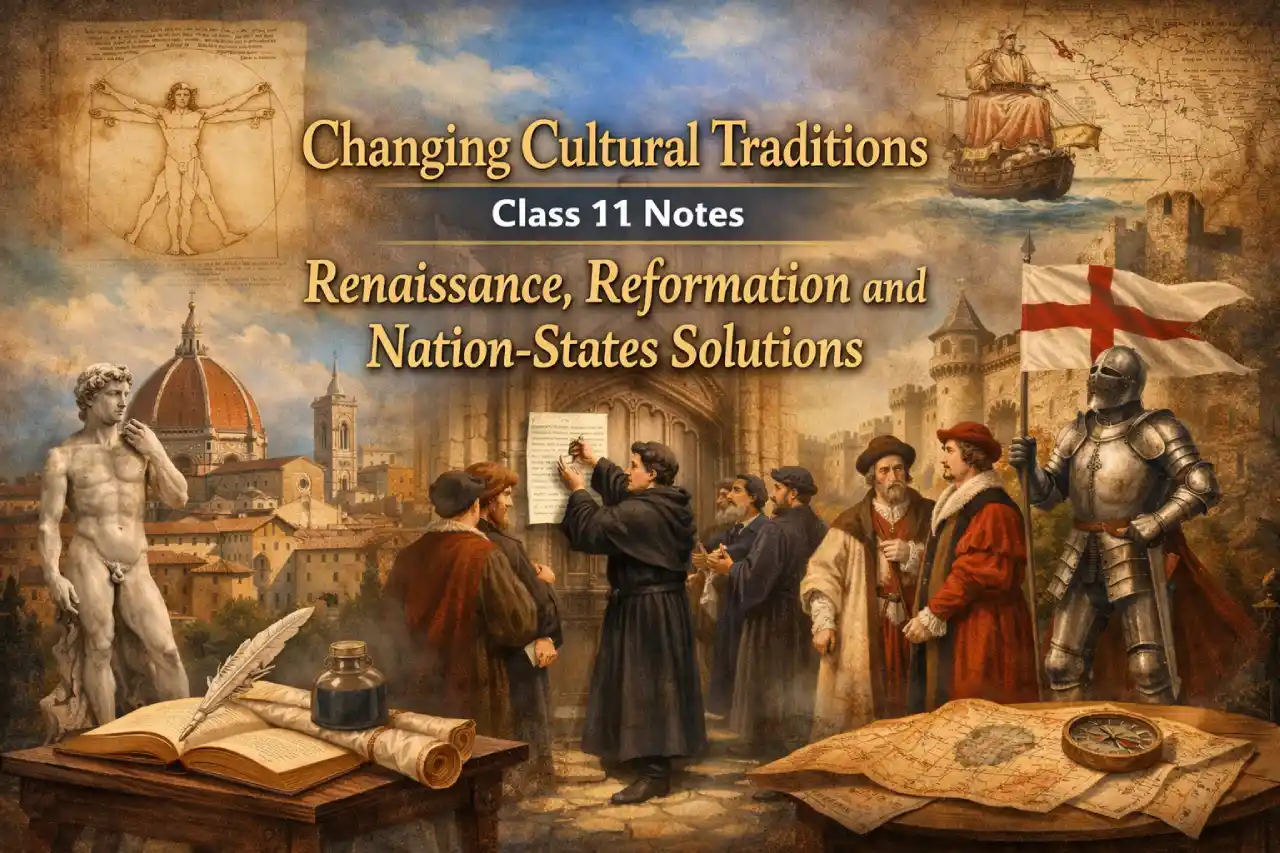
The Class 11 History chapter on Changing Cultural Traditions explains how Europe moved from the medieval world to the modern age. The worksheet analysed here presents detailed short-answer solutions covering Renaissance, Humanism, Mercantilism, Reformation, scientific discoveries and the rise of nation-states. It discusses key personalities like Ibn Rushd, Petrarch, Leonardo da Vinci, Michelangelo, Martin Luther, Galileo and Machiavelli. Together, these ideas show how art, religion, politics and economy were transformed between the 14th and 17th centuries.
I am writing about this because students often focus only on long answers and ignore short conceptual questions. But this chapter is built on clear definitions and strong understanding of ideas like humanism, realism, indulgences, nation-states and mercantilism. In my experience, when these basics are clear, the entire chapter becomes logical and easy to revise. This topic is not just about Europe’s past; it explains how modern political systems, science and cultural values were shaped.
Renaissance and the Revival of Classical Learning
The word Renaissance means “rebirth.” It refers to the revival of classical Greek and Roman culture that began in Italy during the 14th century. Italian cities like Venice and Genoa were different from other parts of Europe because feudal lords and clergy were less powerful there. Instead, wealthy merchants and bankers participated in governance, which encouraged the idea of citizenship.
Trade and commerce made these cities prosperous. As wealth increased, patronage of art and learning also expanded. This economic growth laid the foundation for cultural transformation.
The Renaissance marked the decline of feudalism and the rise of towns, middle classes and new political values.
Humanism and New Thinking
Humanism was a philosophy of life that stressed the importance of man and his sentiments rather than religious authority. Humanists believed that worldly problems should be solved before focusing on heaven or divine matters.
Key features of humanist thought included:
- Dignity and freedom of the individual
- Close reading of Greek and Roman texts
- Encouragement of debate and reasoning
- Reduced control of religion over daily life
Petrarch is regarded as the Father of Humanism. Writers like Dante, Erasmus and Thomas More also contributed significantly to this intellectual awakening.
Humanists even challenged Church authority. They questioned the authenticity of the ‘Donation of Constantine’ and argued that it was forged, which weakened the Church’s political claims.
Renaissance Art and Realism
Realism gave a new direction to Italian art. Artists studied anatomy, geometry and physics to represent life more accurately.
Leonardo da Vinci was a multi-talented genius — painter, scientist, engineer and philosopher. His famous paintings Mona Lisa and The Last Supper are admired worldwide.
Michelangelo Buonarroti contributed through masterpieces like The Pieta, The Fall of Man and The Last Judgement. He also designed the dome of St. Peter’s Church.
Raphael’s painting Madonna reflected harmony and beauty.
According to Alberti, an architect should combine technical skill and artistic beauty to create structures that serve human needs.
Download this Changing Cultural Traditions WS 2 PDF File: Click Here
Printing Press and Spread of Ideas
Johannes Gutenberg is credited with inventing the printing press in the mid-15th century. The first printed book in Europe was the Bible.
Before printing, students depended on hand-written manuscripts, which were rare and expensive. With printing:
- Books became easily available
- Knowledge spread rapidly
- Renaissance ideas reached common people
This invention accelerated intellectual and religious change across Europe.
Scientific Developments and New Discoveries
Medieval Christians believed that the earth was at the centre of the universe. Copernicus challenged this belief and declared that the earth revolves around the sun.
Johannes Kepler demonstrated that planets move in elliptical paths. Galileo emphasised observation and experiment, separating knowledge from blind belief.
Andreas Vesalius dissected the human body and laid the foundation of modern physiology.
These discoveries replaced superstition with scientific reasoning.
Protestant Reformation and Religious Reform
Martin Luther led the Protestant Reformation in Germany. He opposed corruption in the Catholic Church and criticised the sale of indulgences, which were documents promising forgiveness of sins in exchange for money.
Luther believed:
- Faith alone leads to salvation
- Priests are not necessary intermediaries
- Every individual can directly connect with God
The Reformation divided Christianity into Catholic and Protestant branches. It also led to religious conflicts and encouraged the rise of nation-states.
The Counter-Reformation was the Catholic Church’s attempt to reform itself and regain authority.
Rise of Nation-States
Nation-states emerged due to:
- Decline of feudalism
- Growth of trade
- Rise of middle class
- Invention of printing press
- Use of gunpowder
Nation-states were governed by strong rulers, had common language and uniform laws, and remained free from foreign interference.
They contributed to economic growth, constitutional governance and national unity.
Mercantilism and Economic Growth
Mercantilism was an economic theory that measured a country’s wealth by the amount of gold and precious metals it possessed. It encouraged maximum exports and minimum imports to maintain favourable balance of trade.
The growth of trade led to:
- Economic prosperity
- Discovery of new lands
- Beginning of colonial expansion
- Rise of industrial capitalism
Economic development supported cultural and political transformation.
Status of Women and Society
In merchant families, women sometimes played supportive roles in business. They managed shops in the absence of male members and handled financial responsibilities when necessary.
However, despite some progress, women’s public participation remained limited.
Political Thought and Machiavelli
Machiavelli stated that human desires are insatiable and self-interest motivates human actions. His political ideas separated morality from governance and introduced realism in politics.
Despotism referred to arbitrary rule where the ruler’s will was supreme.
These political ideas reflected the changing mindset of Renaissance Europe.