Alternating current is an important concept in Class 12 Physics, especially when studying how electric circuits behave under changing voltage. One important situation discussed in this topic is when alternating voltage is applied to a pure resistor. In such a case, the current in the circuit follows the same pattern as the voltage and changes continuously with time. Students learn about peak value, RMS value, instantaneous current and heating effects of AC while analysing these circuits.
I am writing about this topic because many students find alternating current difficult when they first encounter it. The formulas are simple, but understanding what they actually mean in real electrical circuits requires practice. When students clearly understand how AC behaves in a resistive circuit, many other concepts in electricity become easier to grasp. This topic also connects directly to everyday electrical appliances used in homes.
What is Alternating Current?
Alternating current (AC) is a type of electric current whose magnitude and direction change periodically with time. Unlike direct current (DC), which flows only in one direction, AC reverses its direction many times in a second.
The instantaneous value of alternating current can be expressed as:
i = I₀ sin(ωt)
Where:
- I₀ represents the peak current
- ω represents angular frequency
- t represents time
This sinusoidal nature of alternating current is the foundation for understanding AC circuits.
Domestic Electrical Supply
In India, domestic electricity supply is provided in the form of alternating current.
The standard values are:
| Quantity | Value |
|---|---|
| Voltage | 220 V |
| Frequency | 50 Hz |
This means that the current changes direction 50 times every second. The frequency of AC plays an important role in determining how electrical devices operate.
AC Applied to a Pure Resistor
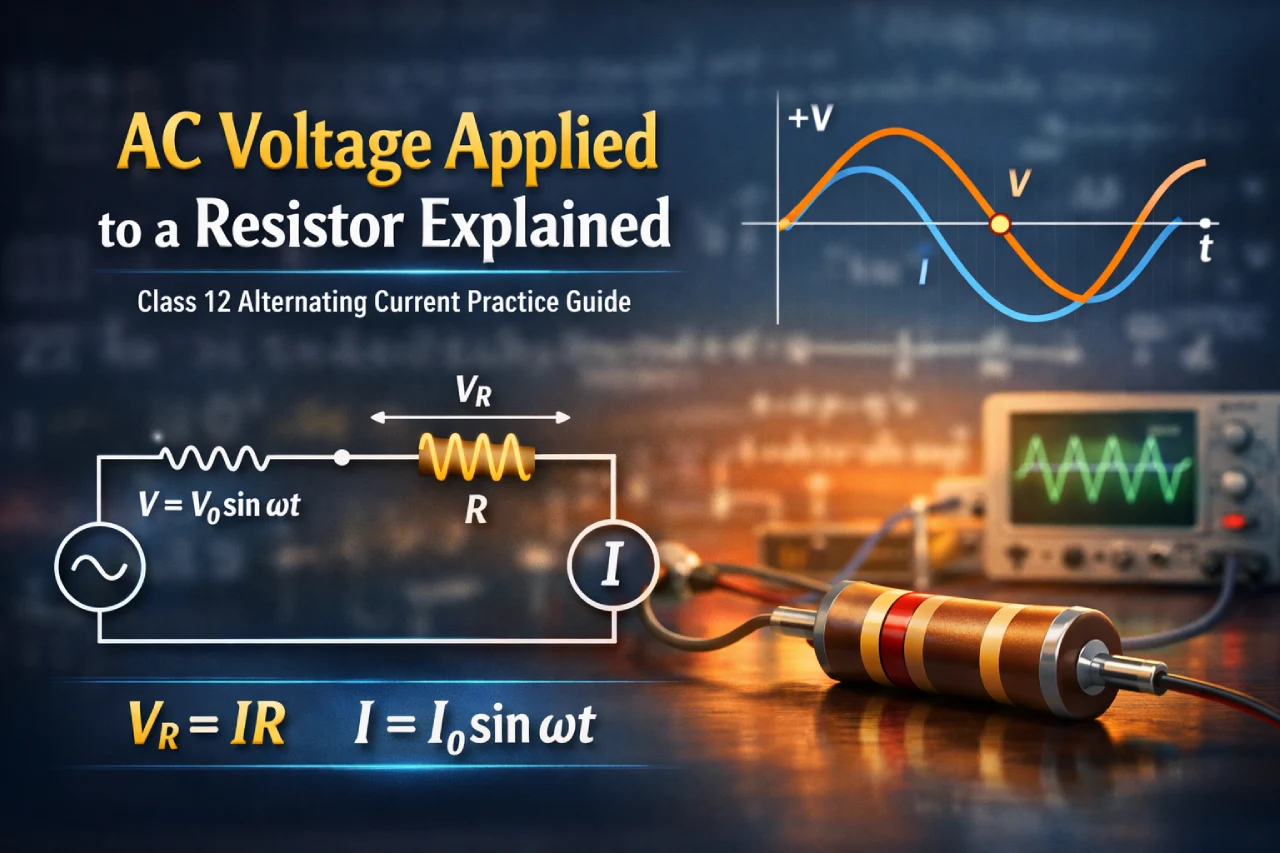
When an alternating voltage is applied across a pure resistor, the relationship between current and voltage follows Ohm’s law.
Important characteristics include:
- Voltage and current are in phase
- Both reach their maximum and minimum values at the same time
- Electrical energy is converted into heat in the resistor
The instantaneous current is given by:
i = (V₀ / R) sin(ωt)
Where:
- V₀ is the peak voltage
- R is resistance
This shows that current varies sinusoidally in the same way as voltage.
RMS Value of AC
The root mean square (RMS) value is used to measure the effective value of alternating current.
The RMS value is defined as the value of direct current that produces the same heating effect in a resistor as the alternating current.
Formulas include:
Irms = I₀ / √2
Vrms = V₀ / √2
This is why electrical appliances are rated using RMS voltage rather than peak voltage.
Download this Alternating Current WS 1 (Ac Voltage Applied To A Resistor) PDF File: Click Here
Average Value of Alternating Current
The average value of alternating current over a complete cycle is zero.
This happens because:
- The positive half-cycle produces positive current
- The negative half-cycle produces equal negative current
When averaged over a full cycle, these values cancel each other.
However, the average value over a half cycle is not zero and is often used in calculations.
Heating Effect of AC Current
When alternating current passes through a resistor, electrical energy is converted into heat.
The heating effect depends on the RMS value of current, not the peak value.
For example, if a bulb is rated at 100 W and 220 V, we can determine:
- Resistance of the bulb
- Current flowing through it
This concept helps in understanding how electrical appliances consume power.
Frequency and Instantaneous Voltage
Alternating voltage can also be represented using mathematical equations.
For example:
V = V₀ sin(ωt)
From such equations, students can determine:
- Peak voltage
- Frequency of supply
- RMS current in a circuit
Understanding these relationships helps in solving numerical problems related to AC circuits.
AC vs DC
It is also important to distinguish between alternating current and direct current.
| Feature | Alternating Current | Direct Current |
|---|---|---|
| Direction | Changes periodically | Constant direction |
| Source | Power stations | Batteries |
| Frequency | Usually 50 or 60 Hz | Zero |
Alternating current is preferred for large-scale power transmission because it can be easily transformed to different voltage levels.