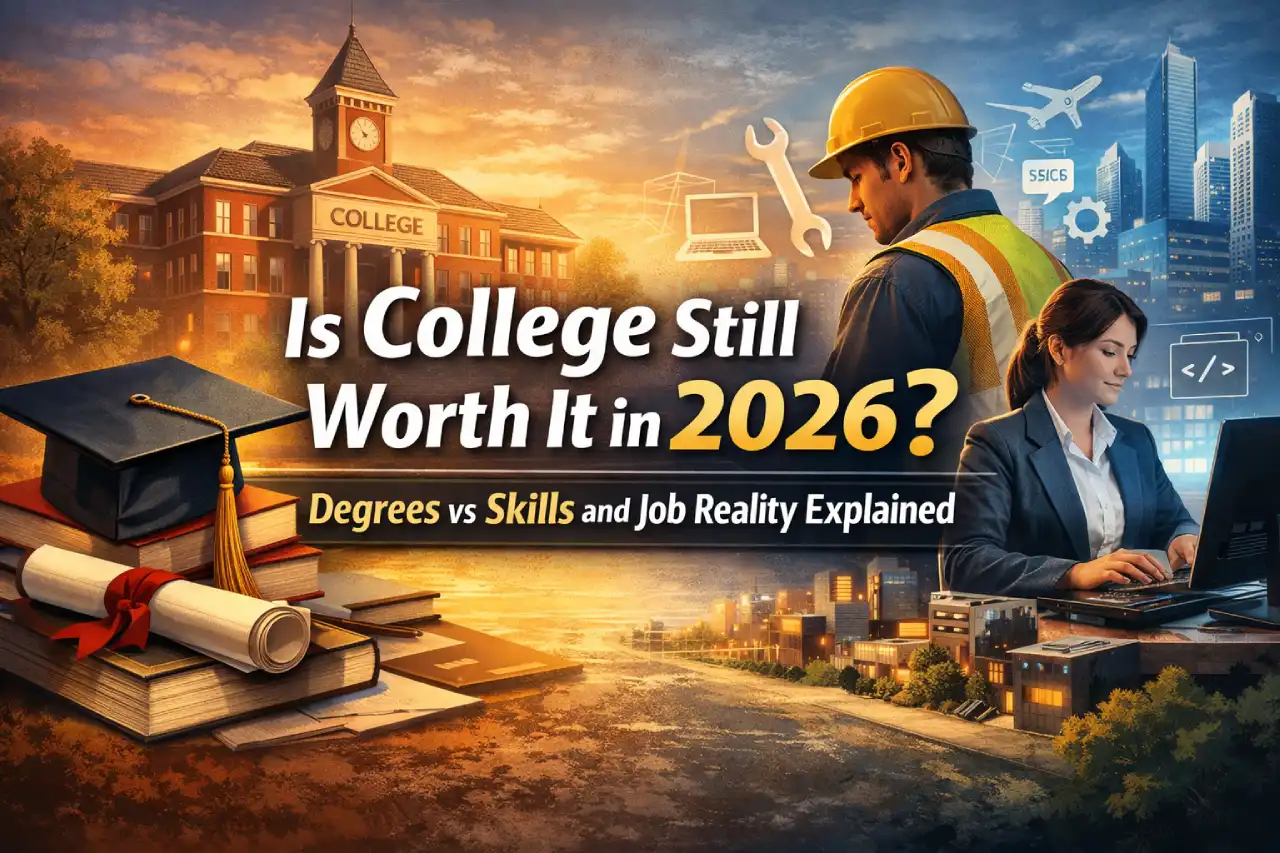
For decades, students in India have grown up believing in a simple formula—study well, get a college degree, and a secure job will follow. This idea became deeply rooted, especially after economic liberalisation, when education was seen as the safest path to success. But today, that belief is being questioned more than ever. With rising unemployment among graduates and changing job market demands, many are asking a serious question: is a college degree still enough?
I am writing about this because this is not just a debate—it’s a reality that millions of students are facing right now. Many young people complete their degrees with hope, only to struggle to find suitable jobs. At the same time, new career paths are emerging that don’t always require traditional degrees. Understanding this shift is important so that students can make smarter decisions about their future, rather than blindly following outdated expectations.
The Changing Reality of Degrees and Jobs
The situation today is very different from what it was a few decades ago. Earlier, a college degree was rare and highly valued. Now, degrees have become common, but quality job opportunities have not increased at the same pace.
According to recent studies, a large percentage of unemployed youth in India are actually graduates. This clearly shows that having a degree alone is no longer a guarantee of employment.
In simple terms, more people are educated, but there are not enough suitable jobs for everyone.
Why Degrees Are Losing Their Value
There are a few key reasons why a degree is not as powerful as it used to be.
Too Many Graduates, Fewer Jobs
Over the years, the number of colleges and universities has increased rapidly. While this has improved access to education, it has also created intense competition.
- More students are graduating every year
- Job creation is not keeping up
- Employers now have too many similar candidates to choose from
This leads to what many experts call “degree inflation.”
Skill Gap Between Education and Industry
Another major issue is the gap between what students learn and what companies actually need.
- Outdated syllabus in many colleges
- Lack of practical exposure
- Limited focus on real-world skills
Reports suggest that only about half of graduates are truly employable in modern industries.
Impact of Technology and AI
Technology is also changing the job market in a big way. With the rise of Artificial Intelligence and automation, many routine jobs are disappearing.
Tasks like basic coding, data entry, or standard reporting can now be done faster by machines. This means companies are looking for people who can:
- Solve complex problems
- Think creatively
- Build real-world solutions
In short, the demand is shifting from “what you know” to “what you can do.”
Rise of Skill-Based Hiring
One major shift I have noticed is that employers are now focusing more on skills than degrees.
Instead of just checking certificates, companies are asking:
- What projects have you worked on?
- Can you show your portfolio?
- Do you have practical experience?
For example:
- A programmer is judged by their GitHub projects
- A writer is judged by published work
- A designer is judged by their portfolio
This change has made the job market more skill-driven and performance-based.
Growth of Alternative Learning Paths
Because of this shift, many students are now exploring alternatives to traditional education.
Some popular options include:
- Online courses and certifications
- Coding boot camps
- Skill-based training platforms
- Freelancing and internships
Government initiatives like Skill India and Digital India are also promoting practical learning and employability.
So, Is College Still Worth It?
The answer is not a simple yes or no.
From my perspective, a college degree is still valuable—but not in the same way as before.
What a Degree Still Offers
- Basic knowledge and academic foundation
- Exposure to different subjects
- Networking opportunities
- Eligibility for many formal jobs
What a Degree Alone Cannot Do
- Guarantee a job
- Replace practical skills
- Ensure career growth
The Right Approach: Degree Plus Skills
The smartest way forward is to combine both.
Instead of depending only on a degree, students should:
- Learn practical skills alongside studies
- Work on real projects
- Do internships and gain experience
- Build a strong portfolio
Think of your degree as a foundation, not the final goal.
Redefining Success in Today’s World
The meaning of education is changing. It is no longer about just getting a certificate—it is about becoming capable.
Students who succeed today are those who:
- Keep learning continuously
- Adapt to new technologies
- Focus on problem-solving
- Take responsibility for their own growth