JOIN WHATSAPP
STORIES

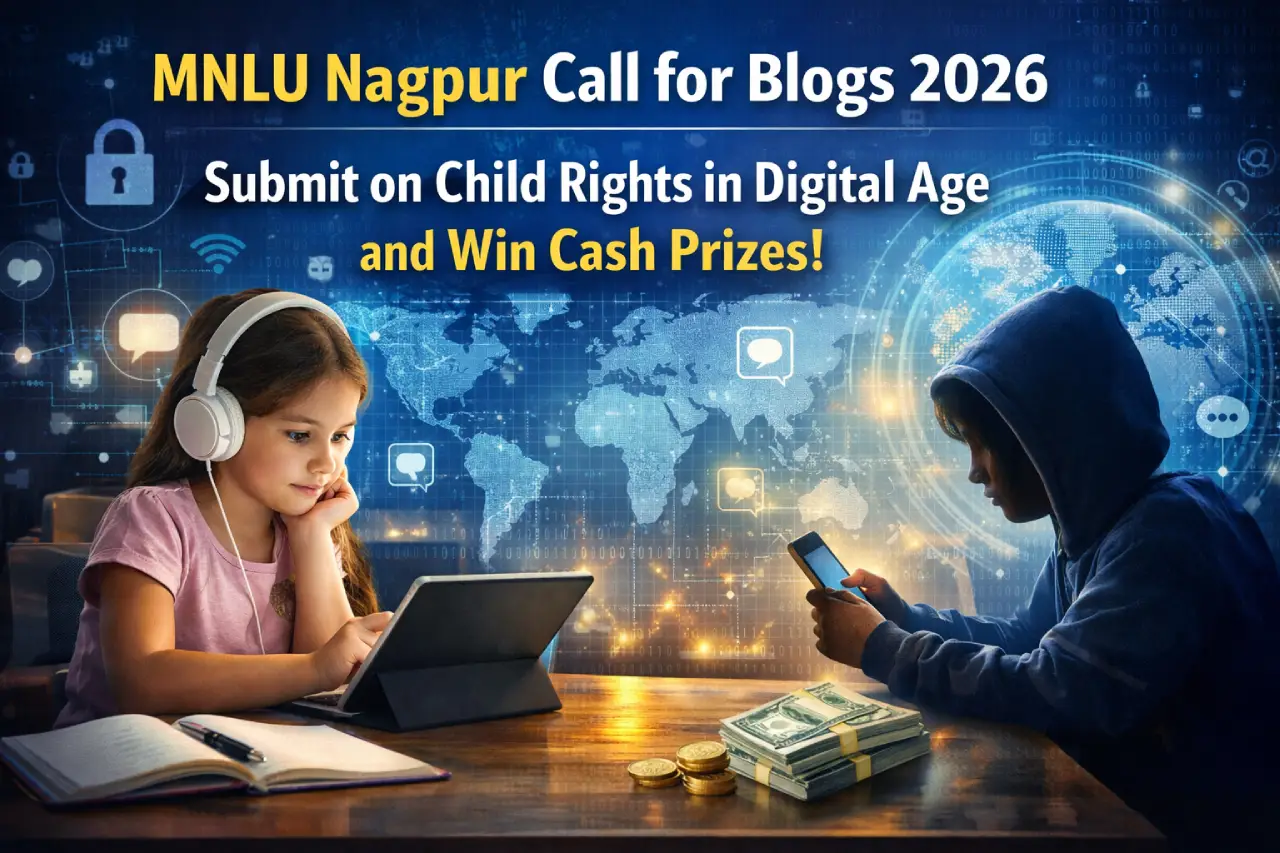
MNLU Nagpur Call for Blogs 2026: Submit on Child Rights in Digital Age and Win Cash Prizes

MNLU Nagpur Call for Blogs 2026: Submit on Child Rights in Digital Age and Win Cash Prizes

The Centre for Child Rights at Maharashtra National Law University (MNLU), Nagpur has invited blog submissions on the theme “Protection, Participation, and Privacy of Children in the Digital Age.” This call is open to law students who are interested in exploring how technology is shaping children’s rights today. With digital platforms becoming a major part of children’s lives, this initiative aims to encourage thoughtful discussion and academic engagement on emerging challenges and legal frameworks.

I am sharing this because opportunities like this are not just about writing but also about building your academic profile. If you are a law student, participating in such calls can help you gain recognition, improve research skills, and even get published. It also allows you to engage with real-world issues like digital safety, privacy, and child protection, which are becoming increasingly important in today’s legal landscape.

About MNLU Nagpur and the Centre for Child Rights

Maharashtra National Law University, Nagpur is a well-known institution established under the Maharashtra National Law University Act, 2014.

  • Focuses on quality legal education and research
  • Encourages interdisciplinary learning
  • Actively engages in social and legal issues

The Centre for Child Rights works with a rights-based approach.

  • Promotes child protection and legal awareness
  • Collaborates with government and civil society
  • Encourages research and policy discussions

About the Call for Blogs

The Centre is inviting original and well-researched blog submissions on the theme:

“Protection, Participation, and Privacy of Children in the Digital Age”

The aim is to explore how digital platforms impact children’s rights and what legal measures can ensure their safety and participation.

Suggested Sub-Themes

Participants can write on a variety of topics within the main theme, such as:

  • Children’s data privacy on social media
  • Role of artificial intelligence in child protection
  • Gaming platforms and child safety issues
  • Freedom of expression for children online
  • Platform liability for harmful digital content
  • Any other related topic within the broader theme

You have flexibility to choose a topic that matches your interest.

Eligibility Criteria

The call is open to:

  • Undergraduate law students in 5-year programmes (BA LL.B., BBA LL.B., etc.)
  • Students enrolled in 3-year LL.B. courses

Important conditions:

  • Submission must be original
  • No plagiarism allowed
  • Minimal or no use of AI-generated content

Submission Guidelines

Here are the key requirements for submission:

  • Word Limit: 1200–2500 words
  • Font: Times New Roman
  • Font Size: 12 (body), 10 (footnotes)
  • Line Spacing: 1.5 (body), 1.0 (footnotes)
  • Format: .doc or .docx file
  • Alignment: Headings centre-aligned, text justified
  • Citations: Use a consistent citation style

Make sure to follow these guidelines carefully to avoid rejection.

How to Submit

Candidates can submit their entries online through the official submission link.

  • Fill out the Google Form provided
  • Upload your manuscript in the required format
  • Ensure all details are correctly filled

Submission Link: https://forms.gle/5Mmhp2PWyNbdVkPK6

Prizes and Recognition

Selected participants will receive cash prizes and recognition:

  • 1st Prize: ₹2500
  • 2nd Prize: ₹1500
  • 3rd Prize: ₹1000

Additionally:

  • Selected blogs may be published on the official website of the Centre
  • Certificate of Merit will be awarded

This adds strong value to your academic profile.

Contact Details

For any queries, participants can reach out via email:

It is always better to clarify doubts before submission.

Why You Should Participate

From my experience, opportunities like this are highly valuable.

  • Helps build research and writing skills
  • Adds weight to your CV
  • Opens doors for publication opportunities
  • Enhances understanding of contemporary legal issues

Even if you are new to legal writing, this is a good place to start.
Leave a Comment

End of Article

AI Chatbot for Autism Support by College Students Wins National Hackathon 2026

AI Chatbot for Autism Support by College Students Wins National Hackathon 2026

At a quiet computer lab in Maharashtra’s Rajarambapu Institute of Technology, three young engineering students are working on something far more meaningful than just code. Vaishnavi Patil, Abhishek Patil, and Ganesh Mahadik have developed an AI-powered chatbot designed to help parents of children with autism by answering their questions in real time. Their innovation recently won first place at GRASP 2026, a national-level AI hackathon, standing out among thousands of participants.

I am writing about this because stories like these show how technology can be used to solve real-life problems, especially in areas that often go unnoticed. Autism awareness and support are still limited in many parts of India, particularly in smaller towns. When students take the initiative to build something that directly helps families, it deserves attention. This is not just about innovation, but about empathy and practical impact.

Meet the Team Behind the Innovation

The project was developed by three 21-year-old students from Maharashtra.

  • Vaishnavi Rajkumar Patil
  • Abhishek Shivprasad Patil
  • Ganesh Ramchandra Mahadik

They call themselves Team Neurostars.

All three come from small-town, agricultural backgrounds, where resources are limited but determination is strong. Their journey reflects how talent and purpose can come together to create meaningful solutions.

What the AI Chatbot Does

The chatbot is designed to support parents of children with autism.

  • Answers questions related to autism in real time
  • Provides guidance for daily challenges
  • Helps parents understand behaviour and needs
  • Offers accessible support without needing experts immediately

This kind of tool can be especially useful in areas where professional help is not easily available.

The Inspiration Behind the Project

The idea did not come from textbooks but from a real-life experience.

  • A classmate shared his family’s struggle with autism
  • The team realised how little awareness existed
  • They understood the emotional and practical challenges faced by parents

This moment changed their perspective and gave direction to their project.

Vaishnavi shared that they had very little understanding of autism earlier, especially in rural areas where awareness is low and acceptance is even lower.

Journey from Small Towns to National Recognition

Each member of the team has a unique story.

  • Vaishnavi discovered coding during the pandemic
  • Abhishek developed interest after getting his first computer in school
  • Ganesh balanced academics with responsibilities from his farming background

Despite different paths, they came together with a shared goal—to build something useful.

Winning GRASP 2026 Hackathon

Their project gained national attention after winning the GRASP 2026 hackathon.

  • Competed against over 5,000 students
  • Won in the “AI for Social Good” category
  • Received ₹1 lakh prize
  • Earned mentorship and internship opportunities
  • Got a chance to collaborate with a European university

This recognition highlights the impact of their work.

Why This Innovation Matters

This chatbot addresses a real gap in society.

  • Lack of awareness about autism
  • Limited access to expert guidance in rural areas
  • Need for quick and reliable information

Technology like this can make support more accessible and less intimidating for families.

From my perspective, this is a great example of how AI can be used for social good, not just business or automation.

Challenges in Autism Awareness

The project also highlights larger issues:

  • Social stigma around autism
  • Lack of proper information
  • Limited support systems in smaller towns

By addressing these, the chatbot goes beyond being just a tool—it becomes a support system.

Future Potential of the Project

The team plans to continue improving the chatbot.

  • Add more features and accuracy
  • Expand accessibility to more users
  • Collaborate with experts and organisations

This could eventually become a widely used support platform.

Leave a Comment

End of Article

Loading more posts...

Important Video