JOIN WHATSAPP
STORIES

NCERT Class 11 Chemistry Chapter 2: Structure of Atom PDF Download

NCERT Class 11 Chemistry Chapter 2: Structure of Atom

Chapter 2 of Class 11 Chemistry – Structure of Atom – dives into the inner framework of atoms, covering how electrons, protons and neutrons are arranged and how their properties shape chemical behaviour. This chapter explains various atomic models including Thomson’s model, Rutherford’s gold foil experiment, and Bohr’s theory. It also touches on quantum mechanical models, orbitals, and the concept of quantum numbers. Understanding this chapter is crucial for mastering atomic structure and electron configurations in chemistry.

I am writing about this topic because most students find the Structure of Atom chapter either confusing or too theoretical. But if you break it down and approach it logically, it becomes quite interesting and important for understanding chemical bonding, periodic properties, and spectroscopy. I remember struggling with quantum numbers and orbital shapes during my Class 11 days until I started linking the concepts with visualisations and simple examples. This chapter forms a major base for topics in both inorganic and physical chemistry later on. That’s why I want to help others simplify it, and I’ve also included the NCERT PDF so that students can revise it anytime.

Main Concepts Covered in Chapter 2

Here are the major topics you’ll study in this chapter:

1. Discovery of Subatomic Particles

  • Electron (J.J. Thomson)
  • Proton (Goldstein)
  • Neutron (Chadwick)

2. Atomic Models

  • Thomson’s Model – Plum pudding model
  • Rutherford’s Model – Gold foil experiment and nuclear model
  • Bohr’s Model – Quantised energy levels, hydrogen atom explanation
  • Limitations of these models

3. Electromagnetic Radiation and Spectrum

  • Nature of electromagnetic waves
  • Wave properties: wavelength, frequency, wave number
  • Spectrum types: emission and absorption spectra

4. Quantum Mechanical Model of Atom

  • Dual nature of matter (de Broglie)
  • Heisenberg’s uncertainty principle
  • Schrodinger’s wave equation
  • Atomic orbitals – s, p, d, f shapes and distribution

5. Quantum Numbers

  • Principal (n), Azimuthal (l), Magnetic (m), Spin (s)
  • Meaning and allowed combinations

6. Electron Configuration

  • Aufbau principle
  • Pauli’s exclusion principle
  • Hund’s rule
  • Examples of electronic configuration for first 30 elements

Download PDF

Click here to download NCERT Class 11 Chemistry Chapter 2: Structure of Atom PDF
Leave a Comment

End of Article

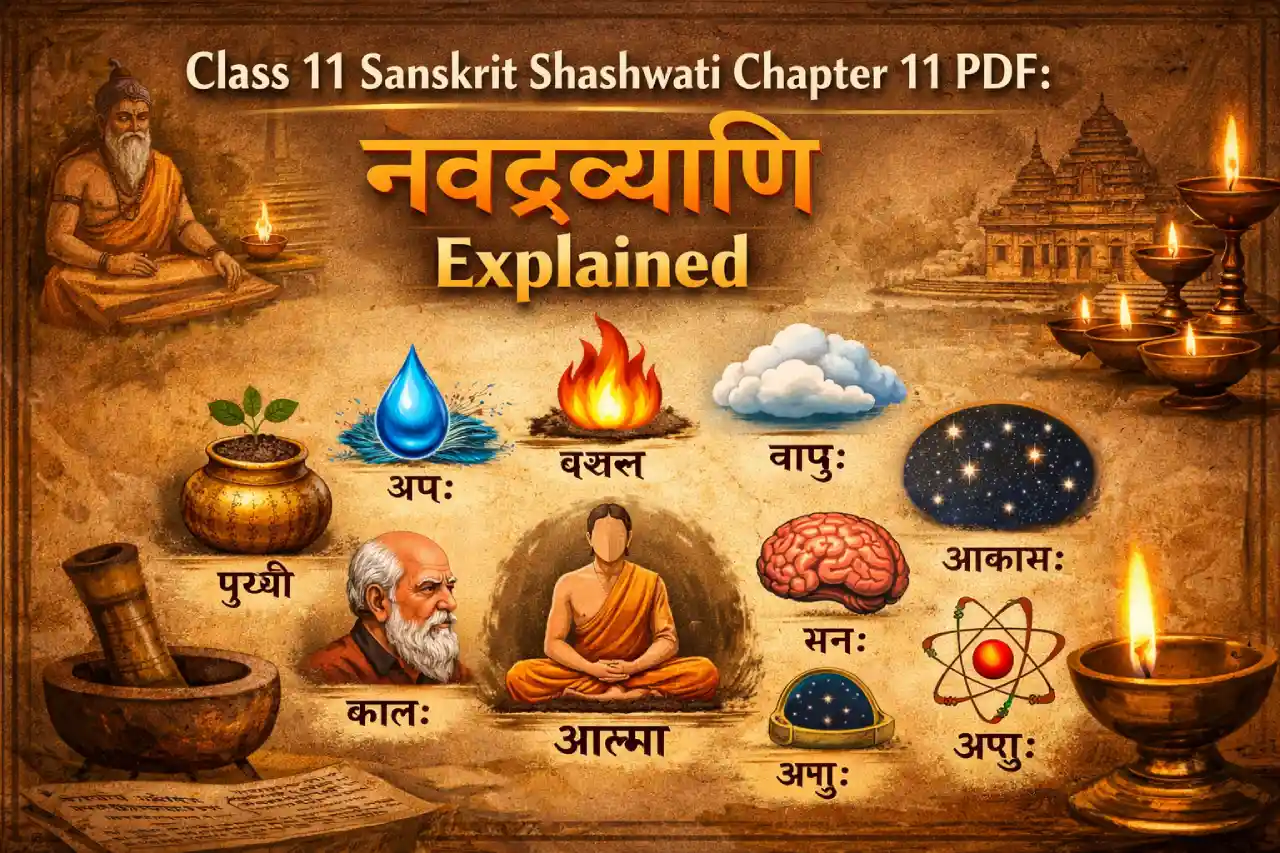
Class 11 Sanskrit Shashwati Chapter 11 PDF: नवद्रव्याणि Explained

Class 11 Sanskrit Shashwati Chapter 11 PDF: नवद्रव्याणि Explained

NCERT Class 11 Sanskrit Shashwati Chapter 11, titled “नवद्रव्याणि”, introduces students to an important concept from Indian philosophy—the nine fundamental substances that make up the universe. The chapter explains these elements in a simple and structured way, helping students understand how ancient thinkers tried to explain the nature of reality through observation and logic.

I am writing about this chapter because many students search for the official NCERT PDF along with a simple explanation before exams. In my experience, topics like “नवद्रव्याणि” may feel slightly abstract at first, but once you understand the list and their meanings, it becomes quite easy to remember and revise. This chapter is important not only for Sanskrit exams but also for gaining a basic idea of traditional Indian philosophy. It helps students connect language learning with deeper concepts. Studying from the official NCERT book and revising regularly can make this chapter scoring and easy to handle.

About the Chapter: नवद्रव्याणि

The term “नवद्रव्याणि” means “nine substances.” These are considered the basic elements that exist in the universe according to classical Indian thought.

The chapter explains each of these substances and their role in the functioning of the world.

The Nine Substances Explained

Here is a simple table to understand the nine dravyas:

Sanskrit TermMeaning (Simple English)
पृथ्वी (Prithvi)Earth
आपः (Apah)Water
तेजः (Tejas)Fire
वायु (Vayu)Air
आकाश (Akasha)Space
काल (Kala)Time
दिशा (Disha)Direction
आत्मा (Atma)Soul
मनः (Manas)Mind

These elements together explain the physical and non-physical aspects of existence.

Key Ideas in the Chapter

1. Understanding the Universe

The chapter explains how everything in the world is made up of basic substances.

2. Physical and Non-Physical Elements

Some substances like earth and water are physical, while others like time and soul are abstract.

3. Connection Between Mind and Body

The inclusion of “मनः” (mind) and “आत्मा” (soul) shows the importance of inner consciousness.

Why This Chapter Is Important for Students

  • Helps understand basic philosophical concepts
  • Improves Sanskrit reading and comprehension
  • Important for exam questions and explanations
  • Builds logical and conceptual thinking

Students who understand the list properly can easily score marks.

Study Tips for Chapter 11

  • Memorise the nine dravyas and their meanings
  • Understand the difference between physical and abstract elements
  • Practise writing short explanations
  • Revise regularly using a table format

This makes the chapter easier to revise before exams.

How to Download NCERT Class 11 Sanskrit Shashwati Chapter 11 PDF

Students can download the official chapter PDF from the National Council of Educational Research and Training website by following these steps:

Always use the official NCERT website to ensure you get the correct and updated version.

Leave a Comment

End of Article

Loading more posts...