JOIN WHATSAPP
STORIES

NCERT Class 11 Chemistry Chapter 6: Equilibrium PDF Download

NCERT Class 11 Chemistry Chapter 6: Equilibrium

Equilibrium is one of the most fundamental chapters in Class 11 Chemistry and it marks the shift from basic physical chemistry into more applied concepts. Chapter 6 in the NCERT textbook introduces us to the concept of chemical equilibrium, which helps us understand how reactions behave when both the forward and backward reactions occur simultaneously. It covers types of equilibrium, the law of mass action, equilibrium constants, and how changes in pressure, concentration, and temperature affect a reaction. The chapter also goes into ionic equilibrium in solutions, acids, bases, and the concept of pH, which are all extremely useful in real-life chemistry.

I am writing about this chapter because I believe students often get confused between physical and chemical equilibrium, especially when it comes to reversible reactions and Le Chatelier’s Principle. This chapter plays an important role not just in board exams but also in competitive exams like NEET and JEE, where understanding the concept clearly makes problem-solving much easier. It connects well with biology, especially in buffer solutions and acid-base balance in our body. I’ve seen many students memorise the formulas without understanding the logic behind equilibrium constants or common ion effects, which makes it harder later. This article is to simplify those concepts and also share the official NCERT PDF so you have the exact textbook in hand.

Important Topics Covered in Equilibrium

The chapter is divided into two major parts — chemical equilibrium and ionic equilibrium. Here’s what you need to know:

1. Dynamic Nature of Equilibrium

  • Reversible reactions
  • Rate of forward and backward reactions becomes equal at equilibrium

2. Law of Mass Action

  • Mathematical expression to calculate the equilibrium constant (K)
  • Kc and Kp — their relation and use

3. Equilibrium Constant

  • Expression and calculation for gaseous and aqueous reactions
  • Units of Kc and Kp based on the balanced equation
  • Homogeneous and heterogeneous equilibria

4. Le Chatelier’s Principle

  • Predicting effect of change in pressure, temperature, or concentration on equilibrium
  • Industrial examples like Haber’s process for ammonia

5. Ionic Equilibrium in Aqueous Solutions

  • Electrolytes and non-electrolytes
  • Strong and weak acids and bases
  • Degree of ionisation

6. Acids and Bases

  • Arrhenius, Bronsted-Lowry, and Lewis concepts
  • Conjugate acid-base pairs

7. Ionisation of Water and Ionic Product (Kw)

  • pH scale
  • Calculations involving [H+] and [OH−]

8. Buffer Solutions and Common Ion Effect

  • Buffers resist change in pH
  • Used in biological systems and chemical industries
  • Common ion effect on weak acid or base equilibrium

Download PDF

Click Here to Download NCERT Class 11 Chemistry Chapter 6: Equilibrium PDF
Leave a Comment

End of Article

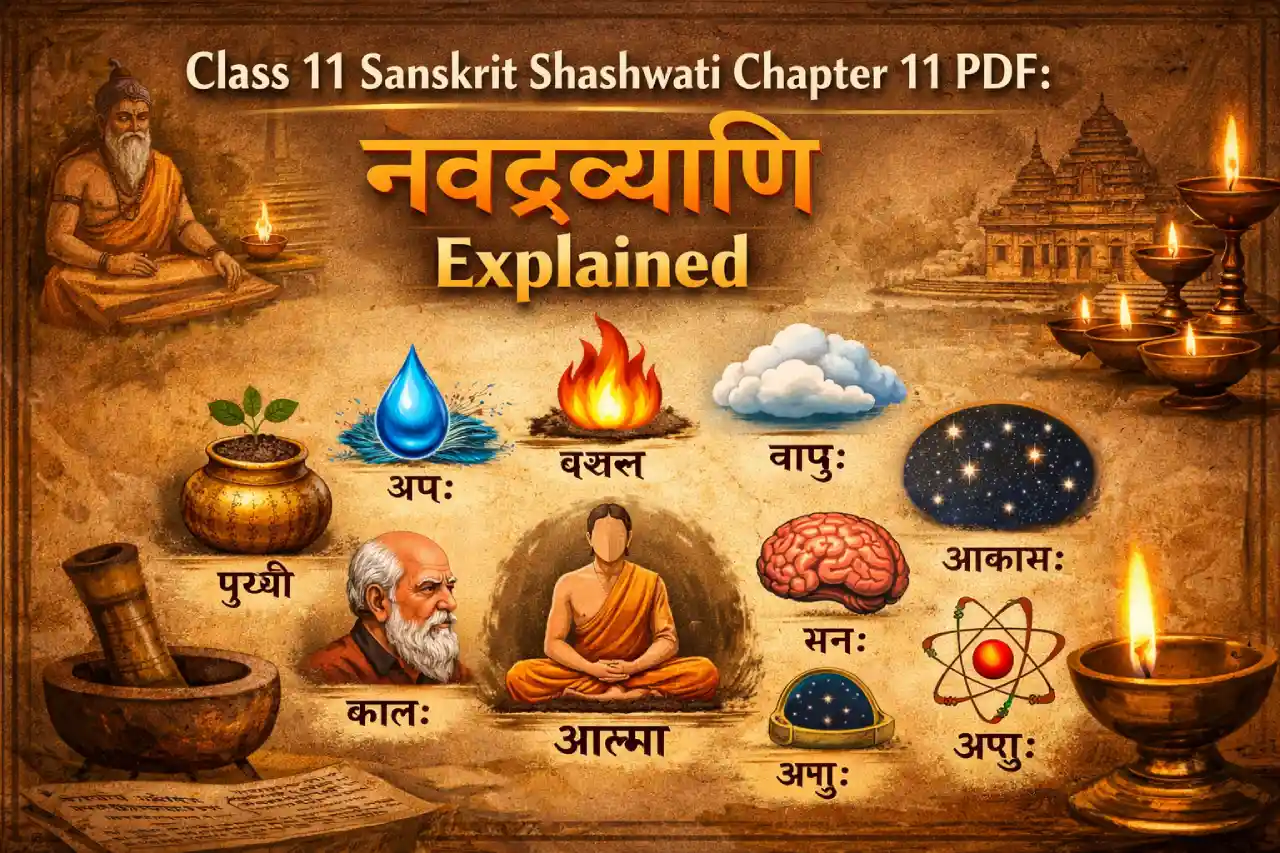
Class 11 Sanskrit Shashwati Chapter 11 PDF: नवद्रव्याणि Explained

Class 11 Sanskrit Shashwati Chapter 11 PDF: नवद्रव्याणि Explained

NCERT Class 11 Sanskrit Shashwati Chapter 11, titled “नवद्रव्याणि”, introduces students to an important concept from Indian philosophy—the nine fundamental substances that make up the universe. The chapter explains these elements in a simple and structured way, helping students understand how ancient thinkers tried to explain the nature of reality through observation and logic.

I am writing about this chapter because many students search for the official NCERT PDF along with a simple explanation before exams. In my experience, topics like “नवद्रव्याणि” may feel slightly abstract at first, but once you understand the list and their meanings, it becomes quite easy to remember and revise. This chapter is important not only for Sanskrit exams but also for gaining a basic idea of traditional Indian philosophy. It helps students connect language learning with deeper concepts. Studying from the official NCERT book and revising regularly can make this chapter scoring and easy to handle.

About the Chapter: नवद्रव्याणि

The term “नवद्रव्याणि” means “nine substances.” These are considered the basic elements that exist in the universe according to classical Indian thought.

The chapter explains each of these substances and their role in the functioning of the world.

The Nine Substances Explained

Here is a simple table to understand the nine dravyas:

Sanskrit TermMeaning (Simple English)
पृथ्वी (Prithvi)Earth
आपः (Apah)Water
तेजः (Tejas)Fire
वायु (Vayu)Air
आकाश (Akasha)Space
काल (Kala)Time
दिशा (Disha)Direction
आत्मा (Atma)Soul
मनः (Manas)Mind

These elements together explain the physical and non-physical aspects of existence.

Key Ideas in the Chapter

1. Understanding the Universe

The chapter explains how everything in the world is made up of basic substances.

2. Physical and Non-Physical Elements

Some substances like earth and water are physical, while others like time and soul are abstract.

3. Connection Between Mind and Body

The inclusion of “मनः” (mind) and “आत्मा” (soul) shows the importance of inner consciousness.

Why This Chapter Is Important for Students

  • Helps understand basic philosophical concepts
  • Improves Sanskrit reading and comprehension
  • Important for exam questions and explanations
  • Builds logical and conceptual thinking

Students who understand the list properly can easily score marks.

Study Tips for Chapter 11

  • Memorise the nine dravyas and their meanings
  • Understand the difference between physical and abstract elements
  • Practise writing short explanations
  • Revise regularly using a table format

This makes the chapter easier to revise before exams.

How to Download NCERT Class 11 Sanskrit Shashwati Chapter 11 PDF

Students can download the official chapter PDF from the National Council of Educational Research and Training website by following these steps:

Always use the official NCERT website to ensure you get the correct and updated version.

Leave a Comment

End of Article

Loading more posts...