JOIN WHATSAPP
STORIES

NCERT Class 11 Physics Chapter 13: Oscillations PDF Download Free
NCERT Class 11 Physics Chapter 13: Oscillations

Chapter 13 of Class 11 Physics, Oscillations, deals with the study of repetitive motions in systems like pendulums, springs, and sound waves. It introduces key terms like amplitude, time period, frequency, and phase, and builds a solid foundation for understanding harmonic motion. Oscillations are seen everywhere around us — from a simple swing in a park to the vibrations of a tuning fork.

I’m writing about this chapter because oscillatory motion is one of those topics that look simple on the surface but has deep connections across many areas of physics. Whether it’s alternating current in electricity, sound in acoustics, or waves in quantum mechanics — the concept of oscillation is everywhere. Personally, when I first learned this chapter, I was surprised how many daily life examples are based on oscillations. So if you understand this chapter well, it will help not only in school exams but also in competitive exams and even in your future physics studies. That’s why it’s important to have a reliable source like the NCERT PDF to revise from.

NCERT Class 11 Physics Chapter 13: Oscillations – Chapter Summary

This chapter introduces the basic concepts of periodic motion and develops the mathematics behind simple harmonic motion (SHM).

Key Concepts Covered

1. Periodic and Oscillatory Motion

  • Periodic motion repeats after equal intervals of time
  • Oscillatory motion is a type of periodic motion, like a pendulum

2. Simple Harmonic Motion (SHM)

  • Defined as motion where restoring force is proportional to displacement and directed towards mean position
  • Equation: F=−kxF = -kxF=−kx

3. Terms You Should Know

  • Amplitude (A): Maximum displacement from mean position
  • Time period (T): Time taken to complete one cycle
  • Frequency (f): Number of oscillations per second
  • Phase: Describes position and direction of motion

4. Mathematical Representation of SHM

  • Displacement: x(t)=Asin⁡(ωt+ϕ)x(t) = A \sin(\omega t + \phi)x(t)=Asin(ωt+ϕ)
  • Velocity: v(t)=Aωcos⁡(ωt+ϕ)v(t) = A\omega \cos(\omega t + \phi)v(t)=Aωcos(ωt+ϕ)
  • Acceleration: a(t)=−ω2x(t)a(t) = -\omega^2 x(t)a(t)=−ω2x(t)

5. Energy in SHM

  • Kinetic and potential energies change continuously
  • Total energy remains constant
  • E=12kA2E = \frac{1}{2} kA^2E=21​kA2

6. Spring-Mass System and Pendulum

  • Time period of spring-mass: T=2πmkT = 2\pi \sqrt{\frac{m}{k}}T=2πkm​​
  • Time period of simple pendulum: T=2πlgT = 2\pi \sqrt{\frac{l}{g}}T=2πgl​​

Download PDF

Click here to download NCERT Class 11 Physics Chapter 13: Oscillations PDF

Leave a Comment

End of Article

Class 11 Sanskrit Shashwati Chapter 11 PDF: नवद्रव्याणि Explained

Class 11 Sanskrit Shashwati Chapter 11 PDF: नवद्रव्याणि Explained

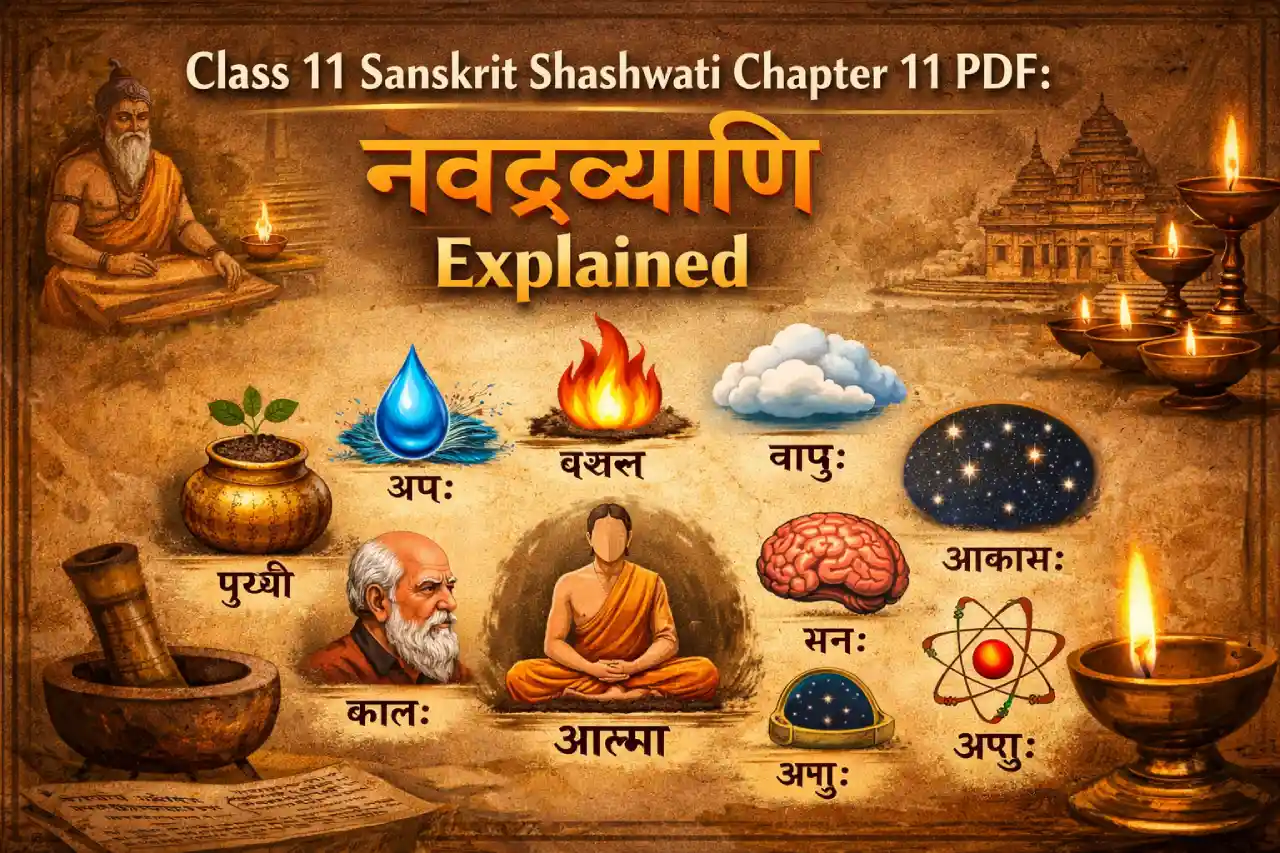
NCERT Class 11 Sanskrit Shashwati Chapter 11, titled “नवद्रव्याणि”, introduces students to an important concept from Indian philosophy—the nine fundamental substances that make up the universe. The chapter explains these elements in a simple and structured way, helping students understand how ancient thinkers tried to explain the nature of reality through observation and logic.

I am writing about this chapter because many students search for the official NCERT PDF along with a simple explanation before exams. In my experience, topics like “नवद्रव्याणि” may feel slightly abstract at first, but once you understand the list and their meanings, it becomes quite easy to remember and revise. This chapter is important not only for Sanskrit exams but also for gaining a basic idea of traditional Indian philosophy. It helps students connect language learning with deeper concepts. Studying from the official NCERT book and revising regularly can make this chapter scoring and easy to handle.

About the Chapter: नवद्रव्याणि

The term “नवद्रव्याणि” means “nine substances.” These are considered the basic elements that exist in the universe according to classical Indian thought.

The chapter explains each of these substances and their role in the functioning of the world.

The Nine Substances Explained

Here is a simple table to understand the nine dravyas:

Sanskrit TermMeaning (Simple English)
पृथ्वी (Prithvi)Earth
आपः (Apah)Water
तेजः (Tejas)Fire
वायु (Vayu)Air
आकाश (Akasha)Space
काल (Kala)Time
दिशा (Disha)Direction
आत्मा (Atma)Soul
मनः (Manas)Mind

These elements together explain the physical and non-physical aspects of existence.

Key Ideas in the Chapter

1. Understanding the Universe

The chapter explains how everything in the world is made up of basic substances.

2. Physical and Non-Physical Elements

Some substances like earth and water are physical, while others like time and soul are abstract.

3. Connection Between Mind and Body

The inclusion of “मनः” (mind) and “आत्मा” (soul) shows the importance of inner consciousness.

Why This Chapter Is Important for Students

  • Helps understand basic philosophical concepts
  • Improves Sanskrit reading and comprehension
  • Important for exam questions and explanations
  • Builds logical and conceptual thinking

Students who understand the list properly can easily score marks.

Study Tips for Chapter 11

  • Memorise the nine dravyas and their meanings
  • Understand the difference between physical and abstract elements
  • Practise writing short explanations
  • Revise regularly using a table format

This makes the chapter easier to revise before exams.

How to Download NCERT Class 11 Sanskrit Shashwati Chapter 11 PDF

Students can download the official chapter PDF from the National Council of Educational Research and Training website by following these steps:

Always use the official NCERT website to ensure you get the correct and updated version.

Leave a Comment

End of Article

Loading more posts...















