JOIN WHATSAPP
STORIES

NCERT Class 11 Economics Chapter 6: Correlation PDF Download

NCERT Class 11 Economics Chapter 6: Correlation

Chapter 6 of Class 11 Economics, titled Correlation, talks about the relationship between two or more variables. It helps us find out whether two things move together and to what extent. For example, is there a connection between study hours and marks? Or rainfall and crop production? This chapter teaches us how to measure and understand such relationships using simple methods like scatter diagrams and Karl Pearson’s coefficient.

I’m writing about this topic because correlation is not just another theoretical concept in economics, but a practical tool that is used everywhere. From students analysing their own performance to government agencies comparing inflation with interest rates – correlation is useful. Knowing how to measure it correctly and interpret its meaning can help students make sense of real-life situations. For exam preparation too, it is a high-scoring chapter with direct formula-based questions. With the help of a simple PDF, you can go through all key concepts and formulas quickly during revisions. That’s why I’ve created this guide.

What is Correlation in Economics?

Correlation means the degree to which two variables move together. If both go up or down together, that’s positive correlation. If one increases while the other decreases, that’s negative correlation. If there is no connection, it’s called zero correlation.

Types of Correlation

  • Positive Correlation: Both variables increase or decrease together
    Example: Height and weight
  • Negative Correlation: One increases while the other decreases
    Example: Number of hours spent watching TV and exam performance
  • No Correlation: No pattern in change
    Example: Roll number and marks

Methods of Measuring Correlation

1. Scatter Diagram

  • A graph with dots showing the relationship between two variables
  • Gives a visual idea of how close or far the points are

2. Karl Pearson’s Coefficient

  • A mathematical method
  • Value lies between -1 and +1
  • +1 means perfect positive, -1 is perfect negative, 0 means no correlation
  • Formula:
    ![r = Σ(xy)/√(Σx² × Σy²)] (The formula is fully explained in the NCERT book)

3. Spearman’s Rank Correlation

  • Used when data is ranked instead of given in numbers
  • Formula uses the difference in ranks to calculate correlation

Importance of Correlation in Real Life

  • Used in economics, business, education, and even weather studies
  • Helps in understanding relationships before making decisions
  • For example, before investing in a sector, we may check correlation between GDP growth and stock market performance
  • In schools, teachers can analyse correlation between attendance and results

Download PDF

Click Here to Download NCERT Class 11 Economics Chapter 6: Correlation PDF
Leave a Comment

End of Article

Class 11 Sanskrit Shashwati Chapter 11 PDF: नवद्रव्याणि Explained

Class 11 Sanskrit Shashwati Chapter 11 PDF: नवद्रव्याणि Explained

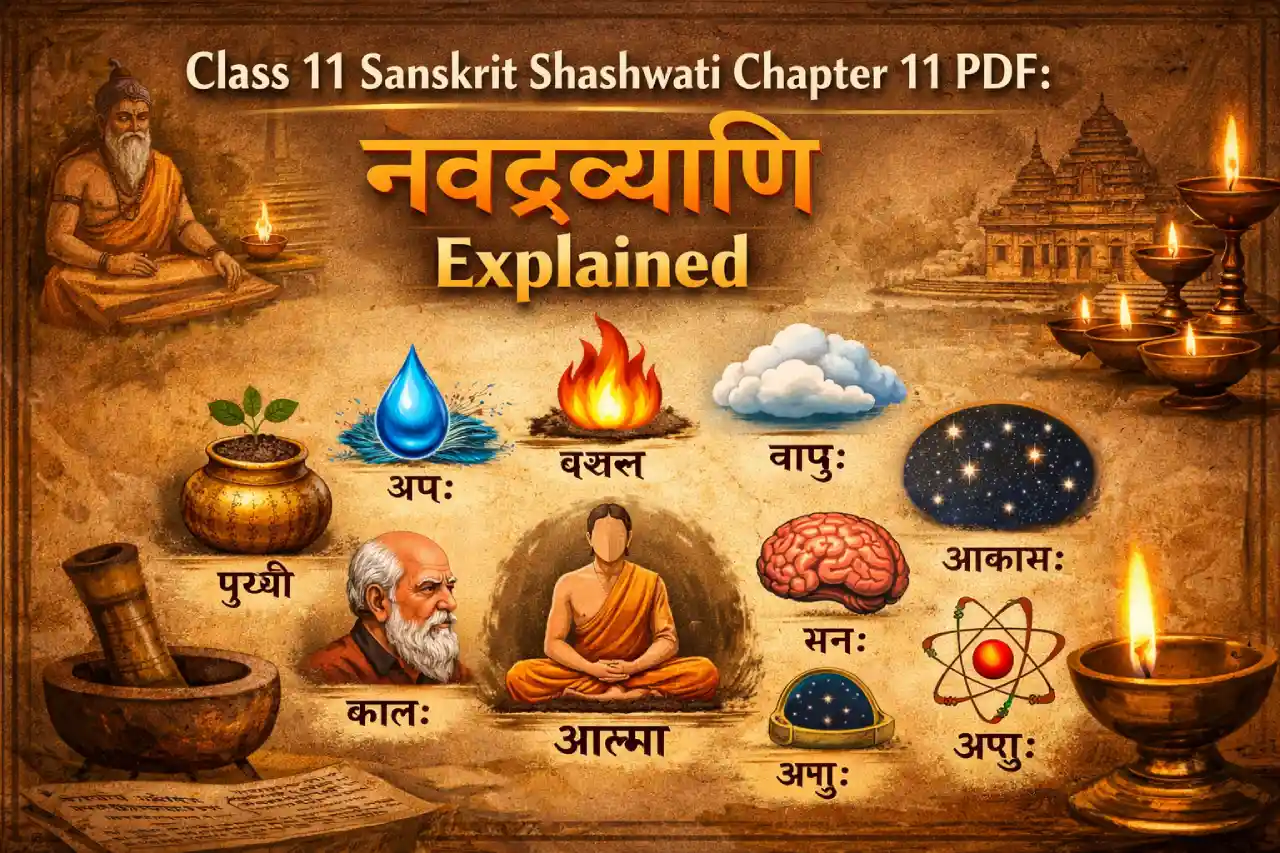
NCERT Class 11 Sanskrit Shashwati Chapter 11, titled “नवद्रव्याणि”, introduces students to an important concept from Indian philosophy—the nine fundamental substances that make up the universe. The chapter explains these elements in a simple and structured way, helping students understand how ancient thinkers tried to explain the nature of reality through observation and logic.

I am writing about this chapter because many students search for the official NCERT PDF along with a simple explanation before exams. In my experience, topics like “नवद्रव्याणि” may feel slightly abstract at first, but once you understand the list and their meanings, it becomes quite easy to remember and revise. This chapter is important not only for Sanskrit exams but also for gaining a basic idea of traditional Indian philosophy. It helps students connect language learning with deeper concepts. Studying from the official NCERT book and revising regularly can make this chapter scoring and easy to handle.

About the Chapter: नवद्रव्याणि

The term “नवद्रव्याणि” means “nine substances.” These are considered the basic elements that exist in the universe according to classical Indian thought.

The chapter explains each of these substances and their role in the functioning of the world.

The Nine Substances Explained

Here is a simple table to understand the nine dravyas:

Sanskrit TermMeaning (Simple English)
पृथ्वी (Prithvi)Earth
आपः (Apah)Water
तेजः (Tejas)Fire
वायु (Vayu)Air
आकाश (Akasha)Space
काल (Kala)Time
दिशा (Disha)Direction
आत्मा (Atma)Soul
मनः (Manas)Mind

These elements together explain the physical and non-physical aspects of existence.

Key Ideas in the Chapter

1. Understanding the Universe

The chapter explains how everything in the world is made up of basic substances.

2. Physical and Non-Physical Elements

Some substances like earth and water are physical, while others like time and soul are abstract.

3. Connection Between Mind and Body

The inclusion of “मनः” (mind) and “आत्मा” (soul) shows the importance of inner consciousness.

Why This Chapter Is Important for Students

  • Helps understand basic philosophical concepts
  • Improves Sanskrit reading and comprehension
  • Important for exam questions and explanations
  • Builds logical and conceptual thinking

Students who understand the list properly can easily score marks.

Study Tips for Chapter 11

  • Memorise the nine dravyas and their meanings
  • Understand the difference between physical and abstract elements
  • Practise writing short explanations
  • Revise regularly using a table format

This makes the chapter easier to revise before exams.

How to Download NCERT Class 11 Sanskrit Shashwati Chapter 11 PDF

Students can download the official chapter PDF from the National Council of Educational Research and Training website by following these steps:

Always use the official NCERT website to ensure you get the correct and updated version.

Leave a Comment

End of Article

Loading more posts...