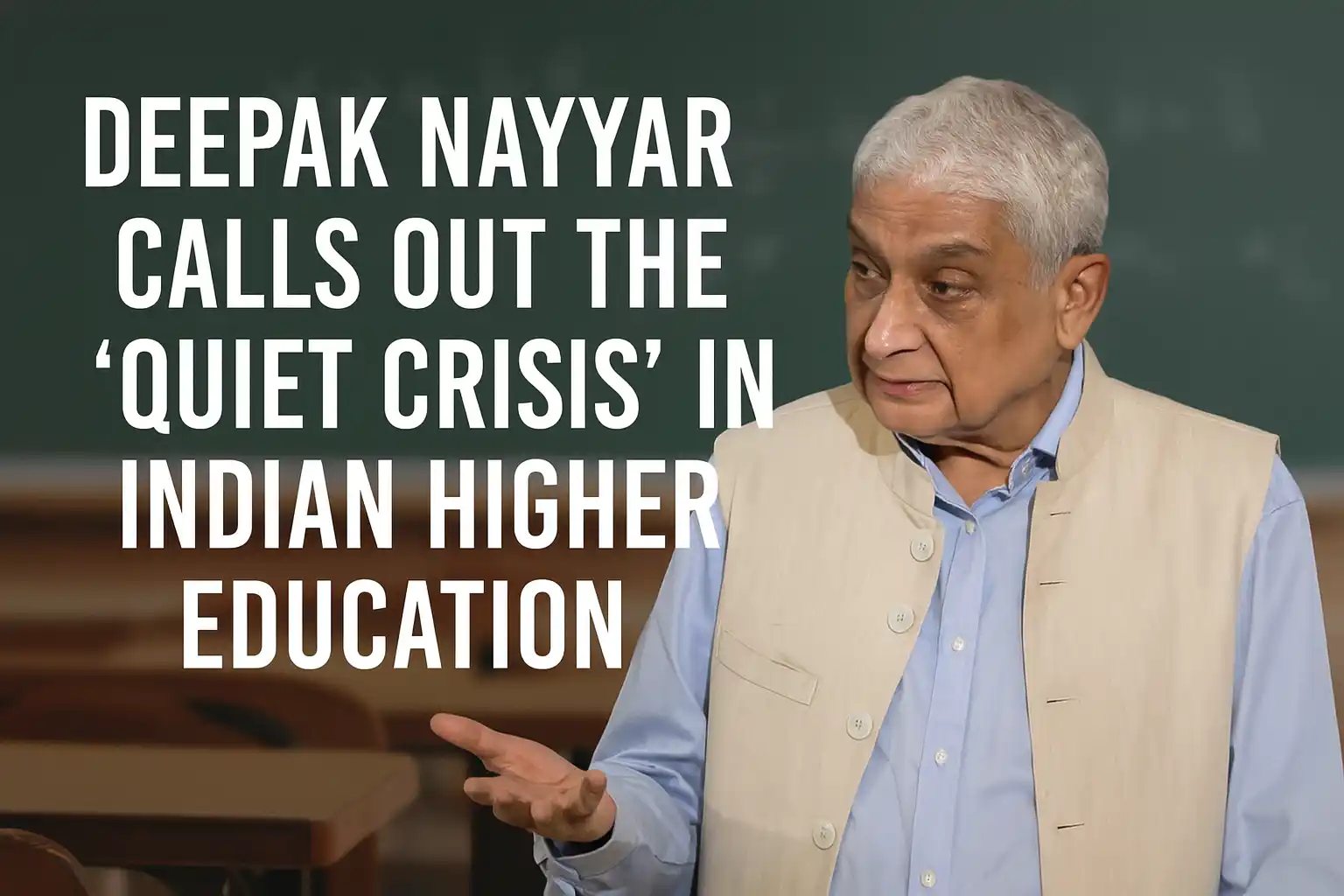
India’s higher education system is going through what economist and former JNU vice-chancellor Deepak Nayyar calls “a quiet crisis.” In his latest observations, he has raised serious concerns about the declining quality, lack of access, poor investment, and increasing privatisation of Indian universities and colleges. According to Nayyar, this crisis is not sudden or loud—but it is deep, slow, and dangerous. It threatens the future of millions of young Indians who depend on affordable and meaningful higher education to move up in life.
I wanted to write on this topic because we often hear about India’s demographic dividend, but rarely do we stop to ask whether our education system is prepared to handle it. I studied in a state university, and I’ve seen both the strength and the rot up close. There are dedicated professors and hardworking students, but outdated syllabi, lack of funding, and political interference create major roadblocks. When someone like Deepak Nayyar—who has both academic and administrative experience—raises a red flag, it’s important we listen. This isn’t just about one university or state, it’s about the future of the country. If we don’t fix our higher education system soon, we’ll have a generation that’s holding degrees with no real value.
What Is the ‘Quiet Crisis’?
Deepak Nayyar describes the current state of higher education as a silent but dangerous failure. It’s not something that’s visible like a collapsed bridge or a sudden power outage. It shows up in subtle ways—poor learning outcomes, falling research standards, unemployable graduates, and growing inequality between private and public institutions.
He points out that while India has expanded access to higher education over the years, it has failed to maintain quality. The Gross Enrolment Ratio (GER) has gone up, but many colleges don’t have enough trained faculty, proper classrooms, or research facilities. A degree is becoming easier to get, but what value does it really hold?
Poor Public Investment in Higher Education
One of the major concerns raised is the extremely low public spending on higher education. India spends less than 0.7% of its GDP on higher education, compared to 2.5% by China and even more by developed nations. This underfunding has left public universities short-staffed, under-equipped, and overburdened.
To cope, many public universities are hiking fees or relying on self-financing courses. This pushes students—especially those from rural or marginalised backgrounds—towards poor-quality private colleges or out of higher education altogether.
Rise of Private Colleges: A Double-Edged Sword
The rapid growth of private institutions has filled some of the gaps in access, but most of them are profit-driven and lack basic academic standards. A large number of these colleges focus on quantity, not quality. They don’t invest in good faculty or infrastructure and are mainly interested in collecting fees.
This has created a two-tier system: elite, expensive private universities for the rich, and low-quality, underfunded institutions for the rest. The idea of education as a public good is slowly being replaced by a market model, where only those who can pay get access to quality learning.
No Focus on Research or Critical Thinking
Nayyar also highlights that Indian higher education does not promote original thinking or research. Most students are trained to memorise and reproduce, not to question or create. This is partly because of outdated teaching methods, overloaded syllabi, and lack of academic freedom.
India’s share in global research output is still less than 5%, and most of our universities don’t even figure in global rankings. Without investment in research and innovation, we cannot expect our universities to produce leaders, thinkers, or problem-solvers.
Political Interference and Bureaucratic Controls
Another point raised by Nayyar is the increasing politicisation and bureaucratisation of universities. From appointments to curriculum changes, politics plays a big role in decision-making. Vice-chancellors are often chosen not for merit, but for loyalty to a particular party or ideology.
Moreover, institutions face constant interference from regulatory bodies that add layers of red tape. This kills autonomy and demoralises good teachers and administrators who want to bring change.
What Can Be Done?
Fixing higher education will need strong political will and long-term vision. Some steps that can help:
- Increase public funding to at least 1.5–2% of GDP
- Ensure merit-based appointments for leadership roles in universities
- Encourage research through grants and academic freedom
- Regulate private players to maintain basic quality standards
- Support underprivileged students with scholarships and infrastructure
India has the potential to build world-class universities, but not without serious reform.