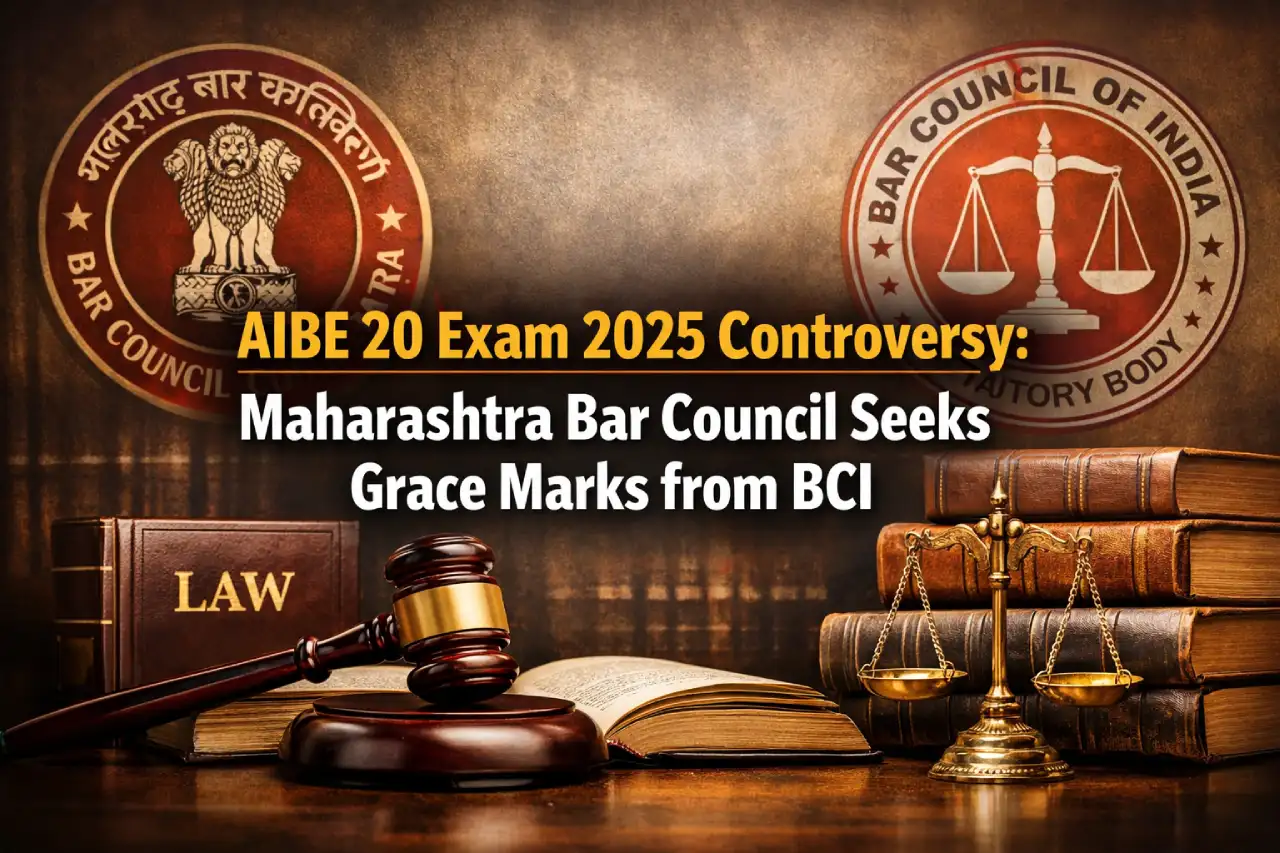
The AIBE 20 Exam 2025 has landed in controversy after the Bar Council of Maharashtra & Goa formally urged the Bar Council of India to award grace marks to candidates. In its representation, the state Bar Council argued that the All India Bar Examination paper was unusually difficult, leaving many students unable to attempt a significant number of questions. The issue has triggered concern among law graduates who see the AIBE as a crucial step to begin legal practice.
I am writing about this development because the AIBE directly affects thousands of young law graduates, especially those from rural and economically weaker backgrounds. Over the years, the exam has been positioned as a basic qualifying test rather than an elimination tool. When a paper is perceived as too tough, it naturally raises questions about fairness and intent. From conversations with law students and junior advocates, there is visible anxiety about results and future prospects. This representation by the Bar Council of Maharashtra & Goa brings those concerns into the public domain and forces a broader discussion on whether the exam format is aligned with the realities of legal education across India.
What the Bar Council of Maharashtra & Goa Has Demanded
In its submission to the Bar Council of India, the Bar Council of Maharashtra & Goa has made a strong case for awarding grace marks to all candidates who appeared for AIBE 20.
The council has demanded that every student should be given 10 grace marks, citing the overall difficulty level of the question paper.
Reasons Cited Behind the Grace Marks Demand
The representation highlights several concerns raised by students and legal bodies:
- The question paper was too complex and lengthy
- Many candidates were unable to attempt all questions
- A large number of examinees come from rural areas
- Students from poor or farmer families lack access to advanced coaching
- AIBE should not become a tool to fail candidates in large numbers
The council argued that it cannot be the strategy of the Bar Council of India to block aspiring advocates from entering the profession through an excessively difficult exam.
Impact on Rural and First-Generation Law Graduates
One of the strongest points raised relates to students from rural backgrounds. According to the Bar Council of Maharashtra & Goa, many candidates do not have access to premium study material or urban coaching centres.
For such students, a high-level paper creates an uneven playing field and risks excluding capable graduates who have already completed recognised law degrees.
What Is the Purpose of the AIBE
The All India Bar Examination was introduced to test basic legal knowledge and professional readiness, not to rank candidates. Traditionally, it has been viewed as a qualifying exam meant to ensure minimum standards.
The current controversy raises questions about whether the exam is drifting away from that original purpose.
What Happens Next
The final decision now rests with the Bar Council of India. If BCI accepts the request, grace marks may be awarded uniformly. If not, students may continue to press for relief through representations and legal channels.
So far, BCI has not issued an official response to the demand.
Why This Issue Matters
For many law graduates, clearing AIBE is the final hurdle before starting their legal career. Any uncertainty around results creates emotional and financial stress, especially for students from modest backgrounds.
This situation also opens up a wider debate on standardisation, inclusivity, and the role of qualifying exams in professional education.