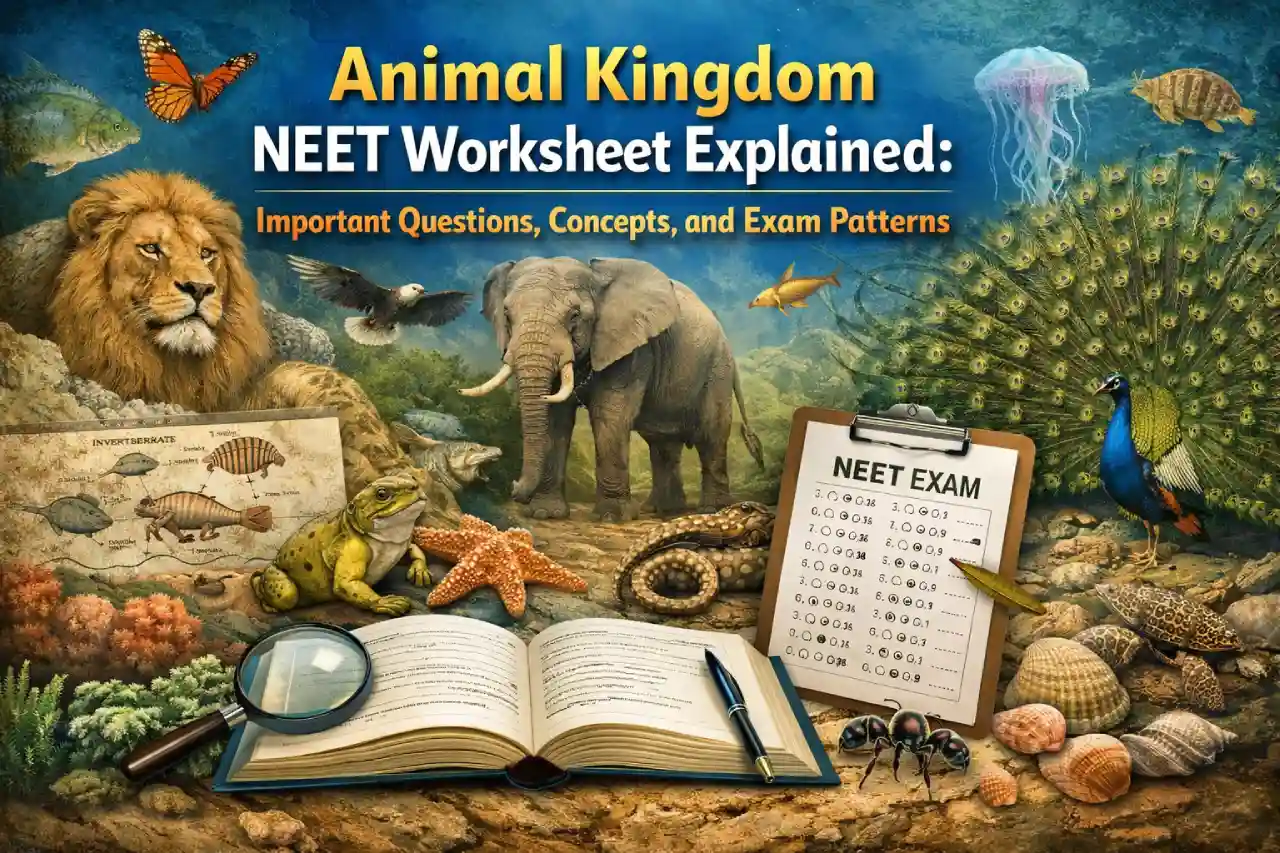
This PDF is a Class 11 Biology worksheet on the Animal Kingdom, designed mainly for NEET and board exam preparation. It contains 75 multiple-choice questions, covering both non-chordates and chordates in detail. The questions are framed directly from NCERT concepts and focus on classification, body organisation, excretory systems, circulation, reproduction, and evolutionary relationships. Overall, the worksheet reflects the kind of factual and concept-based questions students regularly face in competitive exams.
I am writing about this worksheet because the Animal Kingdom chapter often feels lengthy and confusing due to the number of phyla, examples, and exceptions involved. A structured worksheet like this helps students convert NCERT theory into exam-ready knowledge. By analysing the questions carefully, one can clearly understand which areas are frequently tested and how small factual details are turned into scoring MCQs in NEET and other medical entrance exams Animal Kingdom WS (1).
Structure of the Animal Kingdom Worksheet
The worksheet consists of 75 MCQs, each carrying one mark. The questions progress from basic classification to applied biological concepts. Most questions are direct, but the options are closely framed, which tests accuracy and careful reading rather than guesswork.
The overall difficulty level ranges from easy to moderate, making it suitable for both revision and self-assessment.
Evolution and Classification-Based Questions
Several questions focus on evolutionary lineage and classification logic. For example, the worksheet asks about:
- Ancestors of mammals belonging to Therapsida
- Unique features of vertebrates such as the vertebral column
- Distinction between chordates and non-chordates
These questions check whether students understand classification as a logical system, not just a list of names.
Chordates and Their Key Characteristics
A large part of the worksheet is dedicated to chordates. Important points tested include:
- Jawless, circular mouth in cyclostomes
- Two-chambered heart in fishes
- Three-chambered heart in amphibians and most reptiles
- Four-chambered heart in birds, mammals, and crocodiles
Questions also highlight similarities across classes, such as birds and mammals both being warm-blooded.
Excretion and Circulatory System
The worksheet strongly emphasises excretory products and organs, which is a favourite NEET area. Questions cover:
- Ammonotelic excretion in fishes
- Uricotelic excretion in birds and reptiles
- Malpighian tubules in insects
- Proboscis gland in hemichordates
Circulatory system questions focus on single versus double circulation and heart chamber count in different animal groups.
Reproduction and Development
Reproductive strategies are tested through questions on:
- Internal fertilisation in specific organisms
- Oviparous mammals like platypus
- External fertilisation in amphibians
- Larval forms such as ammocoete and tadpole
These questions require clear conceptual understanding rather than memorisation alone.
Download this PDF File: Click Here
Non-Chordates and Phylum-Level Features
The worksheet includes extensive coverage of non-chordates, with questions on:
- Porifera showing cellular level of organisation
- Coelenterates having tissue-level organisation
- Annelids showing true segmentation
- Arthropods being the largest phylum
- Molluscs being the second-largest phylum
Special structures like radula in molluscs and comb plates in ctenophores are also tested.
Applied and Ecology-Based Questions
Some questions connect biology with real-world knowledge, such as:
- Project Tiger being launched in 1973
- Giant panda facing extinction due to low reproductive rate
- Lac being a secretion of lac insect
- Silk types produced by different silkworm species
These questions show how Animal Kingdom concepts extend beyond pure theory.
What Students Can Learn from This Worksheet
From this worksheet, it becomes clear that:
- NCERT lines are the primary source of questions
- Exceptions are as important as general rules
- Classification tables must be revised repeatedly
- Careful reading of options prevents silly mistakes
Regular practice with such worksheets improves speed and confidence.