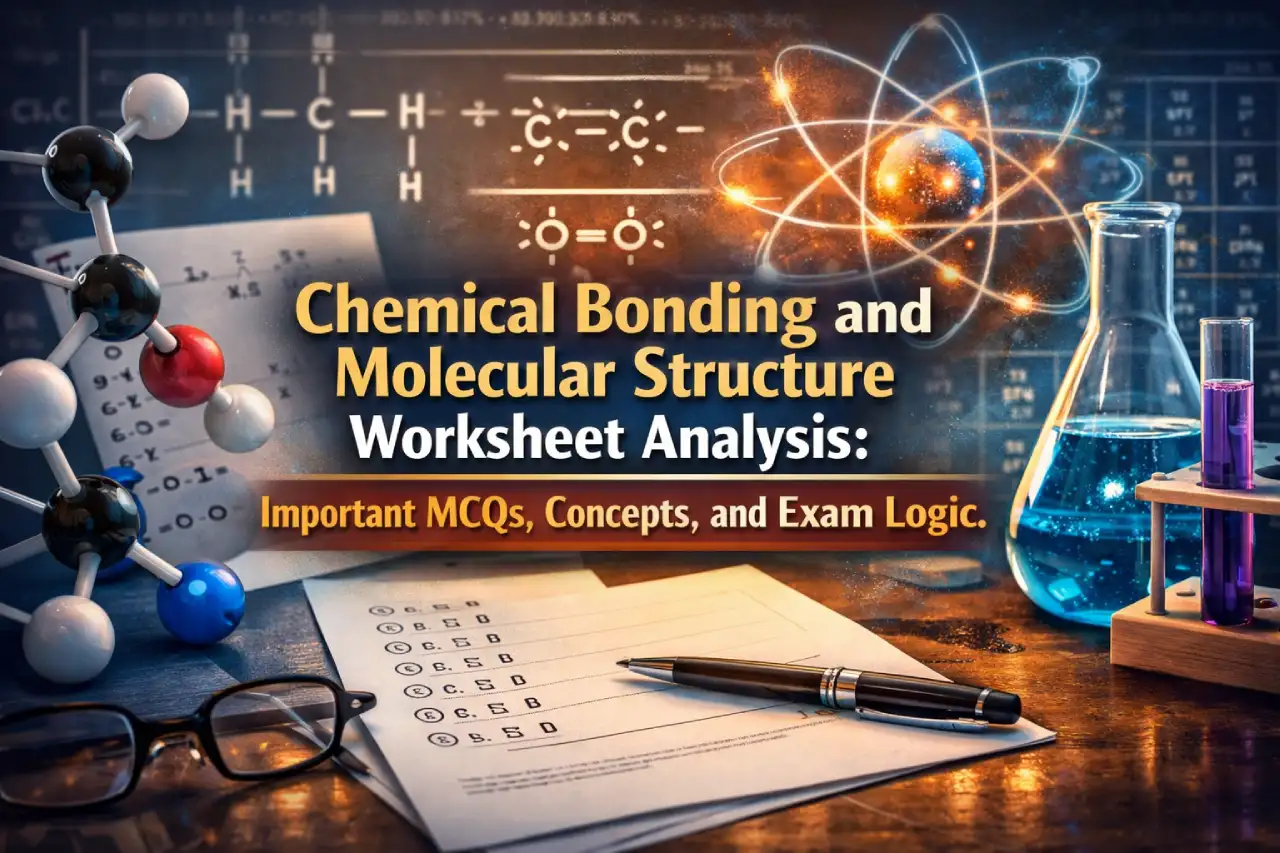
The uploaded PDF is a Class 11 Chemistry worksheet on Chemical Bonding and Molecular Structure, prepared strictly as a question-practice set for board and competitive exams like NEET. It contains 75 multiple-choice questions, all framed from standard NCERT concepts. The worksheet covers molecular geometry, VSEPR theory, hybridisation, molecular orbital theory, bond order, bond length, dipole moment, hydrogen bonding, resonance, and basic ideas of ionic and covalent bonding.
I am writing about this worksheet because Chemical Bonding is one chapter where students often know formulas but lack conceptual clarity. This worksheet shows how simple NCERT statements are converted into exam-level MCQs. By analysing these questions properly, students can clearly see which ideas are repeatedly tested, where common mistakes happen, and how bonding concepts connect structure, stability, and properties of molecules. This article explains only what is present in the uploaded worksheet Chemical Bonding and Molecular ….
Overall Structure of the Worksheet
The worksheet consists of 75 MCQs, each carrying one mark. Questions are arranged to move gradually from basic concepts to more application-based ones. There are no numericals here; the focus is on conceptual understanding, reasoning, and comparison.
Most questions are short, but the options are closely framed, which means careless reading can easily lead to wrong answers. The difficulty level ranges from easy to moderate, matching NEET standards.
VSEPR Theory and Molecular Shapes
A large portion of the worksheet focuses on VSEPR theory and prediction of molecular shapes. Questions test shapes such as:
- Pentagonal bipyramidal geometry of IF₇
- Square pyramidal structure of BrF₅
- Trigonal bipyramidal and octahedral geometries
- Bent, see-saw, linear, and square planar shapes
The worksheet repeatedly emphasises the order of repulsive forces between electron pairs, clearly stating that lone pair–lone pair repulsion is strongest, followed by lone pair–bond pair and bond pair–bond pair.
Hybridisation and Geometry Relationship
Hybridisation is tested across many questions. The worksheet checks whether students can:
- Identify hybridisation from molecular shape
- Link sp, sp², sp³, sp³d, and sp³d² hybridisation correctly
- Apply hybridisation concepts to ions such as NO₂⁺, NO₃⁻, NH₄⁺, and POCl₃
It reinforces the idea that hybridisation depends on total electron pairs, not simply the number of bonds.
Download this PDF File: Click Here
Molecular Orbital Theory and Bond Order
Several MCQs are based on molecular orbital theory (MOT). These questions focus on:
- Isoelectronic species like N₂, CO, and NO⁺
- Calculation and comparison of bond order
- Paramagnetic and diamagnetic behaviour of molecules
- Effect of removal or addition of electrons on bond order
The worksheet clearly tests the relationship between bond order, bond length, bond strength, and stability, which is a high-frequency NEET concept.
Bond Length, Bond Strength, and Polarity
Many questions compare bonds such as:
- C–O, C=O, and C≡O
- Single, double, and triple bonds
Students are expected to know that higher bond order means shorter bond length and greater bond strength. Polarity-based questions test electronegativity differences, dipole moment direction, and the role of molecular shape in determining overall polarity.
Dipole Moment and Molecular Polarity
The worksheet includes clear conceptual questions on dipole moment, explaining that it depends on:
- Magnitude of charge
- Distance of separation
- Molecular shape
Questions compare molecules like H₂O, NH₃, CO₂, HF, and SO₂ to test whether students understand why some polar bonds still result in zero dipole moment due to symmetry.
Resonance, Formal Charge, and Lewis Concepts
Several MCQs focus on:
- Resonance hybrid versus canonical structures
- Formal charge calculation
- Stability of resonance structures
The worksheet reinforces that canonical forms do not have real existence and that the resonance hybrid best represents the actual molecule.
Hydrogen Bonding and Boiling Point Trends
Hydrogen bonding is tested through comparison questions involving H₂O, HF, and NH₃. The worksheet explains that boiling point depends not just on hydrogen bond strength, but also on the number of hydrogen bonds formed per molecule, making water an important exception.
Ionic, Covalent, and Coordinate Bonds
Basic bonding concepts are also tested, including:
- Lewis and Kossel approach
- Formation of coordinate bonds
- Lattice enthalpy as a measure of ionic compound stability
- Conditions for molecular orbital formation
These questions ensure students understand bonding from both structural and energetic perspectives.
What This Worksheet Teaches Students
From this worksheet, it becomes very clear that:
- Chemical bonding questions are logic-based, not memory-based
- NCERT definitions and exceptions are extremely important
- MOT and VSEPR are scoring areas if understood properly
- Many exam questions repeat the same ideas in different wording
Practising such worksheets helps reduce confusion and improves confidence.