
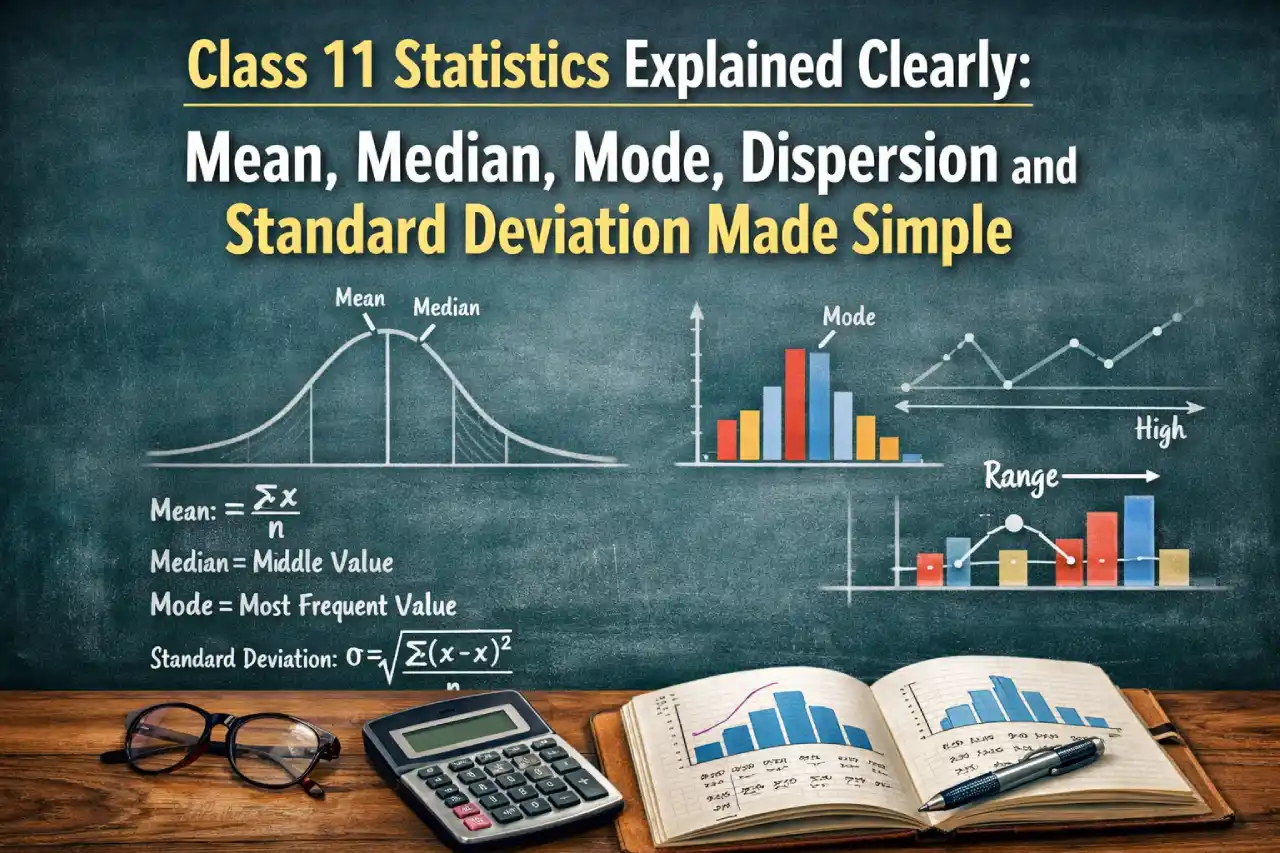
Statistics is one of the most practical and scoring chapters in Class 11 Mathematics. The uploaded PDF is a detailed NCERT-based resource that explains data types, measures of central tendency, measures of dispersion, and step-by-step methods for calculating mean deviation, variance, and standard deviation for both grouped and ungrouped data. It also contains a large number of solved examples from NCERT exercises, helping students understand not just formulas but also their proper application.
I am writing about this topic because many students feel comfortable with formulas but struggle when they see lengthy tables or word problems in exams. Statistics is actually a logical and systematic chapter once the basic ideas are clear. This article simplifies the important concepts from the PDF and presents them in a structured, easy-to-understand manner so that students can revise confidently and score well.
What Is Data and Its Types
Data is a collection of facts or numerical information related to a particular situation.
According to the PDF, data is broadly classified into:
- Ungrouped data: Data listed individually, such as 2, 4, 6, 8
- Grouped data: Data arranged in classes
Grouped data is further divided into:
- Discrete data: Exact values with frequencies
- Continuous data: Data arranged in class intervals
Understanding these types is essential before applying any statistical formula.
Measures of Central Tendency
A measure of central tendency gives a single value that represents the entire dataset. The three main measures are:
Mean
For ungrouped data:
Mean (x̄) = Σx / n
For grouped data:
Mean (x̄) = Σfx / Σf
The PDF also explains the step-deviation (shortcut) method for large data sets, which reduces calculation time.
Median
The median is the middle value when data is arranged in ascending or descending order.
For grouped data:
Median = l + [(N/2 − cf) / f] × h
Where l is lower limit of median class, cf is cumulative frequency before median class, f is frequency of median class, and h is class width.
Mode
Mode is the value that occurs most frequently.
For grouped data:
Mode = l + [(f₁ − f₀) / (2f₁ − f₀ − f₂)] × h
These formulas are repeatedly used in the solved examples in the PDF.
Measures of Dispersion
Measures of central tendency alone do not describe how spread out the data is. Measures of dispersion deal with variability.
Main measures discussed in the PDF:
- Range
- Quartile deviation
- Mean deviation
- Standard deviation
Range
Range = Maximum value − Minimum value
The PDF gives simple examples showing that a higher range means greater scatter in data.
Download this CLASS 11 – STATISTICS PDF File: Click Here
Mean Deviation
Mean deviation is the average of absolute deviations from a central value (mean or median).
For ungrouped data:
MD = Σ|x − A| / n
For grouped data:
MD = Σf|x − A| / Σf
Where A may be mean or median.
The PDF highlights that mean deviation cannot be used for further algebraic treatment, which is one of its limitations.
Variance
Variance is the mean of the squares of deviations from the mean.
For ungrouped data:
s² = Σ(x − x̄)² / n
For grouped data:
s² = Σf(x − x̄)² / Σf
Variance gives a clearer picture of dispersion than range or mean deviation.
Standard Deviation
Standard deviation is the square root of variance.
s = √s²
It is also called root mean square deviation.
The PDF explains both direct method and step-deviation method for grouped data.
Properties of Standard Deviation
Some important points from the PDF:
- Standard deviation is independent of change of origin
- It depends on change of scale
- Smaller standard deviation means data is more consistent
The coefficient of variation (CV) is also introduced:
CV = (s / x̄) × 100
Lower CV indicates more consistency.
Importance of Statistics in Exams
- Regularly asked in CBSE board exams
- Many questions are formula-based
- Step-by-step presentation fetches full marks
Practising NCERT examples and exercises is strongly recommended.
How to Study This Chapter Effectively
- Revise formulas daily
- Practise both grouped and ungrouped problems
- Learn shortcut methods for faster calculation
- Check units and arithmetic carefully

















