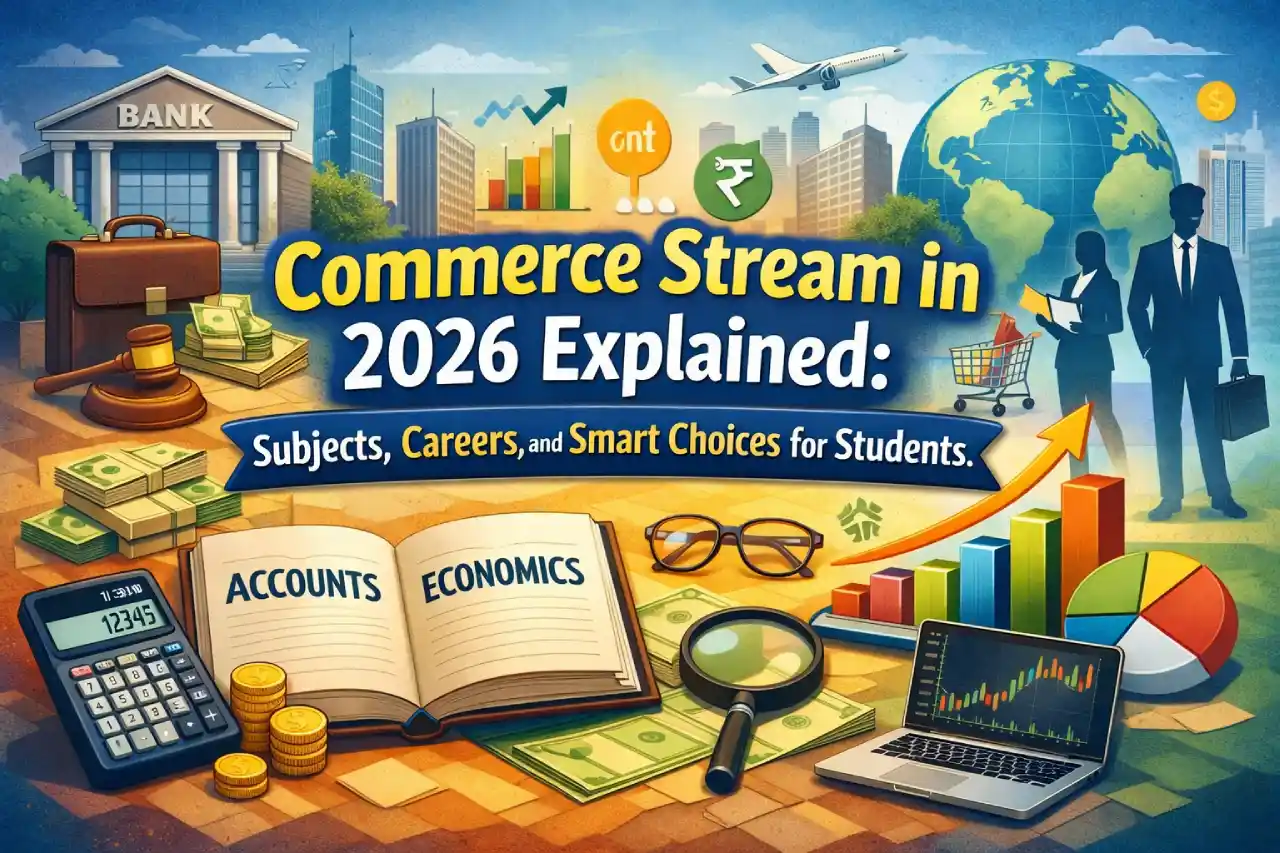
Choosing the right stream after Class 10 is one of the most important academic decisions a student makes, and for many in 2026, Commerce is emerging as a strong and flexible option. The Commerce stream opens doors to careers in business, finance, economics, management, accounting, and even new-age fields like analytics and entrepreneurship. With changing career trends and growing demand for financially skilled professionals, Commerce is no longer seen as a “safe” choice but a strategic one.
I am writing this guide because I see many students and parents still confused about what Commerce really offers. Often, decisions are made based on marks, peer pressure, or outdated assumptions. This article is meant to clear that confusion and help students understand whether Commerce matches their interests, strengths, and long-term goals in 2026 and beyond.
What Is the Commerce Stream All About
Commerce focuses on how businesses, markets, money, and economies work. It helps students understand trade, finance, accounts, taxation, management, and economic systems. Unlike common belief, Commerce is not just about bookkeeping. It builds analytical thinking, decision-making skills, and practical knowledge that is useful in everyday life as well as professional careers.
Students who enjoy numbers, logical thinking, current affairs, business news, or understanding how money flows often find Commerce engaging and relevant.
Core Subjects in Commerce (2026)
The subject combination may vary slightly by board and school, but the core subjects usually include:
- Accountancy
- Business Studies
- Economics
- English
- Mathematics or Applied Mathematics (optional but recommended)
Some schools also offer optional subjects like Informatics Practices, Entrepreneurship, or Legal Studies, which add further career value.
Who Should Choose Commerce
Commerce is suitable for students who:
- Have an interest in business, finance, or economics
- Are comfortable with numbers and logical reasoning
- Like analysing situations and making decisions
- Want diverse career options after school
- Prefer practical and real-world learning over pure theory
You do not need to be a maths topper to choose Commerce, but basic comfort with calculations and data interpretation helps a lot.
Career Options After Commerce
One of the biggest strengths of Commerce is career flexibility. After Class 12, students can choose from a wide range of courses and professions:
- Chartered Accountant (CA)
- Company Secretary (CS)
- Cost and Management Accountant (CMA)
- BCom, BBA, BBM
- Economics (BA/BSc Economics)
- Finance, Banking, and Insurance
- MBA and management roles
- Data analytics and business analytics
- Entrepreneurship and start-ups
With the right planning, Commerce students can even move into fields like law, public policy, or international business.
Commerce With Maths vs Without Maths
This is a common confusion point. Commerce with Maths keeps more doors open, especially for economics, finance, analytics, and top management courses. Commerce without Maths is also a valid option, particularly for careers in accounting, business management, and professional courses like CA and CS.
From my experience, if a student can manage Maths at a basic level, opting for it is usually a smart long-term decision.
Myths Around the Commerce Stream
Many students still hear statements like “Commerce is for average students” or “Science has more respect.” These ideas are outdated. Today, some of the highest-paying and most influential roles come from Commerce and management backgrounds.
Success depends more on interest, consistency, and skill-building than on the stream itself.
How to Decide if Commerce Is Right for You
Before finalising your stream, ask yourself:
- Do I enjoy understanding how businesses and money work
- Am I curious about markets, companies, or the economy
- Can I see myself in roles related to finance, management, or strategy
Talking to teachers, seniors, or career counsellors can also help bring clarity.