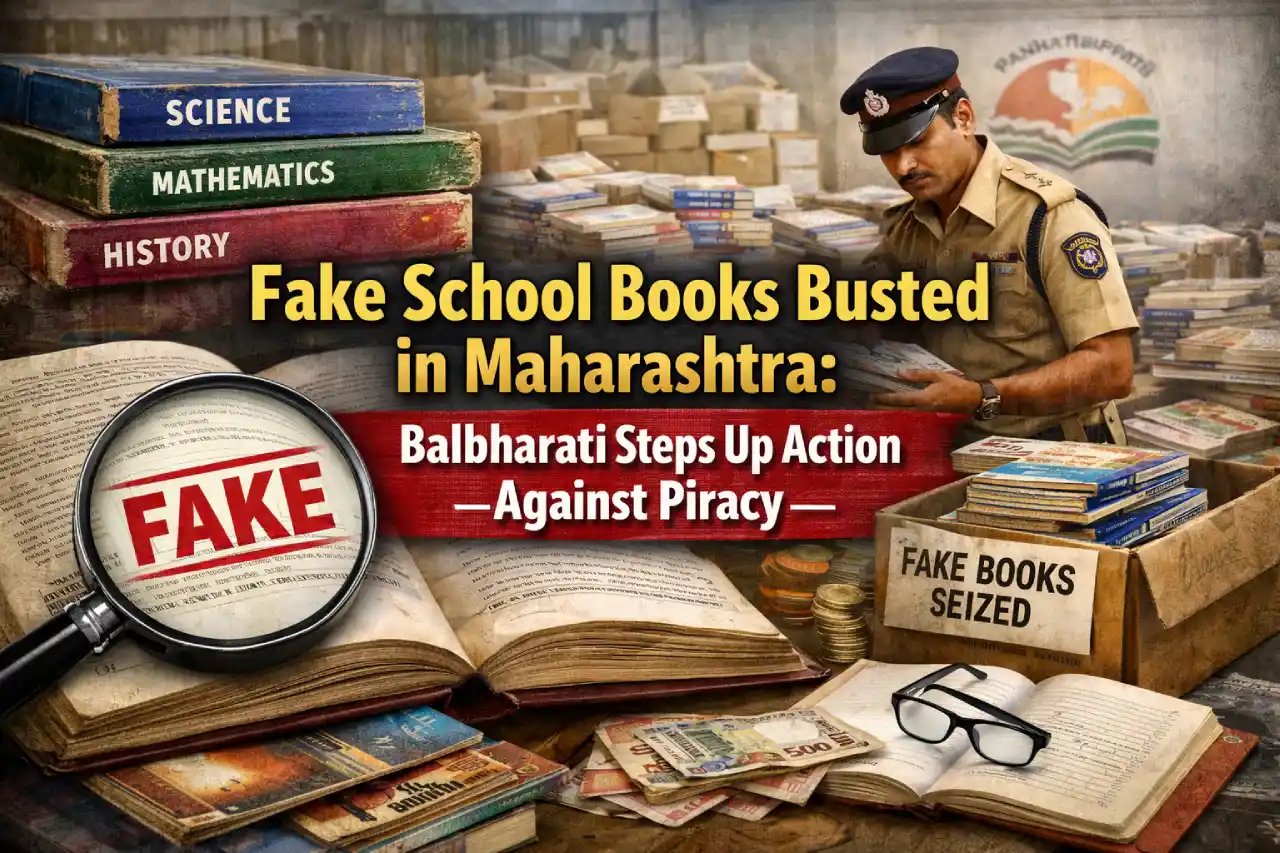
Maharashtra’s State Council of Educational Research and Training, better known as Balbharati, has taken strong action against the illegal printing of school textbooks. Officials recently conducted a raid at a printing press in Nagpur and uncovered large-scale duplication of state board textbooks. During the operation, authorities seized an estimated 20,000 to 30,000 counterfeit books, all printed without authorisation and meant for circulation in the open market.
I am writing about this issue because textbooks form the backbone of school education, especially for students in government and aided schools. When fake books enter the system, it does not just hurt the state exchequer but also compromises the quality of learning for children. This incident highlights a serious problem that often goes unnoticed—textbook piracy—and why strict enforcement is necessary to protect students, parents, and the education system as a whole.
What Balbharati discovered during the raid
According to officials, the raid revealed illegal printing of Balbharati textbooks that are officially published for Classes 1 to 12. These books are produced in multiple languages, including Marathi, Hindi, English, Urdu, and others, and are distributed across Maharashtra.
The counterfeit copies were found to be printed without permission, violating copyright laws and Balbharati’s publishing rights. Following the seizure, Balbharati lodged a formal complaint, and further legal action is expected against those involved in the operation.
Why counterfeit textbooks are a serious concern
Fake textbooks may look similar to original copies, but they often suffer from poor print quality, missing pages, incorrect diagrams, and even factual errors. For students, especially in foundational classes, this can affect understanding and exam preparation.
From a broader perspective, textbook piracy:
- Undermines the state’s efforts to provide standardised education
- Causes financial losses to the government
- Encourages an unregulated supply chain in education materials
Officials have also pointed out that such illegal practices often spike just before the academic year begins, when demand for textbooks is high.
Steps Balbharati is likely to take next
Balbharati has indicated that it will strengthen monitoring of printing and distribution channels. Surprise inspections, coordination with local authorities, and awareness drives for schools and book sellers are expected to increase.
Parents and schools are also being advised to purchase textbooks only from authorised vendors and verify official markings to avoid buying counterfeit copies.