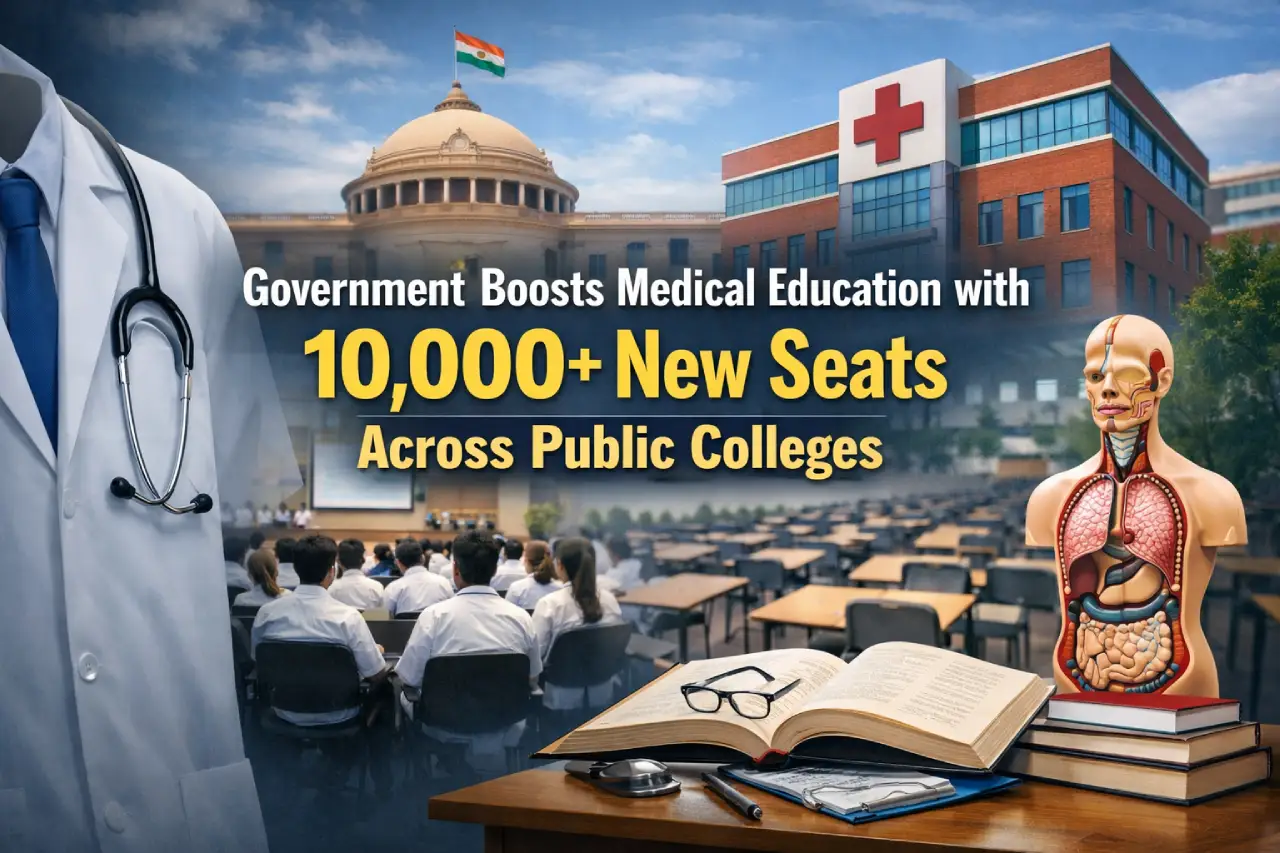
In a significant step towards expanding access to medical education, the Union Government has approved 10,023 additional medical seats in government colleges across the country. These seats have been sanctioned under various Centrally Sponsored Schemes with the aim of strengthening public medical institutions and addressing the long-standing gap between demand and availability of medical education in India. The move is expected to benefit thousands of aspiring doctors who rely on government colleges for affordable and quality education.
I am writing about this development because medical education in India has always faced pressure due to limited seats and high competition. Every year, lakhs of students appear for medical entrance exams, but only a fraction secure admission, especially in government colleges. This decision is important not just for students, but also for the healthcare system as a whole. Increasing seats in government institutions means more trained doctors in the long run, better healthcare coverage in underserved areas, and reduced dependence on costly private colleges. It also reflects a policy push to strengthen public health infrastructure through education, rather than short-term fixes.
What the new medical seats mean for students
The sanctioning of 10,023 new seats is likely to ease the intense competition for MBBS admissions in government colleges. With more seats available, deserving students from economically weaker backgrounds will have a better chance of securing admission without the financial burden associated with private medical colleges.
These additional seats are expected to be distributed across multiple states, ensuring a more balanced regional spread of medical education opportunities.
Strengthening government medical colleges
The expansion is not limited to seat numbers alone. Under centrally sponsored schemes, government colleges receiving new seats are also required to upgrade infrastructure, laboratories, hostels, and teaching facilities. This ensures that quality is not compromised while increasing capacity.
Many colleges will see improvements such as
- New academic blocks and lecture halls
- Upgraded hospitals for clinical training
- Better student accommodation and facilities
Impact on healthcare delivery
More medical seats today mean more doctors tomorrow. This is especially important for rural and semi-urban areas where doctor shortages remain a challenge. By strengthening government colleges, the government is indirectly investing in future public healthcare delivery.
Over time, this could lead to
- Improved doctor-patient ratios
- Better availability of specialists in district hospitals
- Stronger public health systems