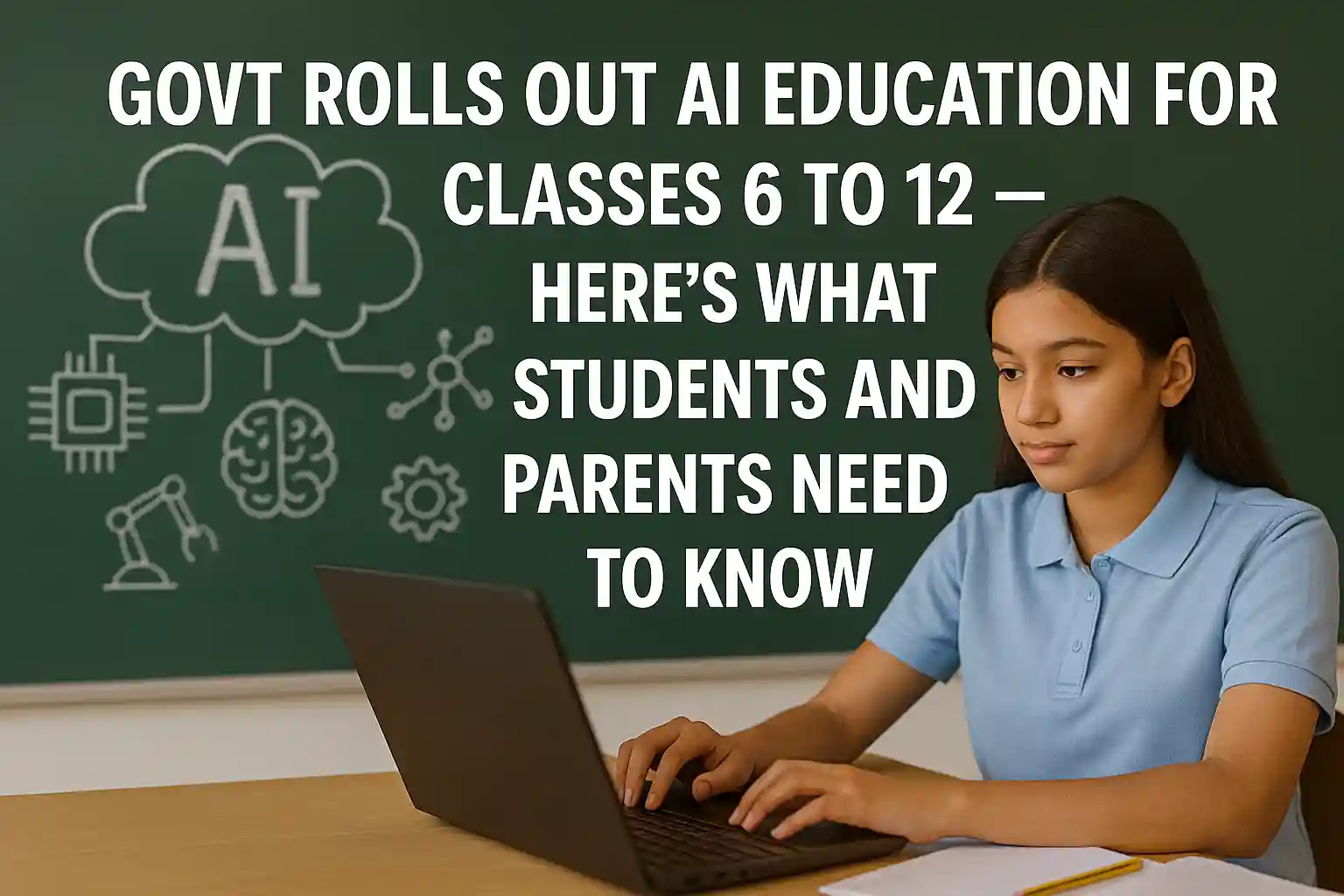
The Indian government has officially launched a nationwide initiative to introduce Artificial Intelligence (AI) education in schools from Classes 6 to 12. This programme, launched under the ‘AI for All’ mission, is being developed in collaboration with key players like Intel and NCERT. The aim is to build digital skills, prepare students for the future of work, and bring AI awareness and basic learning into the mainstream school curriculum. This initiative is a part of the Ministry of Education’s efforts to modernise classrooms and align school learning with fast-growing technologies.
I’m writing about this topic because I believe we’ve reached a point where knowing about AI is as important as learning maths or science. Many students in India—especially in government or rural schools—don’t get early exposure to such topics. That gap needs to be filled now, not later. The government’s decision to introduce AI from Class 6 is a big step in that direction. But I also feel it’s important to understand how this will actually work in schools, what it means for teachers, and whether all students will get equal access. If we don’t look closely now, this may become yet another programme that benefits only a select few instead of truly reaching “all”.
What Is the National AI Education Programme?
The AI education programme was launched by the Ministry of Education in July 2025 as part of its IndiaAI initiative. It is being led by the National e-Governance Division (NeGD) in partnership with Intel India and the National Council of Educational Research and Training (NCERT). The programme is aimed at integrating AI learning into school education in an age-appropriate, simple and engaging way.
The content is divided into three levels:
- AI Aware (basic level): Introduces the concept of AI, its uses and impact on daily life
- AI Appreciate (intermediate level): Discusses how AI works, with examples and activities
- AI Apply (advanced level): Helps students build simple AI models using data, logic and programming
The modules are available in both English and Hindi, and teachers will also be trained to deliver the content in classrooms.
Why Teaching AI in Schools Matters
In today’s world, AI is not just a buzzword. It’s already being used in banking, healthcare, transport, agriculture, and even school management. Students growing up today will enter a workforce where AI tools will be common in most jobs. So, if we want them to be ready for the future, they need to start learning AI early—not after college.
By introducing AI in Classes 6 to 12, the government is trying to create a strong foundation of digital thinking. This can help students become not just users of technology but also future creators, innovators and problem-solvers. For example, understanding how AI works can help them think more critically about data, automation, privacy, and fairness.
How Will It Work in Schools?
According to the plan, AI modules will be rolled out gradually in schools affiliated with CBSE and state boards. The focus will be on:
- Blended learning, with a mix of offline and online content
- Teacher training through workshops and digital guides
- Interactive projects, videos, quizzes, and AI labs where possible
- Use of simple tools like Scratch, Python, and Google Teachable Machine
The idea is not to teach advanced coding to everyone, but to create awareness and build confidence. Schools can integrate the content as a separate subject, club activity, or part of computer science lessons.
Challenges Ahead
While the initiative is promising, there are some real concerns to keep in mind:
- Lack of trained teachers: Many schools, especially in rural areas, don’t have qualified computer teachers.
- Digital divide: Students from low-income families may not have internet or computer access at home.
- Infrastructure gaps: Some schools don’t even have proper classrooms, forget about AI labs.
- Curriculum overload: Adding more content may increase pressure on both students and teachers.
Unless these issues are addressed properly, the benefits of AI education may only reach urban private schools, leaving behind a large number of students.
What Needs to Be Done
To make this initiative work for everyone, we need:
- Strong investment in digital infrastructure in government schools
- Regular and easy-to-understand training sessions for teachers
- Local-language content for students across different states
- Public-private partnerships to bring resources to under-resourced schools
- Monitoring and feedback mechanisms to improve implementation over time
Also, parents need to be informed about why AI learning matters. Right now, many think it’s only for engineers or techies. That mindset has to change.