
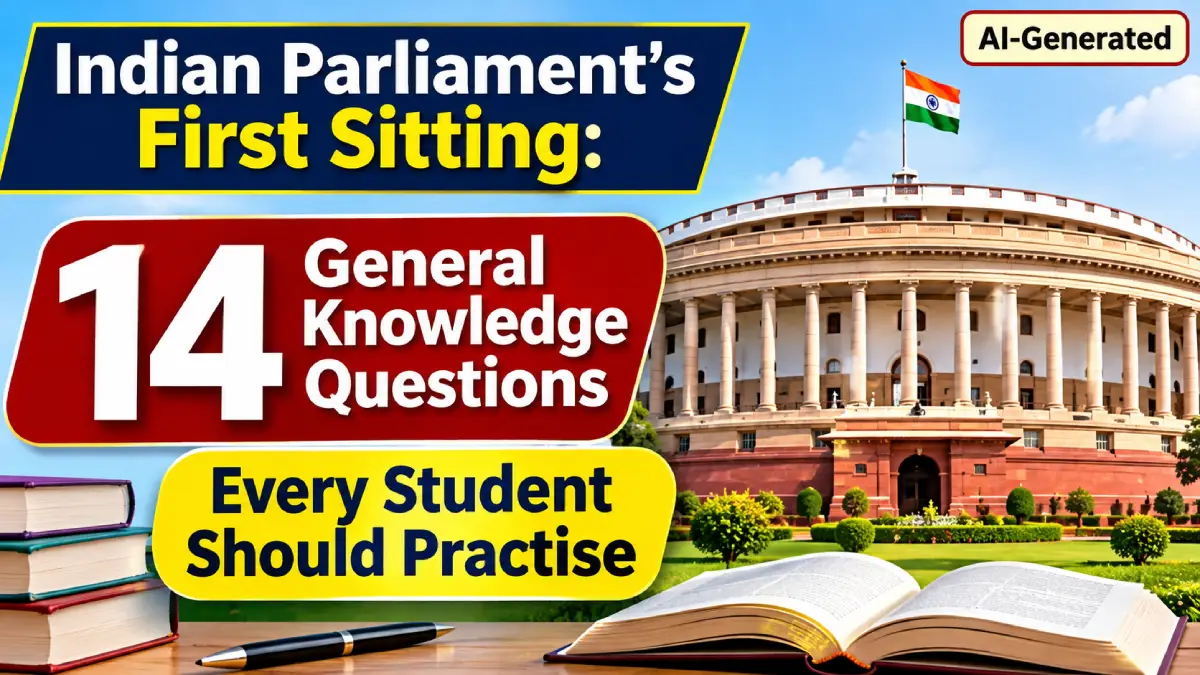
India's Parliament is the central institution through which the country's democratic system functions. Its present structure took shape after the Constitution came into force on 26 January 1950, while the first general elections were held in 1951–52.
The first meeting of the two Houses took place on 13 May 1952 at the Central Hall of Parliament House in New Delhi. From making laws to approving the national budget and discussing matters of public importance, Parliament plays a vital role in running the world's largest democracy.
Knowing a few dates about Parliament is useful, but understanding its responsibilities is equally important for students preparing for competitive examinations. Questions on Indian polity are often combined with general knowledge about geography, science and important world facts. The newspaper clipping brings these subjects together in a short question-and-answer format. Here is a closer look at the information about Parliament, followed by the GK questions featured in the material.
The Indian Parliament consists of the President, the Lok Sabha and the Rajya Sabha. Together, these constitutional institutions take part in the country's legislative process. Parliament examines government policies, discusses public issues, approves expenditure and passes laws. It can also amend existing laws and the Constitution by following the prescribed procedure.
The Union Budget and government spending require parliamentary approval. Members also raise issues affecting citizens and debate matters of national importance. In this way, Parliament provides a platform for public representation and keeps the government accountable.
The clipping also offers a set of general knowledge questions that can help readers revise important facts. The answers given in the newspaper are listed below:
-
What is the hardest naturally occurring substance on Earth?
Answer: Diamond. -
Which fruit is known as the King of Fruits?
Answer: Mango. -
How many continents are there on Earth?
Answer: Seven. -
Which is the largest continent in the world?
Answer: Asia. -
Who was the first person to walk on the Moon?
Answer: Neil Armstrong. -
Which is the longest river in the world?
Answer: The Nile River. -
Which is the largest ocean on Earth?
Answer: The Pacific Ocean. -
Which planet is known as the Red Planet?
Answer: Mars. -
Which is the smallest continent in the world?
Answer: Australia. -
Which country shares India's longest international land border?
Answer: Bangladesh, with a border length of approximately 4,096.7 km. -
Which country shares India's shortest international land border, according to the clipping?
Answer: Afghanistan, approximately 106 km. -
What is the length of the India-China border mentioned in the clipping?
Answer: Approximately 3,488 km. -
Which countries share more than 3,000 km of border with India, according to the figures provided?
Answer: Bangladesh (4,096.7 km), China (3,488 km) and Pakistan (3,323 km). -
What are the approximate lengths of India's borders with Nepal and Bhutan?
Answer: Nepal: 1,751 km; Bhutan: 699 km.
For students, these questions offer a quick revision exercise covering Indian polity, geography and general awareness. However, candidates should also consult reliable reference material for examination preparation, particularly for geographical measurements and facts that may vary according to the source or the definition used. Understanding the background behind each answer is more useful than memorising the options alone.

Comments ( 0)
Leave a Comment
No comments yet. Be the first to comment!