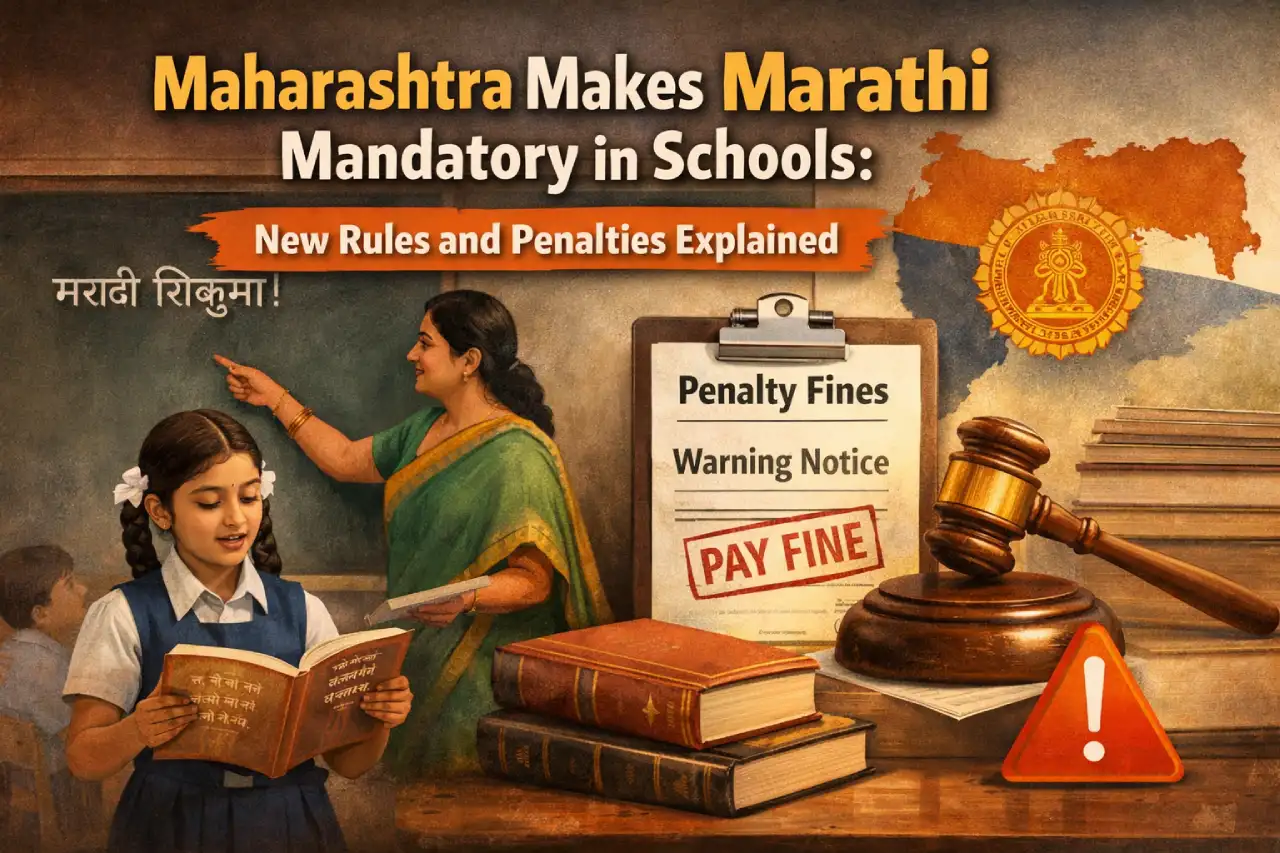
The Maharashtra government has made Marathi a compulsory subject across all schools in the state, regardless of their medium of instruction or education board. School Education Minister Dadaji Bhuse announced this decision in the Legislative Assembly, making it clear that strict action will be taken against schools that fail to follow the rule. The move applies to government, private, unaided, and even international board-affiliated schools operating in Maharashtra.
I am writing about this update because language policies in education often affect students, parents, and schools in very practical ways. From what I have seen, many parents are sometimes confused about language requirements, especially in international or English-medium schools. This decision brings clarity by making Marathi compulsory for all, while also raising important questions about implementation and compliance.
What the New Rule Says
The government has clearly defined how Marathi should be included in schools.
- Marathi must be taught in all schools across Maharashtra
- Applies to all boards, including international and national boards
- Can be introduced as a second or third language
- Cannot be excluded under any circumstances
This ensures that every student studying in the state has some level of exposure to Marathi.
Legal Background of the Decision
The rule is not entirely new but is based on an earlier notification.
- Government notification issued on March 1, 2020
- Made Marathi mandatory in schools across boards
- Recent announcement focuses on strict enforcement
- Assembly discussion highlighted the need for compliance
The latest move is more about implementation and accountability.
Schools Covered Under the Rule
The mandate applies to all types of schools operating in Maharashtra.
- Government schools
- Private and unaided schools
- Schools affiliated with CBSE, ICSE, and other national boards
- International board schools
This wide coverage ensures that no institution is exempt from the rule.
Penalties for Non-Compliance
The government has also introduced strict measures for violations.
- Schools will be inspected by the Education Department
- Non-compliant schools will be warned and instructed to follow rules
- Continued violation may lead to cancellation of recognition
- Legal action may be taken if required
From what I understand, the government is serious about enforcing this policy.
Why Marathi Is Being Made Compulsory
The decision is linked to cultural and administrative reasons.
- Marathi is the official language of Maharashtra
- Helps preserve linguistic and cultural identity
- Ensures students can communicate locally
- Promotes inclusivity in public life
In my opinion, learning the regional language can help students connect better with their surroundings.
Concerns and Discussions Around the Rule
The decision has also sparked discussions among stakeholders.
- Some schools may face challenges in implementation
- Parents may worry about additional academic load
- Need for trained teachers to teach Marathi
- Balancing multiple languages in the curriculum
These concerns highlight the importance of proper planning and execution.
Government’s Stand on the Issue
The state government has taken a firm position on the matter.
- No compromise will be allowed in teaching Marathi
- Immediate inspections will be conducted where complaints arise
- Schools will be guided to follow legal requirements
- Focus on strict and uniform implementation
This shows the government’s commitment to enforcing the rule.