JOIN WHATSAPP
STORIES

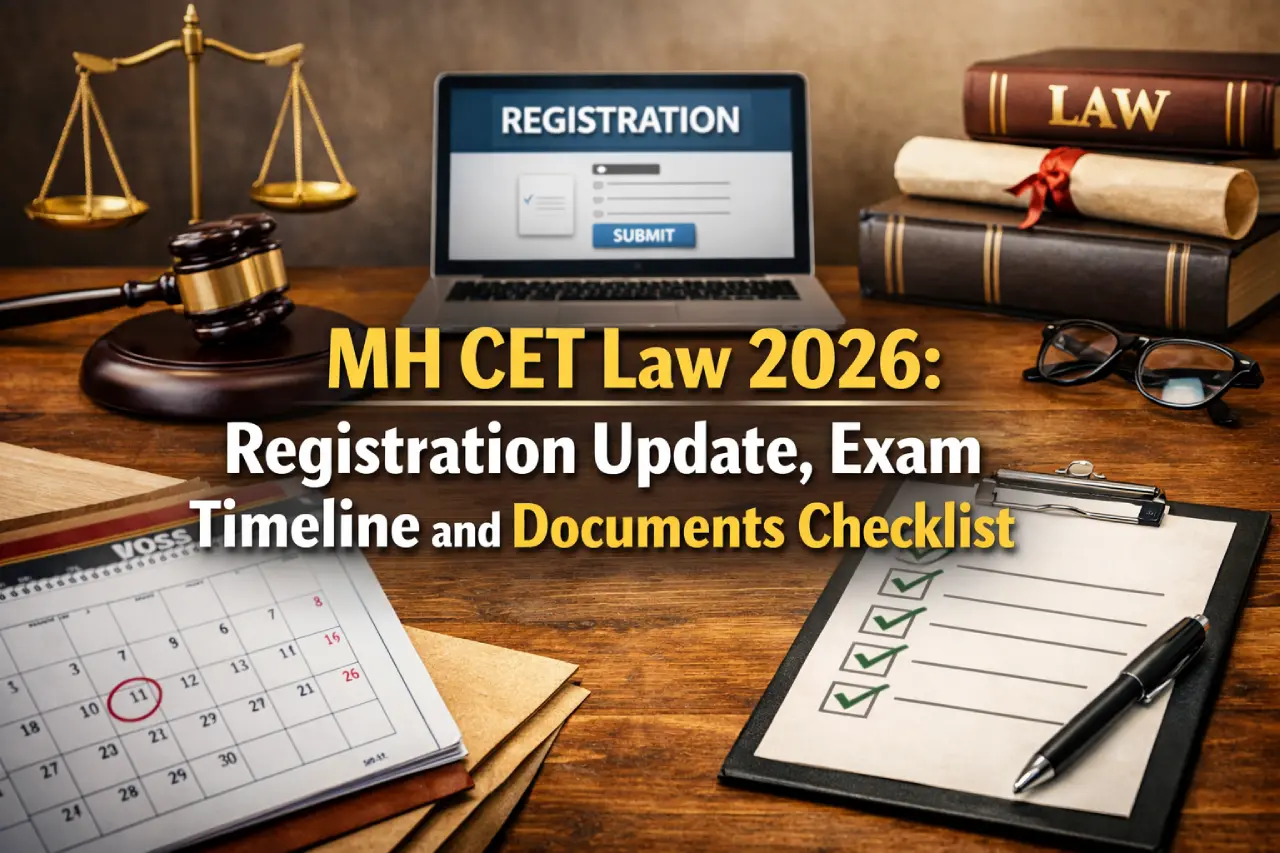
MH CET Law 2026: Registration Update, Exam Timeline and Documents Checklist

MH CET Law 2026: Registration Update, Exam Timeline and Documents Checklist

The MH CET Law 2026 registration process is expected to begin soon on the official website cetcell.mahacet.org, and law aspirants across Maharashtra are closely watching for the announcement. As per the tentative schedule shared earlier, the MH CET Law 3-year LLB exam is likely to be held on April 01 and April 02, 2026. Meanwhile, the MH CET 5-year LLB exam has a tentative date of May 08, 2025, as notified. Candidates planning to appear for these exams should start preparing their documents in advance to avoid last-minute confusion.

I am writing about this update because every year, many students miss important deadlines or make errors during registration due to lack of clarity. MH CET Law is a key entrance exam for admission to government and private law colleges in Maharashtra, and timely information can make a big difference. Knowing the expected exam dates and document requirements early helps students and parents plan better and stay stress-free during the application process.

About MH CET Law 2026

MH CET Law is conducted by the State Common Entrance Test Cell Maharashtra for admission to 3-year and 5-year LLB programmes offered by various law colleges in the state. The exam tests candidates on legal aptitude, general knowledge, reasoning, and language skills.

The registration process is completely online, and all official updates are released only through the CET Cell’s website.

MH CET Law 2026 Tentative Exam Dates

As per the latest available information, the tentative exam schedule is as follows:

CourseTentative Exam Dates
3-year LLBApril 01 and April 02, 2026
5-year LLBMay 08, 2025

Candidates are advised to note that these dates are tentative and final confirmation will be given through an official notification.

MH CET Law 2026 Registration: What to Expect

The registration process for MH CET Law 2026 is expected to follow the usual pattern. Once the application window opens, candidates will need to:

  • Register using a valid email ID and mobile number
  • Fill in personal, academic, and contact details
  • Upload scanned documents
  • Pay the application fee online
  • Submit the form and download the confirmation page

Early registration is always recommended to avoid technical issues closer to the deadline.

Documents Required for MH CET Law 2026 Registration

Candidates should keep the following documents ready before starting the application process:

  • Recent passport-size photograph
  • Scanned signature
  • Class 10 and Class 12 mark sheets
  • Graduation mark sheets for 3-year LLB applicants
  • Category certificate, if applicable
  • Domicile certificate, if required
  • Valid photo ID proof

Having these documents ready in the correct format can save a lot of time during form filling.

Important Points Candidates Should Remember

While applying for MH CET Law 2026, candidates should keep a few key points in mind:

  • Use only the official website for registration
  • Enter details exactly as per academic records
  • Double-check uploaded documents before submission
  • Keep login credentials safe for future use

Mistakes in the application form can lead to rejection at later stages.

What Happens After Registration

After successful registration, candidates will be able to download their admit cards once released. The exam will be followed by result declaration, counselling, and the Centralised Admission Process for seat allotment in law colleges across Maharashtra.
Leave a Comment

End of Article

Education Focus in Union Budget 2025: Key Schemes, Spending and Policy Push

Education Focus in Union Budget 2025: Key Schemes, Spending and Policy Push

As 2025 comes to a close, it is worth looking back at what the Union Budget delivered for the education sector this year. Presented at a time when learning gaps, digital access, and employability were major concerns, the budget placed steady focus on strengthening schools, higher education, and skill development. While there were no dramatic overhauls, the government continued to build on existing reforms with targeted funding and policy support aimed at long-term outcomes.

I am writing about this year-ender because budget announcements often sound impressive on the day they are presented, but their real impact becomes clearer only over time. For students, parents, teachers, and institutions, understanding what the Union Budget actually promised for education in 2025 helps in judging priorities, tracking implementation, and knowing where public money is being directed in the learning ecosystem.

Overall Allocation for Education in Union Budget 2025

In the Union Budget 2025, education continued to remain one of the key social sector priorities. The government maintained a strong allocation for school education, higher education, and skill development, signalling its intent to align learning with employment and national growth goals.

While the overall increase was moderate, the focus remained on consolidation rather than launching too many new schemes, with emphasis on better delivery of existing programmes.

Focus on School Education

School education received attention through continued support for foundational learning and digital access. Key areas highlighted included:

  • Strengthening early childhood education and foundational literacy
  • Improving teacher training and classroom practices
  • Support for digital classrooms and online learning platforms
  • Assistance for disadvantaged students through scholarships and incentives

The government reiterated its commitment to improving learning outcomes rather than just enrolment numbers.

Push for Higher Education and Research

Higher education remained an important pillar in the budget. Funding was directed towards improving quality, research capacity, and global competitiveness of Indian institutions. Some important focus areas included:

  • Support for research and innovation in universities
  • Expansion of digital and blended learning models
  • Encouragement for industry-academia collaboration
  • Continued implementation of education reforms under NEP

The budget aimed to gradually move Indian higher education towards a more research-driven ecosystem.

Skill Development and Employability

A major theme of the 2025 budget was linking education with skills and jobs. The government stressed the need to prepare young Indians for a changing job market. Key steps included:

  • Strengthening vocational and skill-based education
  • Focus on emerging areas such as AI, technology, and green skills
  • Support for training programmes aligned with industry needs

This approach reflects the growing recognition that degrees alone are not enough without practical skills.

Digital Education and Technology Use

Digital education remained a recurring theme in the budget. Lessons from the pandemic years continued to shape policy decisions. The budget supported:

  • Expansion of online learning platforms
  • Digital resources for teachers and students
  • Use of technology to reach remote and underserved areas

The aim was to reduce the digital divide while improving access to quality learning content.

What This Budget Meant in Practice

While some expected a sharper increase in education spending, the 2025 budget took a more measured route. Instead of announcing many new schemes, the focus was on improving implementation, monitoring outcomes, and aligning education with long-term national goals.

Experts noted that real impact would depend on how effectively funds are used at the state and institutional levels.

Leave a Comment

End of Article

Loading more posts...